
Detect Host Header Injection: Warning Signs and Immediate Response
Server logic often trusts the Host header for internal routing, allowing attackers to redirect emails or bypass security controls without executing code.
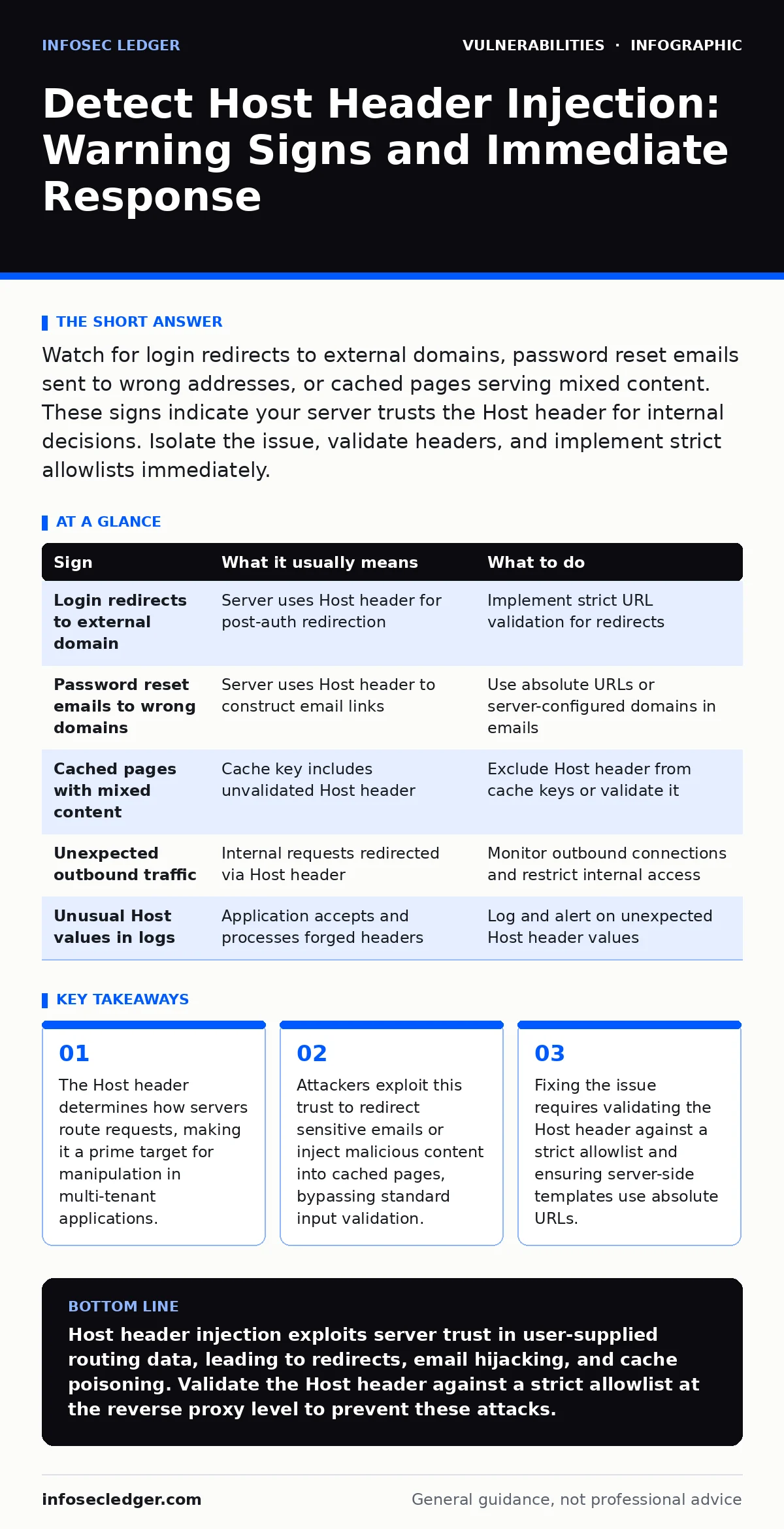
Watch for login redirects to external domains, password reset emails sent to wrong addresses, or cached pages serving mixed content. These signs indicate your server trusts the Host header for internal decisions. Isolate the issue, validate headers, and implement strict allowlists immediately.
First Signs of Host Header Injection
Host header injection attacks often reveal themselves through subtle behavioral changes in your web application. The most immediate sign is a login redirect loop or a redirect to an unexpected external domain. When a user attempts to log in, the server uses the Host header to determine where to send the user after authentication. If an attacker supplies a malicious host value, the server redirects the user to that attacker-controlled site, often capturing the session token or credentials in the process.
Another early warning is the receipt of password reset emails at unintended addresses. Many applications use the Host header to construct the reset URL. If the header is manipulated, the email might link to an attacker’s server instead of yours. Users may report receiving these emails, or you might notice bounce-backs from domains you do not own. This indicates that your server is trusting user-supplied data for critical communication paths.
Cached content displaying mixed or broken resources is another visible symptom. If your application serves dynamic content based on the Host header, an attacker can poison the cache. Subsequent users visiting the site might see images, scripts, or styles loaded from a malicious domain. This breaks the visual integrity of the site and can inject cross-site scripting payloads into the cached response, affecting all users who receive that cached version.
Signs That Are Easy to Miss
Some indicators of host header injection are far less obvious and require deeper inspection of server logs and application behavior. One hidden sign is unexpected outbound connections from your application server. If the application uses the Host header to make internal API calls or send notifications, an attacker can redirect these internal requests to an external server. This might appear as a spike in outbound traffic to unknown IPs, which could be mistaken for a misconfiguration or a separate malware infection.
Another subtle sign is the presence of unusual parameters in internal logs. If your application logs the Host header value, you might see entries containing IP addresses, local hostnames, or domains that do not match your public-facing URLs. These entries suggest that the application is processing requests with forged headers. While this might not immediately compromise data, it indicates that the application is vulnerable to manipulation, which can be chained with other vulnerabilities for greater impact.
Server-side request forgery (SSRF) is a common consequence of host header injection that is difficult to detect without active monitoring. If the application uses the Host header to resolve internal services, an attacker might redirect internal requests to sensitive internal resources, such as cloud metadata services or internal databases. This might not produce immediate errors but could lead to data exfiltration or unauthorized access to internal systems. Monitoring for internal network traffic initiated by the application server is key to detecting this.
| Sign | What it usually means | What to do |
|---|---|---|
| Login redirects to external domain | Server uses Host header for post-auth redirection | Implement strict URL validation for redirects |
| Password reset emails to wrong domains | Server uses Host header to construct email links | Use absolute URLs or server-configured domains in emails |
| Cached pages with mixed content | Cache key includes unvalidated Host header | Exclude Host header from cache keys or validate it |
| Unexpected outbound traffic | Internal requests redirected via Host header | Monitor outbound connections and restrict internal access |
| Unusual Host values in logs | Application accepts and processes forged headers | Log and alert on unexpected Host header values |
Immediate Response Steps
When you suspect host header injection, the first step is to isolate the affected application. Disable any features that rely on the Host header for routing or URL generation. This might include disabling custom redirect logic or temporarily hardcoding domain values in configuration files. This prevents further exploitation while you investigate the scope of the issue.
Next, review your server and application logs for unusual Host header values. Look for entries that do not match your expected domain names or IP addresses. Identify the patterns and frequency of these requests to understand the attack vector. This information will help you determine whether the attack is ongoing and which parts of the application are most vulnerable.
Implement strict validation of the Host header on your web server or reverse proxy. Configure the server to reject requests with Host headers that do not match a predefined allowlist of valid domains. This prevents the application from processing requests with forged headers. Ensure that this validation occurs before the request reaches the application logic to minimize the risk of exploitation.
Long-Term Mitigation Strategies
To prevent host header injection in the future, adopt a defense-in-depth approach. Start by configuring your web server to use the X-Forwarded-Host header if you are behind a reverse proxy, but ensure that this header is also validated. Many applications rely on this header to determine the original host, but it can also be forged. Validate it against a strict allowlist just as you would the Host header.
Update your application code to use absolute URLs for all internal links, emails, and redirects. Avoid constructing URLs based on user-supplied input, including the Host header. Instead, use server-side configuration to define the base URL for your application. This ensures that even if an attacker manipulates the Host header, the application will use the correct domain for critical operations.
Regularly review and update your security headers to mitigate the impact of any residual vulnerabilities. For more details, see our guide on HTTP security headers. Implementing headers like Content-Security-Policy and Strict-Transport-Security can help prevent some of the consequences of host header injection, such as mixed content issues and protocol downgrade attacks. These headers add an extra layer of protection by instructing browsers on how to handle content and connections.
Related Vulnerabilities to Consider
Host header injection is often part of a larger attack chain. Attackers might combine it with other vulnerabilities to increase the impact. For example, they might use host header injection to bypass security controls and then exploit a vulnerability in the application logic. Understanding how these vulnerabilities interact is key to effective defense. See our guide on vulnerability chaining for more information on how attackers combine multiple weaknesses.
Additionally, host header injection can be used to target specific components of your application architecture. If you use AI model serving frameworks, ensure that these components are not accessible via manipulated Host headers. See our guide on vulnerabilities in AI model serving frameworks for details on securing these specialized components. Similarly, ensure that your application does not rely on default credentials, which can be exposed through internal redirects. See our guide on default credentials for best practices.
See also: Malicious Bot Traffic: Detection, Mitigation, and Hidden Costs · Warning Signs of Insecure Direct Object References (IDOR) in Web Apps
Monitoring and Detection
Continuous monitoring is essential for detecting host header injection attempts. Implement alerting for unusual Host header values in your logs. This includes values that do not match your expected domains, contain IP addresses, or include unusual characters. Set up automated alerts to notify your security team when these patterns are detected. This allows for rapid response to potential attacks.
Regularly review your server configurations and application code for potential vulnerabilities. Conduct threat modeling exercises to identify how host header injection could impact your specific architecture. See our guide on threat modeling for applications for a structured approach to identifying and mitigating such risks. Additionally, ensure that your software is up to date, as many vendors release patches for known host header injection vulnerabilities. See our guide on unpatched software for best practices on keeping your systems secure.
Key takeaways
- The Host header determines how servers route requests, making it a prime target for manipulation in multi-tenant applications.
- Attackers exploit this trust to redirect sensitive emails or inject malicious content into cached pages, bypassing standard input validation.
- Fixing the issue requires validating the Host header against a strict allowlist and ensuring server-side templates use absolute URLs.
Host header injection exploits server trust in user-supplied routing data, leading to redirects, email hijacking, and cache poisoning. Validate the Host header against a strict allowlist at the reverse proxy level to prevent these attacks.
Frequently asked questions
How do I check if my server is vulnerable to host header injection?
Send a request to your server with a custom Host header value, such as an IP address or a non-existent domain. If the server processes the request and uses the custom host for routing or URL generation, it is likely vulnerable.
Can a firewall prevent host header injection?
A web application firewall (WAF) can help detect and block requests with suspicious Host header values. However, it is not a complete solution. You must also implement server-side validation to ensure that only trusted host values are processed.
Does using HTTPS prevent host header injection?
HTTPS encrypts the communication between the client and the server but does not prevent host header injection. The Host header is still part of the HTTP request and can be manipulated by an attacker. Validation is required regardless of the transport security.
What is the difference between host header injection and SSRF?
Host header injection is a specific technique where the Host header is manipulated to influence server behavior. SSRF is a broader vulnerability where an attacker forces the server to make requests to unintended destinations. Host header injection can be used to trigger SSRF in some applications.
How this guide was produced: written by the InfoSec Ledger editorial team with AI assistance, checked against the public references listed below, and reviewed when the facts change. See our editorial policy or report an error.