
CVSS Environmental Scores: How to Rank Vulnerabilities That Actually Matter
Base scores ignore your specific architecture, causing teams to waste time patching low-risk flaws while leaving critical business logic exposed to attack.
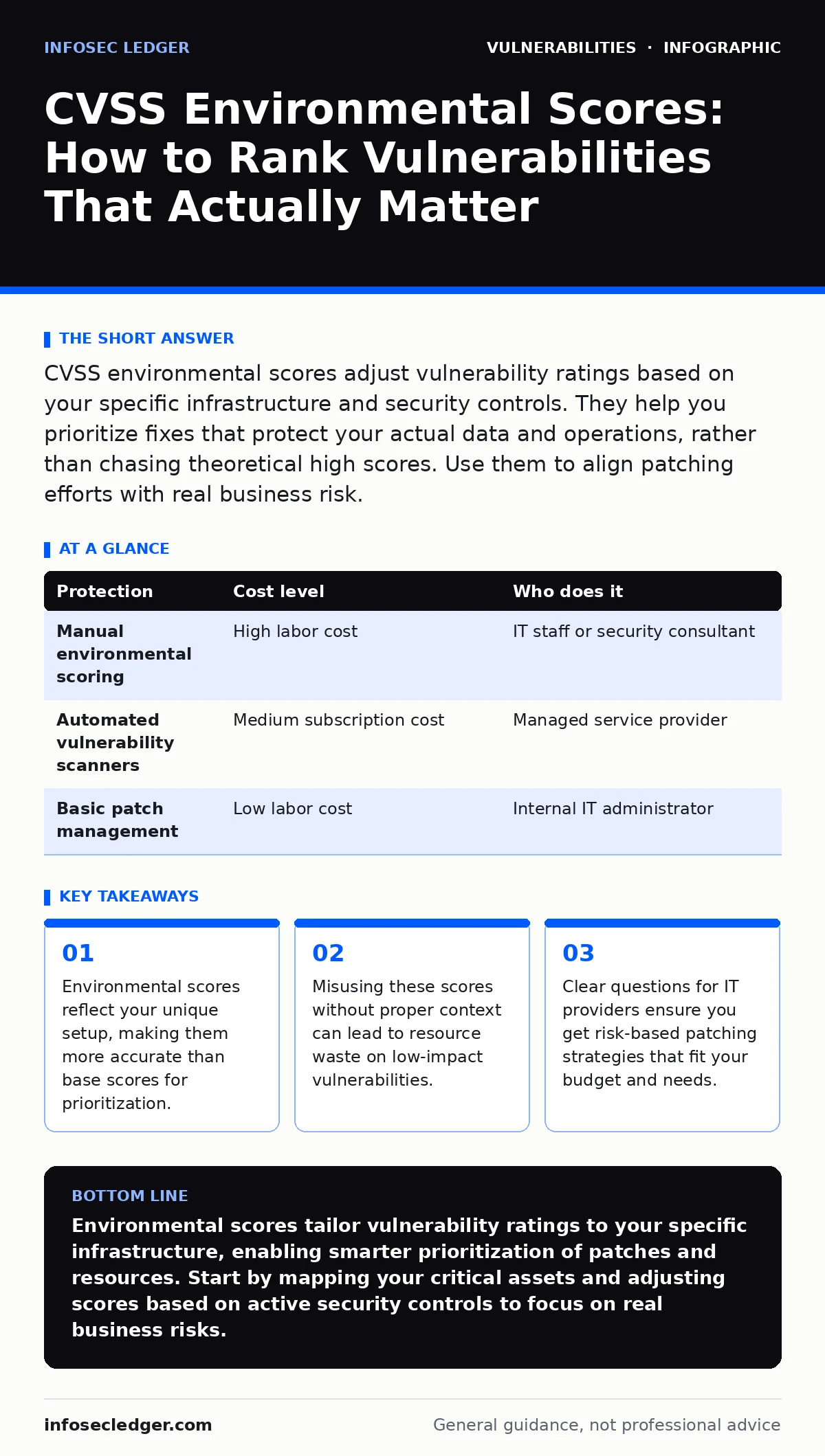
CVSS environmental scores adjust vulnerability ratings based on your specific infrastructure and security controls. They help you prioritize fixes that protect your actual data and operations, rather than chasing theoretical high scores. Use them to align patching efforts with real business risk.
Why Base Scores Fail at Small Scale
Base CVSS scores assume a default configuration with no additional security controls. They measure the intrinsic severity of a flaw in isolation. This approach ignores the reality of how systems are actually deployed. Small organizations often operate with limited resources and specific architectural constraints. A vulnerability that is critical in one environment may be irrelevant in another.
Imagine a scenario where a server runs behind a strict firewall that blocks all external traffic except port 80. A vulnerability in a service listening on port 22 has a high base score. However, the firewall prevents any remote exploitation. The base score does not account for this protection. It treats the flaw as equally dangerous whether the port is open to the internet or locked down. This discrepancy leads to inefficient resource allocation.
Using only base scores creates a false sense of urgency. Teams rush to patch high-score items that pose little actual threat. Meanwhile, lower-score vulnerabilities that align with active attack paths remain unaddressed. This misalignment increases the window of exposure for critical assets. Understanding this limitation is the first step toward effective risk management.
How Environmental Scores Adjust the Picture
Environmental scores modify the base score using three metric groups: Exploitability, Scope, and Requirements. These groups allow you to input specific details about your environment. You adjust the values based on your actual security controls and business impact. The result is a score that reflects the true risk to your organization.
The Exploitability metrics consider the proximity of the attacker and the complexity of the attack. If a vulnerability requires local access but your system has no remote access, you adjust the score downward. The Scope metrics evaluate whether the vulnerability affects components beyond its own security scope. A privilege escalation vulnerability might have a high base score, but if it only affects a service account with no data access, the environmental score drops.
The Requirements metrics account for the presence of security controls. If you have Content Security Policy headers that mitigate a cross-site scripting flaw, you reduce the exploitability score. This adjustment acknowledges that your defenses are active. It prevents the scoring system from double-counting the risk. This nuanced approach provides a clearer view of where your defenses are weakest.
Practical Steps for Implementation
Implementing environmental scoring requires a structured approach. You cannot simply apply a blanket adjustment to all vulnerabilities. Each flaw must be evaluated against your specific infrastructure. This process demands time and technical knowledge, but it yields better prioritization.
- Inventory your assets and their exposure levels. Identify which systems are public, internal, or isolated.
- Map each vulnerability to its specific asset and the relevant security controls. Determine if firewalls, intrusion detection systems, or application-level protections are active.
- Adjust the CVSS metrics based on this mapping. Use the official CVSS calculator to input these environmental factors.
- Re-prioritize your patching queue based on the new scores. Focus on high environmental scores first, regardless of the base score.
This method shifts your focus from theoretical severity to practical impact. It ensures that your limited patching resources are directed where they matter most. It also helps in demonstrating due diligence to stakeholders who may not understand technical details.
| Protection | Cost level | Who does it |
|---|---|---|
| Manual environmental scoring | High labor cost | IT staff or security consultant |
| Automated vulnerability scanners | Medium subscription cost | Managed service provider |
| Basic patch management | Low labor cost | Internal IT administrator |
What to Ask Your IT Provider
When engaging an IT provider for vulnerability management, clarity is key. You need to ensure they are not just reporting base scores. You must verify that their recommendations align with your business context. Asking the right questions prevents misaligned efforts and wasted budget.
- How do you calculate the risk priority for each vulnerability in our environment?
- Do you adjust CVSS scores based on our specific network architecture and security controls?
- Can you provide examples of vulnerabilities you deprioritized due to low environmental impact?
- How do you integrate findings from software bill of materials (SBOM) analysis into your risk assessment?
- What is your process for validating that a patch actually resolves the identified issue without introducing new problems?
These questions force the provider to explain their methodology. They reveal whether the provider uses a sophisticated risk-based approach or a simplistic score-based one. A provider who understands environmental scoring will save you time and reduce your exposure to real threats.
Hidden Costs and Trade-offs
Adjusting scores manually is time-consuming. It requires expertise in both the vulnerability and your infrastructure. Small teams may lack the bandwidth to perform this analysis for every new CVE (Common Vulnerabilities and Exposures). This creates a bottleneck in the patching process.
Automated tools can help, but they often struggle with context. They may not understand the nuances of your custom applications or legacy systems. Relying solely on automation can lead to incorrect adjustments. You must validate automated scores periodically to ensure accuracy.
There is also the risk of under-scoring. If you are too aggressive in reducing scores based on perceived controls, you may miss emerging threats. Controls can fail or be misconfigured. Regular reviews are necessary to ensure that environmental scores remain accurate over time. This balance between efficiency and accuracy is a constant challenge.
See also: Vulnerability Chaining: How Attackers Link Weaknesses to Breach Systems · Detect Host Header Injection: Warning Signs and Immediate Response
Integrating with Broader Security Practices
Environmental scoring does not exist in a vacuum. It works best when integrated with other security practices. For instance, threat modeling for applications can identify high-value assets that need closer scrutiny. This context informs the environmental adjustments you make.
Understanding vulnerability chaining helps you see how multiple low-severity flaws can combine to create a high-severity attack path. Environmental scoring can highlight these chains by adjusting scores based on the likelihood of exploitation in your specific setup. It also complements patch management strategies by ensuring that critical patches are applied first.
By combining these practices, you create a more resilient security posture. You move from reactive patching to proactive risk management. This holistic approach is more sustainable and effective in the long run. It reduces the overall attack surface and minimizes the impact of successful breaches.
Key takeaways
- Environmental scores reflect your unique setup, making them more accurate than base scores for prioritization.
- Misusing these scores without proper context can lead to resource waste on low-impact vulnerabilities.
- Clear questions for IT providers ensure you get risk-based patching strategies that fit your budget and needs.
Environmental scores tailor vulnerability ratings to your specific infrastructure, enabling smarter prioritization of patches and resources. Start by mapping your critical assets and adjusting scores based on active security controls to focus on real business risks.
Frequently asked questions
Do I need to recalculate environmental scores for every new vulnerability?
No, you can focus on high-severity base scores first. Recalculate environmental scores for vulnerabilities that affect critical assets or have high exploitability in your environment.
Can small businesses use automated tools for environmental scoring?
Yes, many vulnerability management platforms offer automated scoring. However, you should verify the accuracy of automated adjustments, especially for custom applications and unique configurations.
How often should I review my environmental score adjustments?
Review them whenever your infrastructure changes significantly, such as after a major deployment, network reconfiguration, or addition of new security controls. Regular quarterly reviews are also recommended.
What if my IT provider refuses to use environmental scoring?
This may indicate a lack of sophistication in their risk assessment process. Consider discussing the benefits of risk-based prioritization or seeking a provider who offers more tailored security services.
How this guide was produced: written by the InfoSec Ledger editorial team with AI assistance, checked against the public references listed below, and reviewed when the facts change. See our editorial policy or report an error.