
Software Bill of Materials Explained: What It Is and Why You Need One
An SBOM reveals hidden third-party components in your software, exposing supply chain risks that standard security checks often miss.
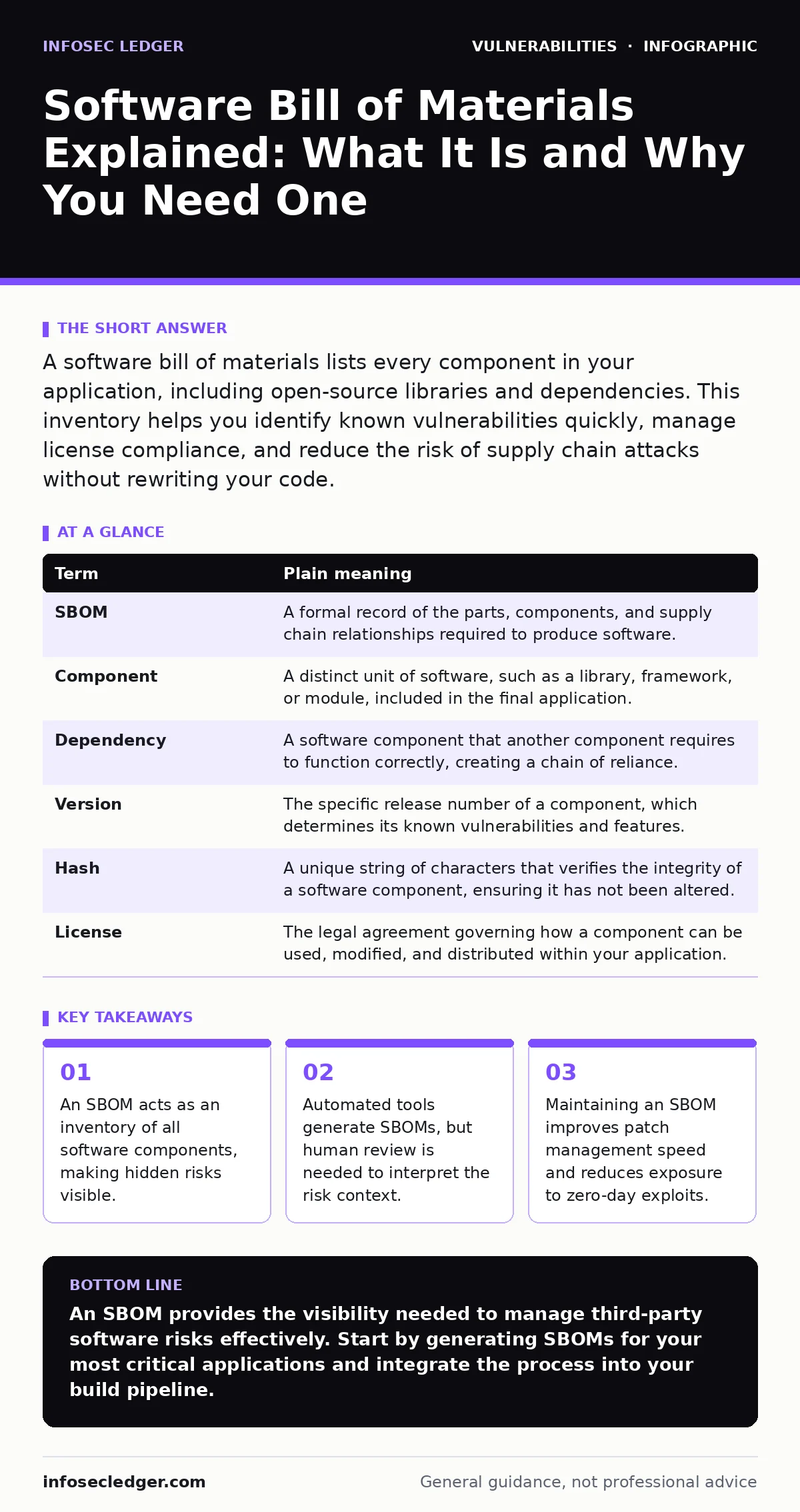
A software bill of materials lists every component in your application, including open-source libraries and dependencies. This inventory helps you identify known vulnerabilities quickly, manage license compliance, and reduce the risk of supply chain attacks without rewriting your code.
The Recipe Book Analogy
Imagine you run a bakery. Your signature cake is your proprietary product. You know exactly what flour, sugar, and eggs you buy. But suppose you also use a pre-made frosting mix from a supplier. That mix contains stabilizers, colorings, and preservatives you did not source directly. If a regulatory agency finds a banned substance in that frosting, you must recall your cakes. You cannot claim ignorance because you did not make the frosting yourself.
This scenario mirrors modern software development. Your application is the cake. The code you write is the flour and sugar. But modern apps rely heavily on third-party libraries and frameworks. These are the pre-made frosting mixes. You integrate them to save time, but you inherit their flaws. A software bill of materials (SBOM) is the complete list of ingredients in that frosting, including every sub-component.
What Is an SBOM?
An SBOM is a structured list of software components used in an application. It details the name, version, and supplier of each library, module, or framework. Think of it as a nutritional label for your code. Just as a food label lists allergens, an SBOM lists security vulnerabilities associated with specific versions of software.
Without an SBOM, you are flying blind. You might know your core code is secure, but you remain unaware of the risks in the libraries you import. This lack of visibility creates a blind spot that attackers exploit. They target the weakest link in the supply chain, which is often a outdated open-source library.
Key Terms Defined
Understanding an SBOM requires familiarity with specific terminology. These terms define the scope and structure of the inventory.
| Term | Plain meaning |
|---|---|
| SBOM | A formal record of the parts, components, and supply chain relationships required to produce software. |
| Component | A distinct unit of software, such as a library, framework, or module, included in the final application. |
| Dependency | A software component that another component requires to function correctly, creating a chain of reliance. |
| Version | The specific release number of a component, which determines its known vulnerabilities and features. |
| Hash | A unique string of characters that verifies the integrity of a software component, ensuring it has not been altered. |
| License | The legal agreement governing how a component can be used, modified, and distributed within your application. |
Why Visibility Matters
Most developers focus on securing their own code. They write secure functions and validate inputs. However, the majority of code in a modern application comes from external sources. These external components introduce unpatched software risks that you did not create but must manage.
An SBOM provides the visibility needed to address these risks. It allows you to scan for known vulnerabilities automatically. When a new threat emerges, you can check your SBOM to see if you are affected. This speeds up response times significantly. Instead of guessing which apps might be vulnerable, you know exactly which ones contain the compromised component.
The Hidden Cost of Complexity
Generating an SBOM is not a one-time task. It requires integration into your development pipeline. This adds complexity to your build process. You must ensure that every component, including transitive dependencies, is captured. Transitive dependencies are libraries used by the libraries you directly import. They are often the most dangerous because they are invisible to casual inspection.
This complexity reveals a non-obvious consequence: security becomes a shared responsibility. Developers, operations teams, and security officers must collaborate. Developers must choose components wisely. Operations must maintain the SBOM generation tools. Security must interpret the risk data. This coordination effort is a hidden cost that many organizations underestimate.
First Practical Steps
You do not need a perfect SBOM to start. You need a process. Follow these three steps to begin building visibility into your software supply chain.
- Identify your critical assets. List the applications that handle sensitive data or face the internet. Focus your SBOM efforts on these high-risk systems first.
- Select a standard format. Choose a widely accepted format like SPDX or CycloneDX. These standards ensure compatibility with scanning tools and future-proof your data.
- Automate the generation. Integrate an SBOM tool into your continuous integration pipeline. Ensure it runs every time you build a new version of your software.
Integrating with Security Practices
An SBOM is not a standalone solution. It works best when integrated with other security practices. For example, it complements patch management by telling you exactly what needs updating. It helps you avoid default credentials in embedded components by identifying them early.
Consider how an SBOM interacts with privilege escalation vulnerabilities. If a component in your SBOM has a known privilege escalation flaw, you can assess the risk. Does that component run with elevated privileges? If so, the risk is high. If not, the risk is lower. This context allows you to prioritize fixes effectively.
Beyond Basic Security
SBOMs also help with compliance and licensing. Many open-source components require specific attribution or restrict commercial use. An SBOM tracks these licenses, preventing legal issues. This is particularly important for organizations that sell software products.
Furthermore, an SBOM supports broader security strategies. It helps you understand the impact of IoT device vulnerabilities if your software controls connected devices. It aids in preventing server-side template injection by ensuring template engines are updated. It even relates to Content Security Policy by identifying scripts and libraries that might violate your security headers.
Key takeaways
- An SBOM acts as an inventory of all software components, making hidden risks visible.
- Automated tools generate SBOMs, but human review is needed to interpret the risk context.
- Maintaining an SBOM improves patch management speed and reduces exposure to zero-day exploits.
An SBOM provides the visibility needed to manage third-party software risks effectively. Start by generating SBOMs for your most critical applications and integrate the process into your build pipeline.
Frequently asked questions
Does an SBOM fix security vulnerabilities?
No, an SBOM only identifies components and their versions. It does not patch code or remove vulnerabilities. You must still update or replace vulnerable components.
How often should I update my SBOM?
Update your SBOM every time you change your dependencies or release a new version of your software. Regular updates ensure the inventory remains accurate.
Can I use an SBOM for legal compliance?
Yes, an SBOM tracks software licenses and components. This helps you ensure compliance with open-source license requirements and regulatory standards.
Is an SBOM required by law?
Requirements vary by industry and region. Some government contracts and industry standards now mandate SBOMs. Check your specific regulatory obligations.
How this guide was produced: written by the InfoSec Ledger editorial team with AI assistance, checked against the public references listed below, and reviewed when the facts change. See our editorial policy or report an error.