
Privilege Escalation Vulnerabilities: How Attackers Steal Admin Control
A single misconfigured permission can allow a low-level user to seize full administrative control of your entire network infrastructure.
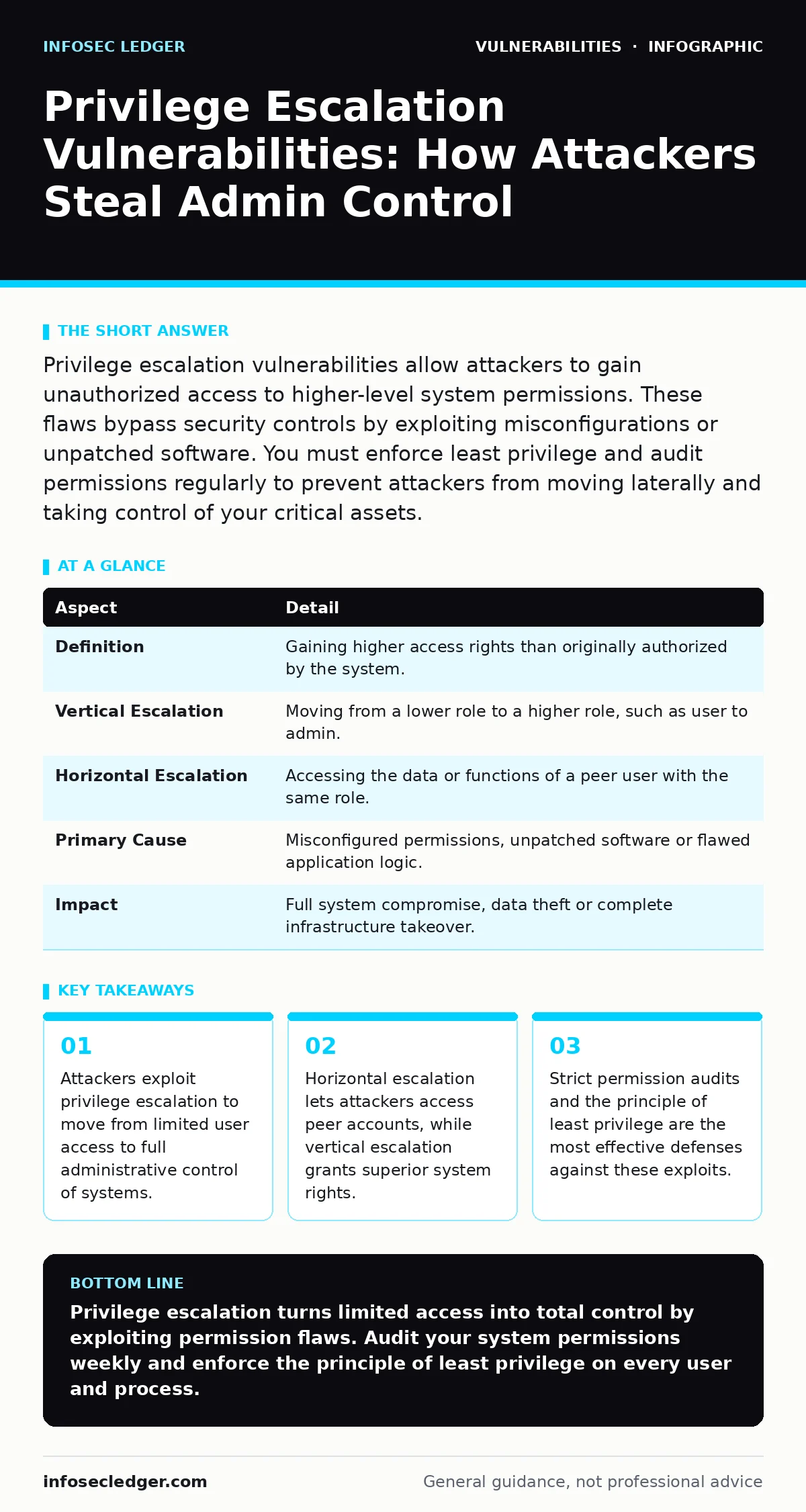
Privilege escalation vulnerabilities allow attackers to gain unauthorized access to higher-level system permissions. These flaws bypass security controls by exploiting misconfigurations or unpatched software. You must enforce least privilege and audit permissions regularly to prevent attackers from moving laterally and taking control of your critical assets.
Understanding the Core Mechanism
Imagine a building with multiple security levels. A visitor enters through the front door with a badge that only allows access to the lobby. Privilege escalation is the equivalent of that visitor finding a maintenance closet, stealing a master key, and unlocking the executive suite. In digital systems, this means an attacker starts with limited access and manipulates the system to gain higher authority.
Privilege escalation vulnerabilities occur when a system fails to enforce its permission boundaries correctly. The attacker does not need to break the outer wall. They simply need to find a flaw in the internal rules that govern who can do what. This allows them to act with rights they were never granted.
These vulnerabilities affect any system with multiple user roles. This includes web servers, operating systems, databases and cloud environments. If your system distinguishes between a regular user and an administrator, you have a target for this attack. The damage depends on the level of access gained. A small escalation might let an attacker read sensitive files. A full escalation lets them install malware or erase data.
| Aspect | Detail |
|---|---|
| Definition | Gaining higher access rights than originally authorized by the system. |
| Vertical Escalation | Moving from a lower role to a higher role, such as user to admin. |
| Horizontal Escalation | Accessing the data or functions of a peer user with the same role. |
| Primary Cause | Misconfigured permissions, unpatched software or flawed application logic. |
| Impact | Full system compromise, data theft or complete infrastructure takeover. |
How Vertical Escalation Works
Vertical escalation is the most dangerous form. It happens when a system trusts a user input too much. The attacker sends a command or request that the system interprets as coming from a higher authority. This often happens in software that does not properly validate user identity at every step.
Consider a web application that allows users to edit their own profiles. The application code might include a parameter for the user ID. If the developer forgets to check if the logged-in user owns that ID, an attacker can change the ID number in the request. The server processes the request and updates the profile. If the attacker changes the ID to that of an administrator, they may gain admin privileges. This is a direct path to total control.
Operating systems also suffer from these flaws. Kernel vulnerabilities are a common vector. The kernel is the core of the operating system that manages hardware and software resources. If a bug exists in the kernel, a user-level process can exploit it to execute code with kernel-level privileges. This bypasses all application-level security controls. The attacker effectively becomes the system itself.
The Hidden Danger of Horizontal Escalation
Horizontal escalation is often overlooked but equally damaging. It involves accessing the resources of another user who has the same privilege level. The attacker does not gain more power. They simply gain access to different data. This is common in applications that use predictable identifiers.
If user accounts are numbered sequentially, an attacker can guess the ID of a colleague. By changing the ID in a URL or API request, they might view that colleague's private messages or financial records. This violates confidentiality without violating integrity. The system still thinks the attacker is a valid user. It just fails to verify that the requested data belongs to that specific user.
This type of escalation allows attackers to map out your organization. They can collect emails, phone numbers and internal structures. This intelligence helps them craft more sophisticated attacks later. They might use a manager's credentials to perform a vertical escalation. Horizontal movement is the reconnaissance phase of many breaches. It turns a low-level access point into a high-value target.
What People Usually Get Wrong
Many organizations believe that firewalls and antivirus software prevent privilege escalation. This is incorrect. These tools protect the perimeter. They do not monitor internal permission checks. Once an attacker is inside, even with limited rights, perimeter defenses are irrelevant. The battle is now about internal trust.
Another common mistake is assuming that complex passwords stop escalation. Passwords protect the initial login. They do not protect the session after login. If the application logic is flawed, the attacker can bypass the need for a password entirely. They exploit the system's trust in their own session token. Strong authentication is necessary but not sufficient. You must also enforce strict authorization.
Teams often neglect to review third-party components. Your application might be secure, but the library it uses might not. A vulnerability in a common logging library can allow an attacker to write files to sensitive directories. This is where a software bill of materials (SBOM) becomes useful. It lists every component in your software. You can check this list against known vulnerability databases. Without an SBOM, you are blind to risks in your dependencies.
Defending Against Permission Abuse
The primary defense is the principle of least privilege. Every user and process should have only the permissions necessary to perform its specific task. No more, no less. If a web server only needs to read files, it should not have write access. If an employee only needs to view reports, they should not have database write access. This limits the damage if an account is compromised.
Regular audits are critical. Permissions drift over time. Employees change roles. Projects end. Old accounts remain active. You must review access rights periodically. Remove unnecessary permissions immediately. Automate this process where possible. Manual audits are slow and error-prone. Automated tools can detect anomalies in permission usage. They alert you when a user accesses resources outside their normal pattern.
Patch management is non-negotiable. Most privilege escalation vulnerabilities are known. Patches exist for them. Unpatched software is an open door. You must update operating systems, applications and libraries promptly. Delaying updates leaves you exposed to exploits that are already in the wild. This is why unpatched software remains a top cause of breaches.
The Role of Configuration Security
Misconfiguration is a leading cause of privilege escalation. Default settings are often too permissive for production environments. Many systems ship with default credentials that are well-known. If you do not change these, attackers can log in immediately. They then escalate their privileges using known exploits.
You must harden your systems. Disable unused services. Remove default accounts. Change default passwords. Configure logging to capture all authentication and authorization events. This helps you detect escalation attempts in real-time. You can see when a user tries to access resources they should not.
Cloud environments add complexity. Misconfigured cloud storage buckets or identity policies can expose data. You must understand the security model of your cloud provider. Use managed identity services where possible. They reduce the need for long-lived credentials. They also make it easier to revoke access quickly. This reduces the window of opportunity for an attacker.
Integrating Security into Development
Privilege escalation vulnerabilities often originate in the code. Developers must understand security patterns. They should never trust user input. Every request must be validated. Every permission check must be explicit. Implicit trust is a vulnerability.
Implement role-based access control in your architecture. Define roles clearly. Assign permissions to roles, not to users. This makes it easier to manage permissions at scale. When a user changes roles, their permissions update automatically. This reduces the chance of human error.
Conduct code reviews with a security focus. Look for places where permissions are checked. Ensure that these checks are consistent. Look for race conditions. These occur when two processes access a resource simultaneously. An attacker might exploit a race condition to bypass a permission check. This is a subtle but serious flaw.
Key takeaways
- Attackers exploit privilege escalation to move from limited user access to full administrative control of systems.
- Horizontal escalation lets attackers access peer accounts, while vertical escalation grants superior system rights.
- Strict permission audits and the principle of least privilege are the most effective defenses against these exploits.
Privilege escalation turns limited access into total control by exploiting permission flaws. Audit your system permissions weekly and enforce the principle of least privilege on every user and process.
Frequently asked questions
How do I know if I have a privilege escalation vulnerability?
You typically find out during a penetration test or when monitoring logs for unusual permission changes. Look for users accessing resources outside their defined role.
Can privilege escalation happen in cloud environments?
Yes. Misconfigured identity and access management policies in cloud platforms are a common source of these vulnerabilities.
Is privilege escalation the same as a backdoor?
No. A backdoor is a hidden entry point. Privilege escalation is the act of gaining higher rights after entering through a legitimate or compromised door.
How do mass assignment vulnerabilities relate to this?
Mass assignment vulnerabilities allow attackers to modify multiple parameters at once. This can include setting their own role to administrator, causing immediate privilege escalation.
How this guide was produced: written by the InfoSec Ledger editorial team with AI assistance, checked against the public references listed below, and reviewed when the facts change. See our editorial policy or report an error.