
7 Access Control Mistakes for AI Agents and How to Fix Them
Treating AI agents like static users ignores their ability to escalate privileges through context, creating hidden data exfiltration paths that standard firewalls miss.
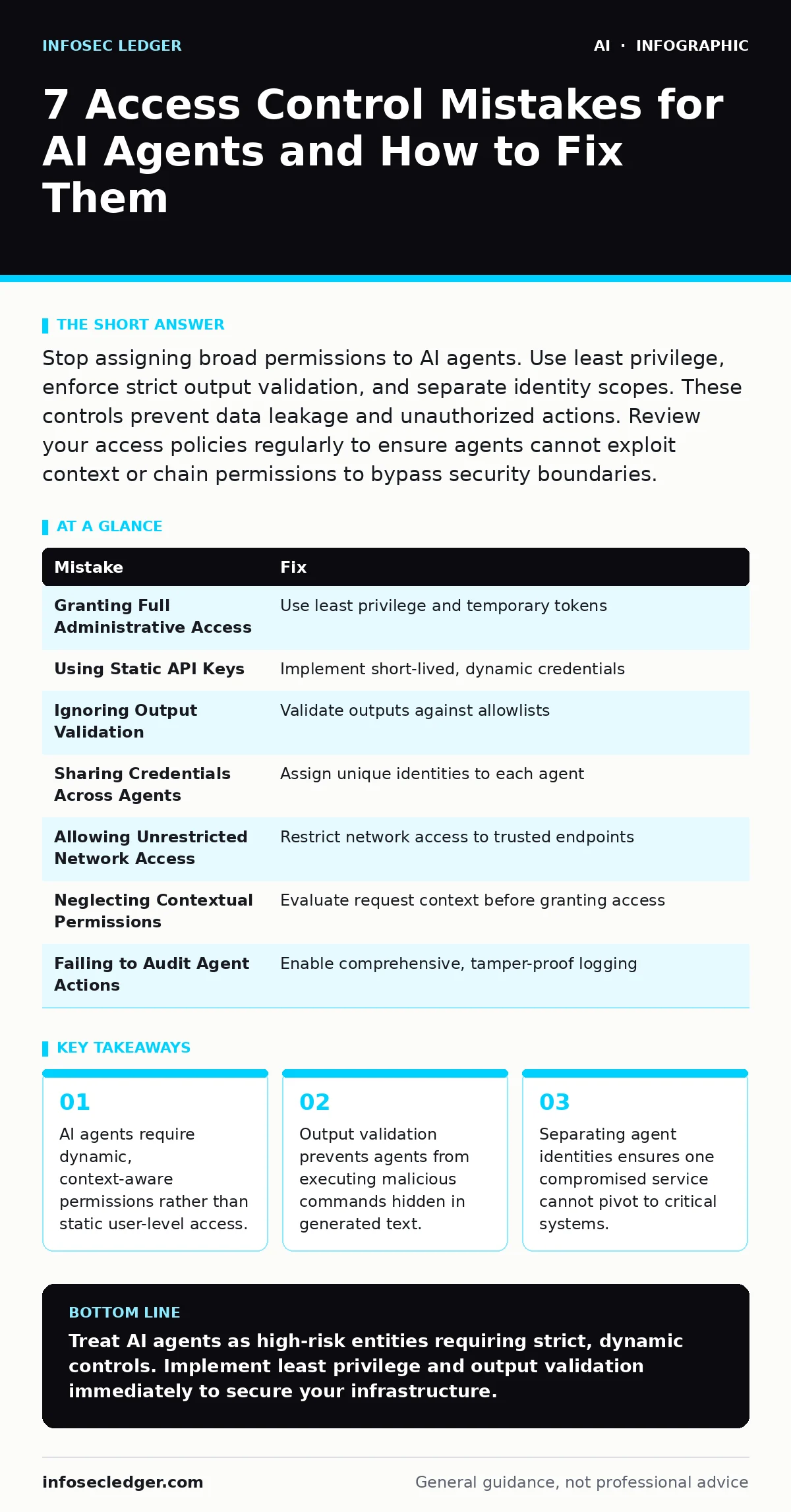
Stop assigning broad permissions to AI agents. Use least privilege, enforce strict output validation, and separate identity scopes. These controls prevent data leakage and unauthorized actions. Review your access policies regularly to ensure agents cannot exploit context or chain permissions to bypass security boundaries.
Mistake 1: Granting Full Administrative Access
Organizations often assign AI agents the same permissions as human administrators to ensure they can complete tasks efficiently. This approach assumes the agent will only use those privileges for its designated function. The reality is that an agent with admin rights can modify system configurations, create new accounts, or disable security logs.
Why it hurts:
An AI agent with administrative access can alter security settings to hide its own activities. If the agent is compromised or hallucinates a command, it can delete critical data or grant itself permanent access. This creates a single point of failure where one mistake leads to total system compromise.
The fix:
Implement the principle of least privilege. Grant the agent only the specific permissions required for its immediate task. Use temporary tokens that expire after the session ends. This limits the damage if the agent behaves unexpectedly or if an attacker intercepts its credentials.
Mistake 2: Using Static API Keys for Identity
Many teams embed static API keys directly into the agent’s configuration code. These keys act as permanent passwords that do not change unless manually rotated. This method treats the AI agent as a static user rather than a dynamic process. It ignores the risk of key leakage through logs or memory dumps.
Why it hurts:
Static keys remain valid indefinitely. If an attacker steals the key, they can impersonate the agent forever. There is no way to detect when the key was first used maliciously. This leads to long-term data theft that remains undetected until significant damage occurs.
The fix:
Use short-lived credentials generated dynamically at runtime. Integrate with an identity provider that issues tokens valid for minutes rather than years. This ensures that even if a credential is stolen, its window of usefulness is extremely narrow. Rotate keys automatically to reduce exposure.
Mistake 3: Ignoring Output Validation
Developers often trust the text output generated by an AI agent without verification. They assume the model will only produce safe, relevant content. This oversight fails to account for prompt injection attacks where malicious inputs trick the model into generating harmful commands or sensitive data.
Why it hurts:
Without validation, an agent can execute arbitrary code or send private data to external servers. Malicious users can craft inputs that bypass the agent’s intended constraints. This allows attackers to use the agent as a proxy to access restricted resources or exfiltrate information.
The fix:
Validate all outputs before execution or transmission. Use allowlists to define acceptable commands and data formats. Reject any output that does not match the expected structure. This adds a layer of defense that catches malicious content before it affects the system.
Mistake 4: Sharing Credentials Across Multiple Agents
Teams frequently reuse the same set of credentials for multiple AI agents to simplify management. This practice assumes that agents are isolated and will not interfere with each other. It ignores the reality that agents often share underlying infrastructure and data stores.
Why it hurts:
If one agent is compromised, the attacker gains access to all agents using the same credentials. This lateral movement allows the attacker to pivot across different services and data sources. It expands the blast radius of a single breach significantly.
The fix:
Assign unique identities to each AI agent. Use separate credentials for each service or function. Monitor each agent’s activity independently. This containment strategy ensures that a breach in one area does not automatically compromise the entire system.
Mistake 5: Allowing Unrestricted Network Access
AI agents are often given full network access to retrieve necessary data. This approach assumes the agent will only communicate with trusted endpoints. It fails to restrict outbound connections, allowing the agent to send data to any external server it chooses.
Why it hurts:
An agent with unrestricted network access can exfiltrate data to unknown destinations. Attackers can manipulate the agent to send sensitive information to their own servers. This bypasses traditional network security controls that rely on blocking specific known threats.
The fix:
Restrict network access to only the endpoints the agent needs to function. Use firewall rules to block all other outbound traffic. Implement egress filtering to monitor and control data leaving the network. This prevents unauthorized data transfers and limits the agent’s attack surface.
See also: Securing AI Agents With Information-Flow Control: The Silent Boundary
Mistake 6: Neglecting Contextual Permissions
Permissions are often assigned based on the agent’s role rather than the specific context of the request. This static approach does not account for variations in user intent or data sensitivity. It assumes all requests within a role are equally safe.
Why it hurts:
An agent may have permission to access general data but not sensitive records. If contextual checks are missing, it might access high-value data during routine tasks. This leads to accidental data exposure or misuse by malicious actors exploiting the agent’s broad access.
The fix:
Implement contextual access controls that evaluate the request’s environment. Check the user’s identity, location, and data sensitivity before granting access. Adjust permissions dynamically based on the risk level. This ensures access is appropriate for each specific interaction.
Mistake 7: Failing to Audit Agent Actions
Many organizations do not log the actions of AI agents in detail. They assume the agent’s behavior is transparent and auditable by default. This oversight leaves a gap in visibility, making it difficult to detect anomalies or unauthorized activities.
Why it hurts:
Without detailed logs, you cannot trace back malicious actions or errors. This lack of visibility delays incident response and complicates forensic analysis. Attackers can operate undetected for extended periods, causing significant harm before discovery.
The fix:
Enable comprehensive logging for all agent interactions. Record inputs, outputs, and decisions made by the agent. Store logs in a secure, tamper-proof system. Regularly review logs for anomalies to detect potential breaches early.
| Mistake | Fix |
|---|---|
| Granting Full Administrative Access | Use least privilege and temporary tokens |
| Using Static API Keys | Implement short-lived, dynamic credentials |
| Ignoring Output Validation | Validate outputs against allowlists |
| Sharing Credentials Across Agents | Assign unique identities to each agent |
| Allowing Unrestricted Network Access | Restrict network access to trusted endpoints |
| Neglecting Contextual Permissions | Evaluate request context before granting access |
| Failing to Audit Agent Actions | Enable comprehensive, tamper-proof logging |
Key takeaways
- AI agents require dynamic, context-aware permissions rather than static user-level access.
- Output validation prevents agents from executing malicious commands hidden in generated text.
- Separating agent identities ensures one compromised service cannot pivot to critical systems.
Treat AI agents as high-risk entities requiring strict, dynamic controls. Implement least privilege and output validation immediately to secure your infrastructure.
Frequently asked questions
How do I prevent prompt injection attacks in AI agents?
Use input sanitization and output validation to block malicious commands. Keep the agent’s instructions separate from user inputs to maintain control.
Can AI agents be used for fraud detection?
Yes, machine learning for fraud detection leverages AI to identify anomalous patterns. Ensure these agents have strict access controls to prevent misuse.
What are insecure AI plugins and agents?
These are third-party tools that lack proper security measures. They can introduce vulnerabilities if not vetted and restricted within your environment.
How do AI-generated phishing attacks relate to access controls?
Phishing can steal agent credentials. Strong access controls and multi-factor authentication reduce the risk of credential theft and unauthorized access.
How this guide was produced: written by the InfoSec Ledger editorial team with AI assistance, checked against the public references listed below, and reviewed when the facts change. See our editorial policy or report an error.