
Incident Response Plans: Why Your Security Tools Fail Without One
An incident response plan turns chaotic technical alerts into a coordinated legal and operational recovery, preventing minor breaches from becoming existential threats.
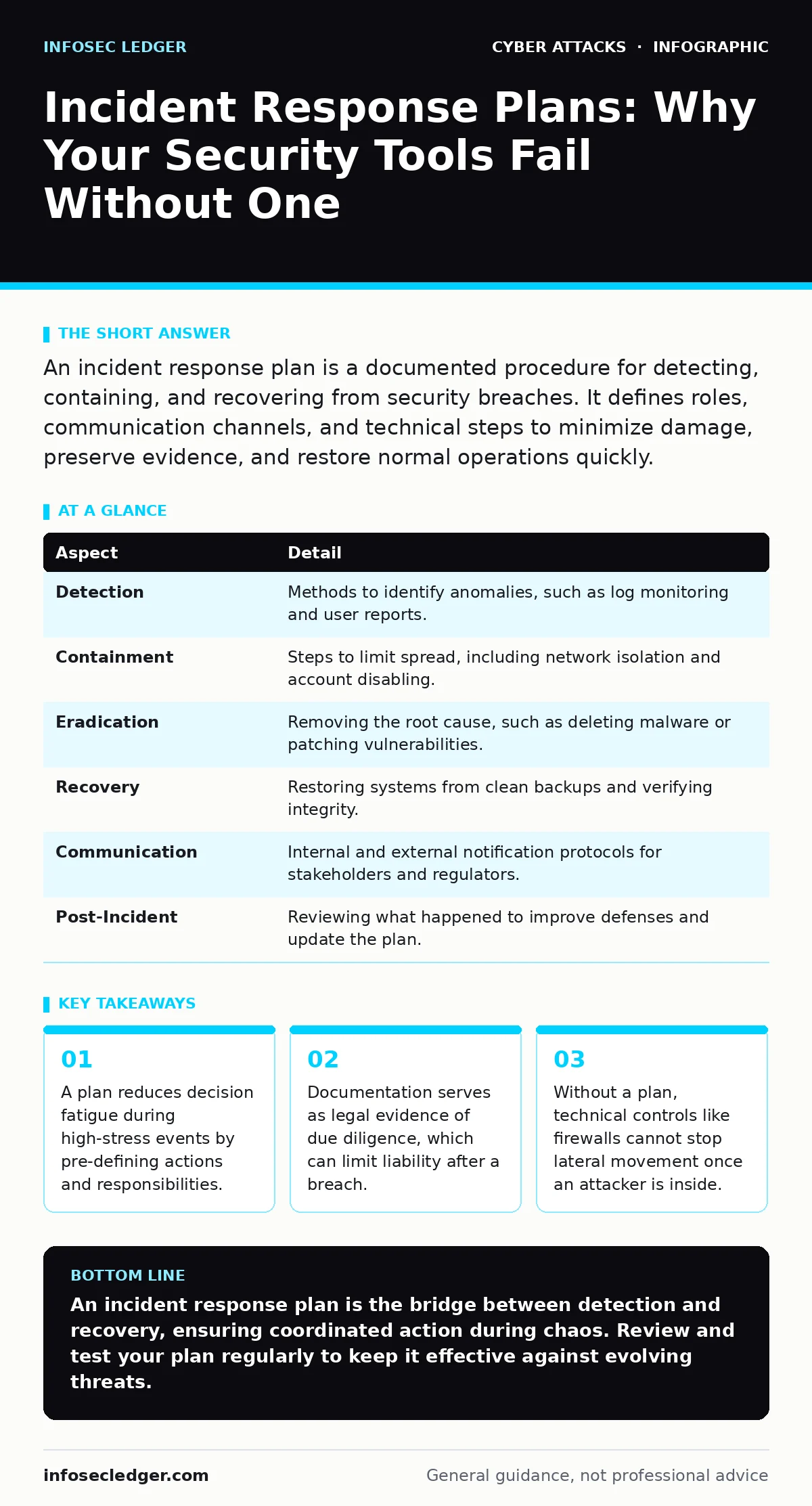
An incident response plan is a documented procedure for detecting, containing, and recovering from security breaches. It defines roles, communication channels, and technical steps to minimize damage, preserve evidence, and restore normal operations quickly.
The Fire Drill Analogy
Imagine a building with excellent fireproof materials and high-quality sprinklers. These are your preventive controls. They stop most fires from starting. However, if a fire does start, the materials alone do not tell anyone where the exits are. They do not tell the staff who calls the fire department. They do not tell you how to account for every person in the building.
An incident response plan is the fire drill. It is the set of instructions that activates when prevention fails. It ensures that when the alarm sounds, you do not panic. You execute a rehearsed sequence of actions that saves lives and property. In cybersecurity, "lives" are data integrity and business continuity. "Property" is your reputation and financial stability.
Without this plan, your security tools are passive. They detect, but they do not direct. You might have a firewall that blocks external traffic, but it cannot tell you how to isolate an infected workstation that was compromised via a USB drive. The plan provides the direction that tools cannot give.
The Core Problem: Chaos vs. Coordination
When a security breach occurs, time is the most scarce resource. Attackers move quickly to escalate privileges and exfiltrate data. Defenders often move slowly because they are figuring out what is happening. This gap is where the damage occurs.
The primary problem an incident response plan solves is coordination. It aligns technical teams, legal counsel, public relations, and management. Without it, the IT team might wipe a server to stop malware, destroying the evidence the legal team needs for litigation. The marketing team might issue a statement before the scope of the breach is known, causing reputational harm.
The plan creates a single source of truth. It dictates who makes decisions and in what order. This prevents contradictory actions that can worsen the situation. It transforms a reactive scramble into a managed process.
At a Glance: Plan Components
| Aspect | Detail |
|---|---|
| Detection | Methods to identify anomalies, such as log monitoring and user reports. |
| Containment | Steps to limit spread, including network isolation and account disabling. |
| Eradication | Removing the root cause, such as deleting malware or patching vulnerabilities. |
| Recovery | Restoring systems from clean backups and verifying integrity. |
| Communication | Internal and external notification protocols for stakeholders and regulators. |
| Post-Incident | Reviewing what happened to improve defenses and update the plan. |
How It Fits With Other Defenses
An incident response plan is not a security tool. It is a process that leverages your tools. It sits at the center of your defense strategy. Think of it as the operating system for your security team.
Preventive measures like attack surface reduction aim to stop attackers from entering. If those measures fail, the plan activates. It works in tandem with detection systems. For example, if you detect signs of botnet attacks, the plan tells you which networks to disconnect. If you identify session cookie theft, the plan dictates how to invalidate all active sessions for affected users.
The plan also informs your preventive work. Each incident reveals a weakness. The post-incident review updates your firewalls, access controls, and training. This creates a feedback loop. You do not just fix the immediate problem. You strengthen the perimeter to prevent recurrence.
What People Usually Get Wrong
Many organizations treat the incident response plan as a static document. They write it once and file it away. This is a critical error. The plan must be living. It must be updated as your technology changes.
Another common mistake is focusing only on technical steps. Teams often detail how to block an IP address or delete a file. They forget the human and legal elements. Who talks to the press? Who notifies customers? Who preserves evidence for law enforcement? Ignoring these aspects can lead to severe legal and reputational consequences.
A third error is assuming the plan will be followed perfectly under stress. In a crisis, cognitive load increases. Complex plans are ignored. The plan must be simple and actionable. It should use checklists. It should avoid ambiguity. If a step takes more than two sentences to explain, it is too complex.
See also: Cyber Insurance for Small Teams: Coverage Gaps and Cost Control · Cloud Incident Response: Definition, Purpose, and Execution Strategy
The Hidden Cost of Complexity
There is a trade-off between detail and usability. A highly detailed plan covers every edge case. It is also likely to be too long to read during a crisis. A simple plan is easy to follow but may miss specific scenarios.
You must balance this by using tiered responses. Have a high-level checklist for immediate actions. Reference detailed technical guides for specific threats. For instance, the immediate response to ARP spoofing might be to isolate the affected network segment. The detailed guide explains how to implement static ARP entries to prevent recurrence.
This tiered approach ensures speed without sacrificing precision. It allows junior staff to take initial containment steps while senior analysts handle complex eradication. It reduces the burden on decision-makers during the critical first hours.
Integrating With Related Controls
Your incident response plan must reference other security frameworks. It should specify how to handle breaches involving social engineering. It should define the process for verifying identity when email authentication failures occur.
It should also outline steps for responding to DDoS attacks. While technical mitigation might involve upstream filtering, the plan ensures that business continuity measures are activated. It coordinates with cloud providers and internet service providers.
By integrating these elements, the plan becomes a holistic strategy. It does not exist in isolation. It connects your technical controls with your business objectives. This ensures that security supports the organization rather than hindering it.
Key takeaways
- A plan reduces decision fatigue during high-stress events by pre-defining actions and responsibilities.
- Documentation serves as legal evidence of due diligence, which can limit liability after a breach.
- Without a plan, technical controls like firewalls cannot stop lateral movement once an attacker is inside.
An incident response plan is the bridge between detection and recovery, ensuring coordinated action during chaos. Review and test your plan regularly to keep it effective against evolving threats.
Frequently asked questions
How often should we update our incident response plan?
Update it after every significant change in infrastructure, personnel, or following any actual security incident or tabletop exercise.
Do we need a plan if we use managed security services?
Yes. While vendors handle technical detection, you remain responsible for legal, communication, and business continuity decisions.
Who should be involved in creating the plan?
Include IT, legal, human resources, public relations, and executive leadership to cover all aspects of a breach.
How do we know if our plan is effective?
Measure effectiveness through regular simulations. Track how quickly you detect, contain, and recover from simulated incidents.
How this guide was produced: written by the InfoSec Ledger editorial team with AI assistance, checked against the public references listed below, and reviewed when the facts change. See our editorial policy or report an error.