
Cyber Insurance for Small Teams: Coverage Gaps and Cost Control
Policies often exclude losses from poor log retention or missing incident communication plans, turning coverage into a hollow promise during a crisis.
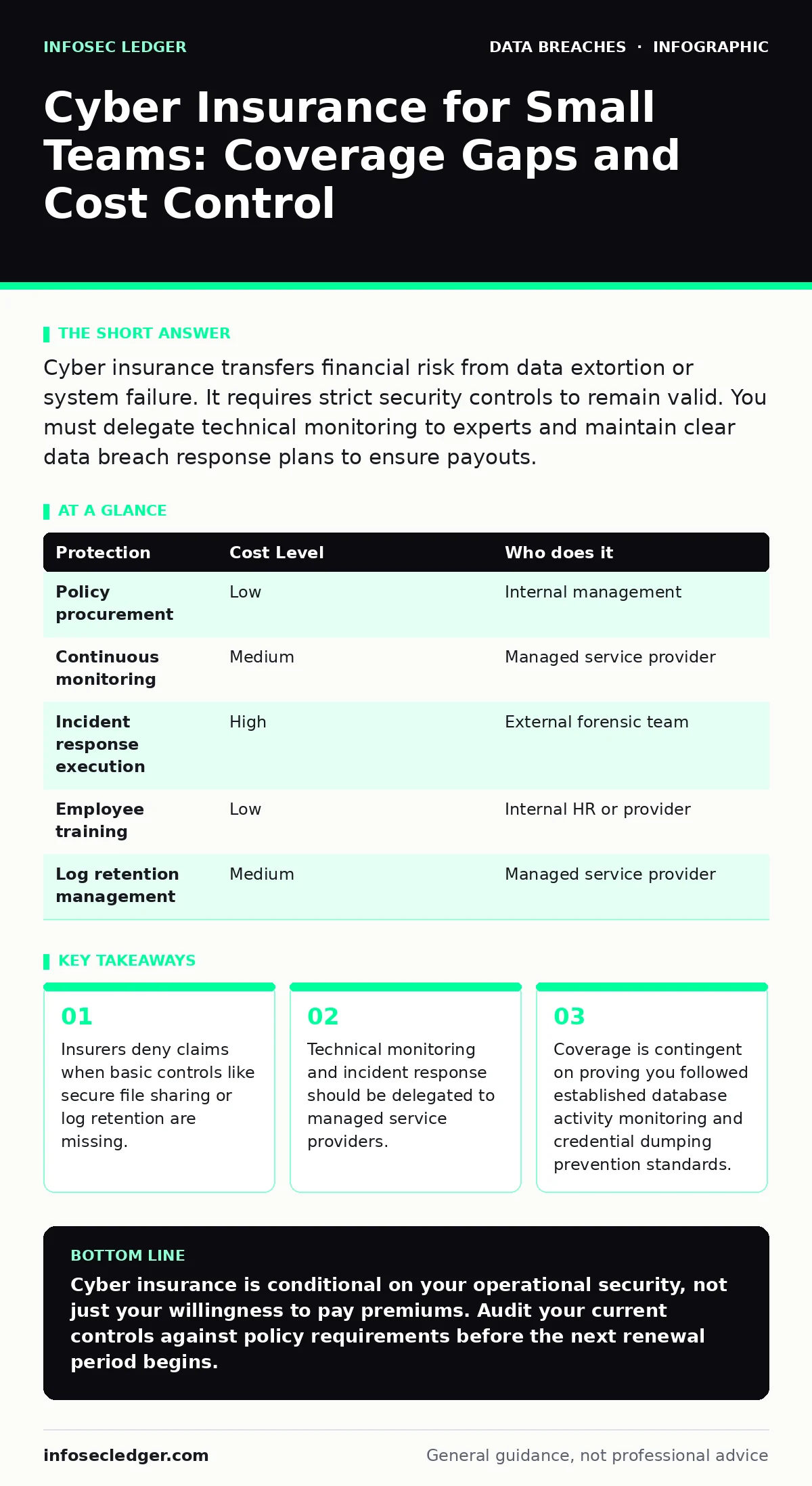
Cyber insurance transfers financial risk from data extortion or system failure. It requires strict security controls to remain valid. You must delegate technical monitoring to experts and maintain clear data breach response plans to ensure payouts.
The Coverage Trap for Small Teams
Cyber insurance is not a reward for having a website. It is a financial transfer mechanism that requires you to prove you managed risk actively. Many small organizations believe that buying a policy protects them from all digital threats. This belief is dangerous. Insurers view small businesses as high-risk because they often lack dedicated security staff.
The policy language usually contains exclusions for "known vulnerabilities" or "failure to maintain reasonable security." If you ignore updates or fail to implement secure file sharing protocols, the insurer may argue you were negligent. Negligence voids the contract. You are paying for a safety net that disappears the moment you trip.
The cost of a policy is rarely the issue. The issue is the deductible and the coverage limits. Insurers lower premiums if you demonstrate specific controls. These controls are the price of admission.
What Must Be Delegated
You cannot inspect every server log yourself. You likely do not have the time or the technical expertise to monitor database activity monitoring tools effectively. Attempting to do so creates a false sense of security. You will miss subtle indicators of compromise that a specialist would catch.
Delegate continuous monitoring to a managed service provider. This provider should handle the technical heavy lifting. They must configure alerts for unusual data movement or login attempts. You retain responsibility for reviewing their reports and acting on them.
Delegation does not mean abdication. You must understand what the provider is doing. If they claim to prevent credential dumping, ask how. Credential dumping is a technique where attackers extract password hashes from memory. If you cannot explain the mitigation strategy to your provider, you cannot verify their work.
| Protection | Cost Level | Who does it |
|---|---|---|
| Policy procurement | Low | Internal management |
| Continuous monitoring | Medium | Managed service provider |
| Incident response execution | High | External forensic team |
| Employee training | Low | Internal HR or provider |
| Log retention management | Medium | Managed service provider |
The Hidden Cost of Compliance
Insurers require you to maintain specific security postures. Maintaining these postures costs money and time. You must invest in tools that generate logs. You must store those logs securely. This is where log retention becomes a financial liability.
Storing logs for the required period increases storage costs. If you do not store them, you violate the policy terms. If you store them but cannot retrieve them quickly, you fail the incident response requirement. Both scenarios lead to denied claims.
Consider the cost of a data breach response plan. Writing the plan is cheap. Testing it is expensive. Insurers often require annual tabletop exercises. These exercises simulate a breach to test your team's reaction. Without this testing, the plan is just a document. Insurers know this and may exclude coverage for untested scenarios.
Questions for Your IT Provider
You need to vet your IT provider rigorously. They are your first line of defense. If they fail, your insurance fails. Ask these questions before signing any contract or renewal.
- How do you handle secure file sharing for sensitive client data?
- What is your protocol for detecting credential dumping attempts?
- Do you provide detailed logs for database activity monitoring?
- How do you assist with incident communication plans during a crisis?
- What is your process for data extortion negotiation if ransomware strikes?
- How long do you retain logs, and who has access to them?
- Do you conduct regular tests of the data breach response plans?
Navigating Data Extortion
Data extortion is a growing threat. Attackers do not just encrypt files. They steal data and threaten to publish it. This doubles the pressure on your organization. You face reputational damage and regulatory fines.
Cyber insurance may cover extortion payments. However, paying a ransom is legally complex. Some jurisdictions prohibit paying criminals. Insurers may refuse to cover the payment if it violates local laws.
You must have a clear stance on extortion before it happens. Your data breach response plans should outline when to pay and when to refuse. This decision must be made by leadership, not IT staff. IT staff will panic. Leadership must weigh the legal and reputational risks.
See also: Detecting AI Content: Practical Filters and Delegation for Small Teams · How AI Usage Policies Work: From Data Capture to Risk Control
The Role of Incident Communication
A breach is a public relations crisis as much as a technical one. Your customers will want to know what happened. Regulators will demand details. If you communicate poorly, you amplify the damage.
Insurers often require an incident communication plan. This plan dictates who speaks to the media, what they say, and when. It also covers internal communications. Employees must know what to tell customers.
Without this plan, you risk inconsistent messaging. One employee might say the data was encrypted. Another might say it was stolen. This confusion erodes trust. It also complicates the insurance claim. Insurers need a clear timeline of events. Inconsistent stories make that timeline hard to establish.
Practical Steps to Affordability
You can reduce premiums by demonstrating control. Start with the basics. Enable multi-factor authentication everywhere. This is often a requirement for coverage. Next, implement secure file sharing. Do not use email for sensitive documents.
Review your log retention policies. Ensure you keep logs long enough to satisfy the insurer. This might mean paying for cloud storage. It is cheaper than a denied claim. Finally, test your data breach response plans annually. Document the test results.
Share these documents with your insurer. They may offer a discount for proven practices. Do not assume they will know you are compliant. You must prove it. The burden of proof is on you, not them.
Key takeaways
- Insurers deny claims when basic controls like secure file sharing or log retention are missing.
- Technical monitoring and incident response should be delegated to managed service providers.
- Coverage is contingent on proving you followed established database activity monitoring and credential dumping prevention standards.
Cyber insurance is conditional on your operational security, not just your willingness to pay premiums. Audit your current controls against policy requirements before the next renewal period begins.
Frequently asked questions
Does cyber insurance cover ransomware payments?
Coverage varies by policy. Some cover extortion payments, while others exclude them due to legal restrictions. Check the specific wording regarding criminal payments.
What happens if I forget to update my software?
Insurers may deny claims if they determine that unpatched software contributed to the breach. This is considered negligence.
Do I need a separate incident communication plan?
Yes. Technical response is not enough. You need a plan for public and internal messaging to manage reputation and legal liability.
How much does cyber insurance cost?
Costs vary based on industry, size, and security posture. Small businesses typically pay hundreds to thousands annually, depending on coverage limits.
How this guide was produced: written by the InfoSec Ledger editorial team with AI assistance, checked against the public references listed below, and reviewed when the facts change. See our editorial policy or report an error.