
Data Breach Response Plan Checklist for Containment
Most organizations fail not because they lack tools, but because they lack pre-defined decision trees for containment actions during high stress.
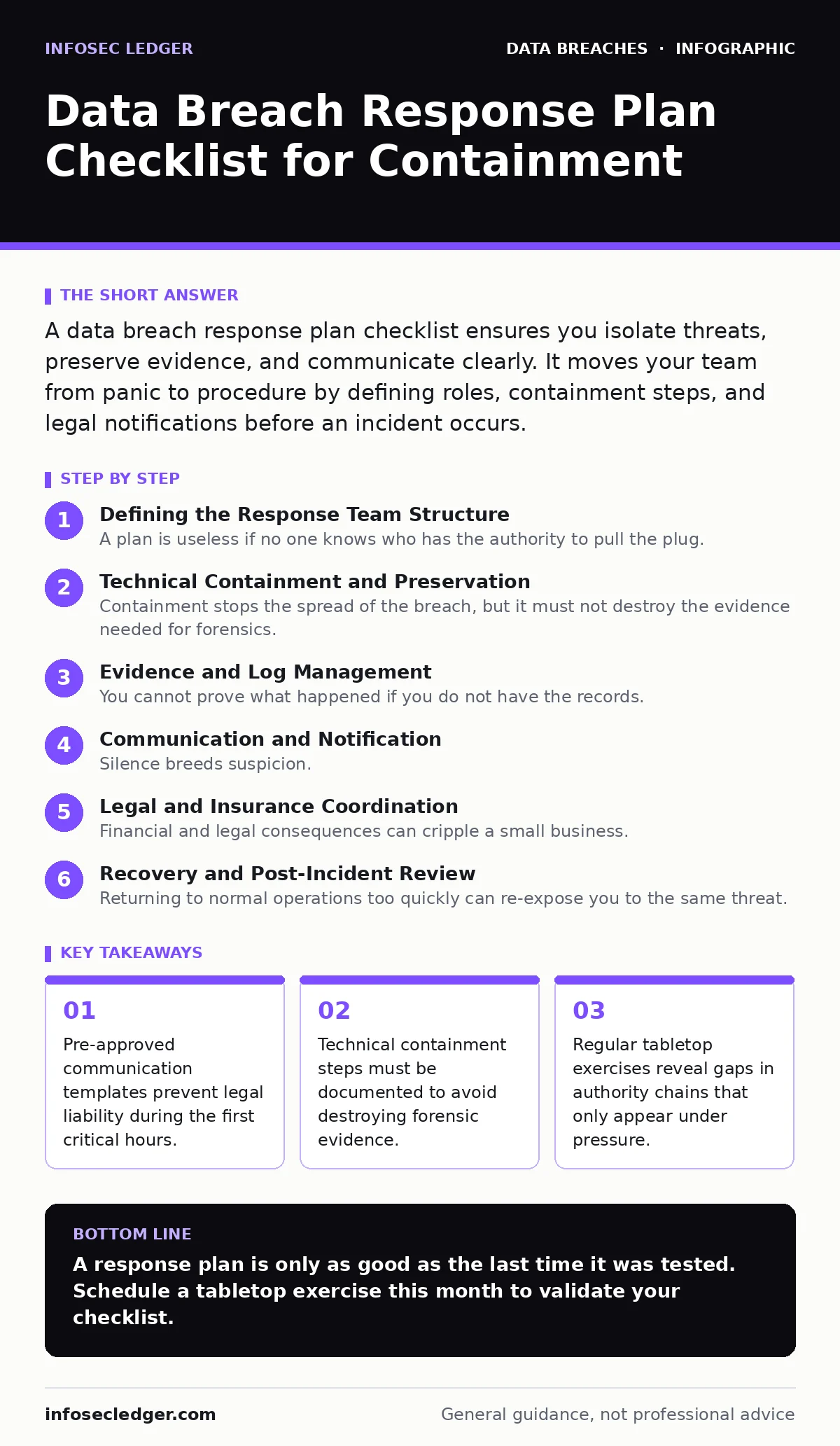
A data breach response plan checklist ensures you isolate threats, preserve evidence, and communicate clearly. It moves your team from panic to procedure by defining roles, containment steps, and legal notifications before an incident occurs.
Defining the Response Team Structure
A plan is useless if no one knows who has the authority to pull the plug. You must assign specific roles before the crisis hits. This section identifies who makes technical decisions versus who handles legal and public relations.
- Incident Commander: One person has final authority to order system shutdowns to prevent split-second decision paralysis.
- Technical Lead: The engineer responsible for executing containment steps without altering disk images.
- Legal Counsel: An attorney who reviews all external communications to ensure regulatory compliance.
- Communications Officer: The only person authorized to speak to media or customers to maintain message consistency.
Technical Containment and Preservation
Containment stops the spread of the breach, but it must not destroy the evidence needed for forensics. Many teams rush to wipe systems, which erases the log data required to determine the scope. You need a clear order of operations for isolation.
- Network Segmentation: Isolate affected subnets to stop lateral movement while keeping business-critical services running.
- Credential Reset: Force password changes for all administrative accounts immediately to prevent persistence.
- Snapshot Creation: Take forensic images of affected systems before any remediation to preserve the state of compromise.
- Log Export: Copy local logs to a secure, offline storage medium to prevent tampering by the attacker.
Evidence and Log Management
You cannot prove what happened if you do not have the records. Many organizations retain logs for only a short period, which is insufficient for complex investigations. Your plan must specify where logs are stored and how long they are kept.
- Centralized Log Storage: Ensure logs are sent to a write-once-read-many server to prevent deletion by attackers.
- Retention Policy Verification: Confirm that logs cover the full investigation window, including historical data.
- Chain of Custody Form: A document tracking who accessed evidence and when, required for legal admissibility.
For more on maintaining these records, see the guide on log retention. Proper retention ensures you have the historical context needed to identify the initial entry point.
Communication and Notification
Silence breeds suspicion. Customers and partners will look for answers. Your plan must include pre-drafted templates for different scenarios, such as data exfiltration versus ransomware. This reduces the time to first notification, which is often a legal requirement.
- Internal Alert Template: A standard message to staff outlining what they should not do, such as deleting files.
- Customer Notification Draft: A template that explains what data was exposed and what steps customers should take.
- Regulatory Notification Checklist: A list of agencies that must be contacted within specific timeframes.
See the guide on incident communication plans for deeper strategies on maintaining trust during disclosure.
Legal and Insurance Coordination
Financial and legal consequences can cripple a small business. You need to know exactly when to involve external experts. Delaying insurance notification can void coverage, while premature legal action can expose sensitive investigation details.
- Insurance Policy Review: Confirm coverage limits and notification deadlines for cyber incidents.
- Forensic Firm Contact: Pre-approved vendors who can begin investigation immediately without conflict of interest.
- Legal Hold Notice: A directive to preserve all relevant documents and emails to avoid spoliation claims.
Review the guide on cyber insurance to understand what is typically covered and what is excluded.
See also: Cyber Insurance for Small Teams: Coverage Gaps and Cost Control · Secure File Sharing Mistakes That Expose Your Business Data
Recovery and Post-Incident Review
Returning to normal operations too quickly can re-expose you to the same threat. You must verify that the root cause is eliminated before restoring services. This phase also includes updating the plan based on what went wrong.
- System Rebuild Protocol: Instructions to rebuild systems from clean media rather than restoring from potentially infected backups.
- Threat Hunting Scan: A thorough search for remaining indicators of compromise across the network.
- Post-Mortem Report: A document detailing what happened, what worked, and what failed in the response.
For more on securing your backups and files, see the guide on secure file sharing.
Handling Extortion and Fraud
Some breaches involve threats or financial fraud. Your plan must address how to handle demands for payment or reports of fraudulent transactions. Ignoring these aspects can lead to secondary losses.
- Extortion Policy: A clear stance on whether to engage with extortionists, usually involving law enforcement.
- Fraud Alert Procedure: Steps to place fraud alerts on affected individuals' credit files.
- Account Monitoring: Instructions for monitoring accounts for unauthorized activity post-breach.
See the guide on data extortion for strategies on handling ransom demands. Also, review fraud alerts to protect your customers' financial identities.
Key takeaways
- Pre-approved communication templates prevent legal liability during the first critical hours.
- Technical containment steps must be documented to avoid destroying forensic evidence.
- Regular tabletop exercises reveal gaps in authority chains that only appear under pressure.
A response plan is only as good as the last time it was tested. Schedule a tabletop exercise this month to validate your checklist.
Frequently asked questions
How often should I update my data breach response plan?
Update it at least annually or whenever there are significant changes to your infrastructure, personnel, or regulatory environment.
Do I need a separate plan for cloud breaches?
Yes, cloud environments have different containment mechanisms, such as identity-based isolation
How this guide was produced: written by the InfoSec Ledger editorial team with AI assistance, checked against the public references listed below, and reviewed when the facts change. See our editorial policy or report an error.