
Fraud Alerts: How Early Warning Systems Stop Identity Theft
Fraud alerts create a mandatory pause in account opening, forcing verification before thieves can exploit stolen credentials for new credit.
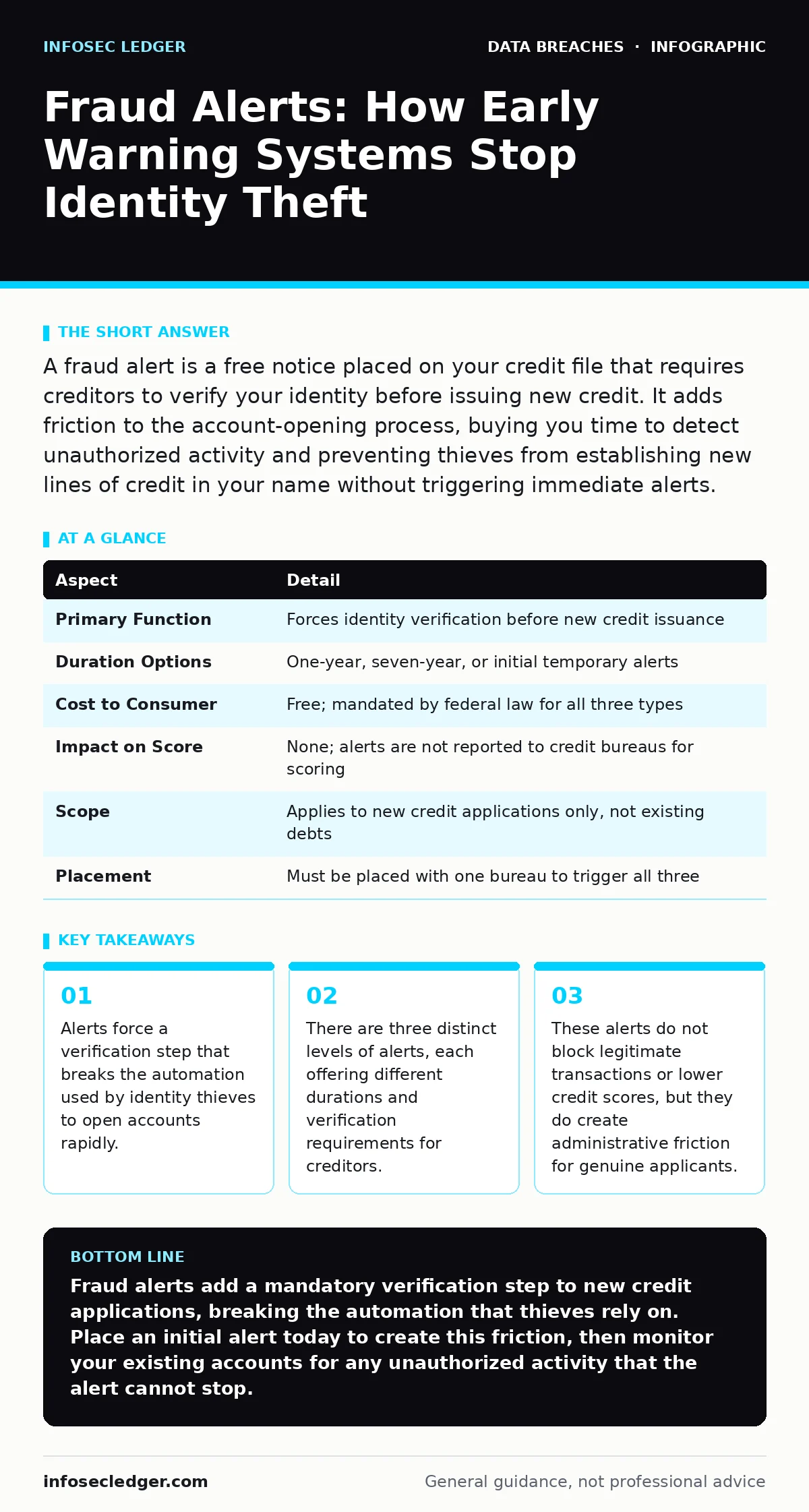
A fraud alert is a free notice placed on your credit file that requires creditors to verify your identity before issuing new credit. It adds friction to the account-opening process, buying you time to detect unauthorized activity and preventing thieves from establishing new lines of credit in your name without triggering immediate alerts.
The Library Book Analogy
Imagine a library that allows anyone to check out a book simply by showing their card. If a thief steals a card, they can walk in and take whatever they want without resistance. Now imagine the library installs a system where every checkout requires a guard to check the person’s face against the photo on the file. This extra step slows down every patron slightly, but it stops the thief in their tracks.
Fraud alerts operate on this same principle of friction. They do not lock your existing accounts or prevent you from spending money you already have. Instead, they place a flag on your credit file that tells lenders to pause. When a creditor sees this flag, they cannot issue new credit automatically. They must contact you directly to verify your identity before proceeding.
This mechanism transforms the account-opening process from a silent, automated approval into a two-step verification. It removes the element of surprise for the victim while adding a significant hurdle for the attacker.
At a Glance: Alert Mechanics
| Aspect | Detail |
|---|---|
| Primary Function | Forces identity verification before new credit issuance |
| Duration Options | One-year, seven-year, or initial temporary alerts |
| Cost to Consumer | Free; mandated by federal law for all three types |
| Impact on Score | None; alerts are not reported to credit bureaus for scoring |
| Scope | Applies to new credit applications only, not existing debts |
| Placement | Must be placed with one bureau to trigger all three |
How The System Stops Theft
The core problem these alerts solve is the speed of automated underwriting. Modern lending platforms use algorithms that approve loans in seconds based on data points like credit score, income history, and address verification. An identity thief with your Social Security number and date of birth can pass these automated checks instantly.
A fraud alert interrupts this automation. When you place an alert, the credit bureau marks your file. When a lender pulls your report, the system flags the file. The lender’s software then halts the application process. A human representative must then call the phone number you provided. If you do not answer, or if you confirm you did not apply, the lender denies the request.
This creates a "verification gap." Thieves rely on speed and volume. They try to open dozens of accounts quickly before the victim notices. The alert forces a pause that breaks their workflow. It turns a high-volume, low-effort attack into a high-effort, low-success operation.
The Three Levels of Protection
Not all alerts are created equal. The system offers three tiers, each with different durations and security implications. Understanding these differences helps you choose the right level of friction for your situation.
Initial Fraud Alerts last for one year. They are the standard option and require lenders to verify your identity. This is suitable for most people who suspect they might be at risk but have not yet seen evidence of theft.
Extended Fraud Alerts last for seven years. The longer duration reduces the administrative burden of renewing the alert annually.
Active Duty Alerts are a specialized form used primarily by active military personnel. These provide additional protections for service members who may be deployed and unable to monitor their accounts closely.
You only need to contact one of the three major credit bureaus to place an alert. Federal law requires that bureau to notify the other two, ensuring your file is protected across all reporting agencies. This simplifies the process, but you should verify with all three that the alert is active.
Where Alerts Fit in Defense
Fraud alerts are a perimeter control, not a deep inspection. They sit at the edge of your financial identity, stopping new entries. They do not monitor your existing behavior. If a thief uses your existing credit cards, the alert will not trigger. You need other tools for that.
This is why alerts work best alongside data breach response plans. An alert stops new accounts, but a plan tells you what to do when you discover your data was exposed in the first place. The alert is the shield; the plan is the strategy for when the shield is breached.
Similarly, log retention policies help you prove when an attack started. If you discover fraud, having historical logs of your financial activity can help you distinguish between authorized and unauthorized transactions. This evidence is critical for disputing charges and restoring your credit file.
See also: Third-Party Cookies: Hidden Risks and Protection for Small Businesses · Unauthorized Access Meaning: How Intruders Bypass Controls
Common Misconceptions
The most persistent error is confusing alerts with freezes. A freeze is harder to manage because you must lift it every time you apply for legitimate credit. An alert is passive; it works in the background. However, an alert is easier to bypass if the thief has enough personal information to answer verification questions.
Another misconception is that alerts affect your credit score. They do not. Credit scoring models ignore alerts because they are not financial behavior. They are administrative flags. Your score remains unchanged whether you have an alert or not.
Finally, people often think alerts stop all fraud. They do not. They only stop new credit applications. They do not protect against account takeover on existing lines of credit, nor do they prevent thieves from using your identity for non-credit crimes like tax fraud or medical identity theft.
Integrating With Broader Security
To make alerts effective, you must treat them as part of a layered defense. Standalone alerts are useful, but they are blind to what happens inside your existing accounts.
Consider database activity monitoring if you manage sensitive data yourself. While this is an enterprise tool, the principle applies: you need to see what is happening in real-time. For personal finance, this translates to enabling transaction alerts on your bank accounts. These alerts notify you of spending, while credit alerts notify you of new applications.
Furthermore, secure file sharing practices reduce the risk of initial data exposure. If you send sensitive documents insecurely, you increase the surface area for theft. Reducing the chance of initial compromise reduces the need for reactive measures like alerts.
Key takeaways
- Alerts force a verification step that breaks the automation used by identity thieves to open accounts rapidly.
- There are three distinct levels of alerts, each offering different durations and verification requirements for creditors.
- These alerts do not block legitimate transactions or lower credit scores, but they do create administrative friction for genuine applicants.
- They serve as a critical early warning signal within a broader data breach response strategy, complementing active monitoring tools.
Fraud alerts add a mandatory verification step to new credit applications, breaking the automation that thieves rely on. Place an initial alert today to create this friction, then monitor your existing accounts for any unauthorized activity that the alert cannot stop.
Frequently asked questions
Does a fraud alert lower my credit score?
No, credit scoring models do not consider fraud alerts as a factor in calculating your score. They are administrative notices that do not reflect your financial behavior or creditworthiness.
How long does it take to place a fraud alert?
It usually takes only a few minutes to place an alert by phone. You must speak with a representative at one of the major credit bureaus, provide personal details for verification, and specify the type of alert you want.
Can a lender ignore a fraud alert?
No, federal regulations require lenders to verify your identity when they see an active fraud alert on your file. They cannot issue new credit until they have confirmed that you are the person applying.
Do I need to renew a fraud alert?
Initial fraud alerts last for one year and must be renewed if you want to maintain protection. Extended fraud alerts last for seven years and do not require annual renewal, though you can request removal at any time.
How this guide was produced: written by the InfoSec Ledger editorial team with AI assistance, checked against the public references listed below, and reviewed when the facts change. See our editorial policy or report an error.