
Privacy by Design Meaning: How to Embed Protection Early
Privacy by Design shifts security from a final audit step to the first line of code, preventing data leaks before the product even launches.
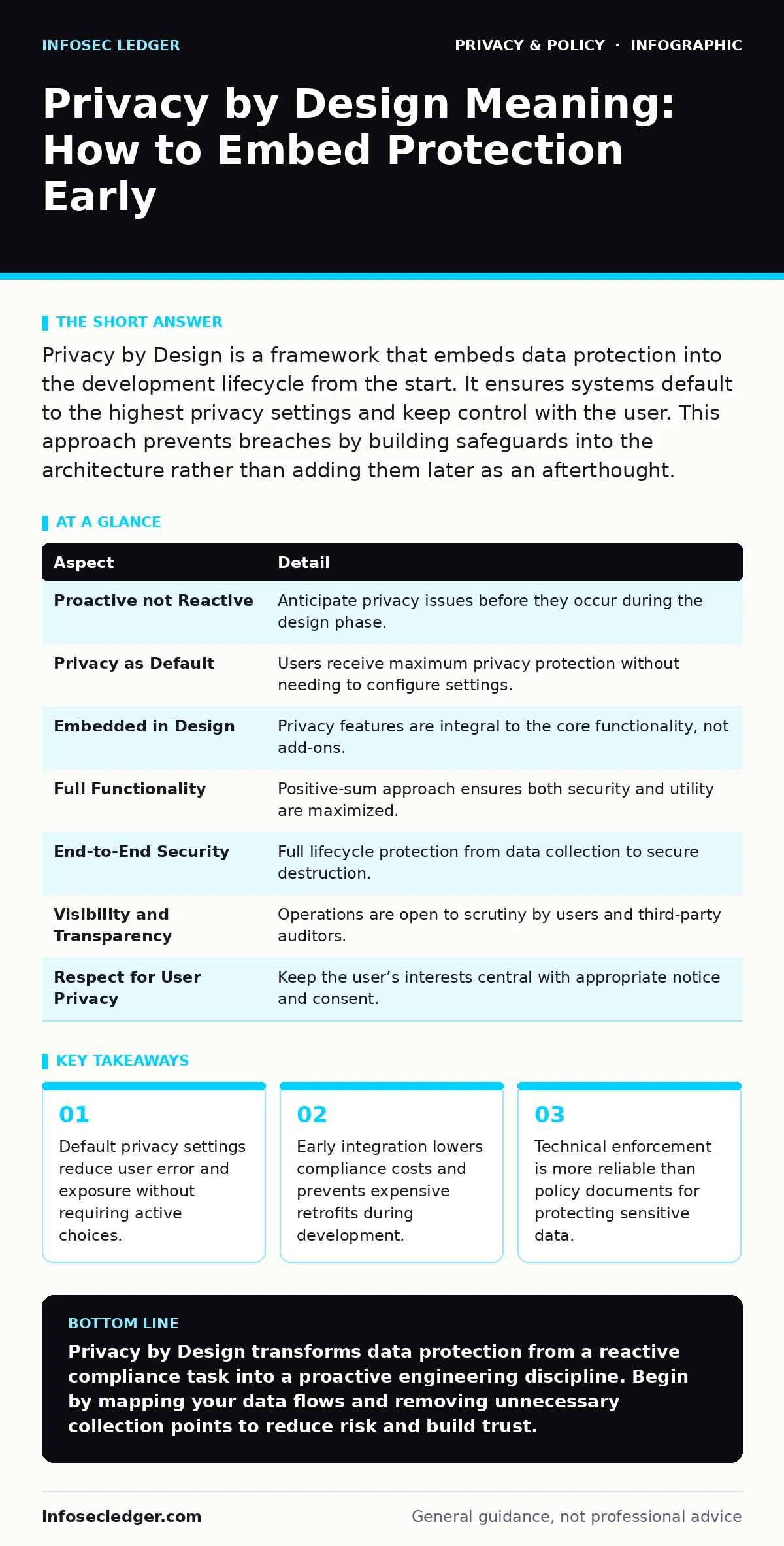
Privacy by Design is a framework that embeds data protection into the development lifecycle from the start. It ensures systems default to the highest privacy settings and keep control with the user. This approach prevents breaches by building safeguards into the architecture rather than adding them later as an afterthought.
Privacy by Design Meaning and Core Principles
Privacy by Design means embedding data protection into the very fabric of a system’s architecture and business practices. It is not a checklist you complete before launch, but a continuous engineering discipline. The framework rests on seven foundational principles that shift responsibility from the user to the provider. You build the system so that privacy is the automatic result of normal operations. This changes the security posture from reactive patching to proactive prevention.
| Aspect | Detail |
|---|---|
| Proactive not Reactive | Anticipate privacy issues before they occur during the design phase. |
| Privacy as Default | Users receive maximum privacy protection without needing to configure settings. |
| Embedded in Design | Privacy features are integral to the core functionality, not add-ons. |
| Full Functionality | Positive-sum approach ensures both security and utility are maximized. |
| End-to-End Security | Full lifecycle protection from data collection to secure destruction. |
| Visibility and Transparency | Operations are open to scrutiny by users and third-party auditors. |
| Respect for User Privacy | Keep the user’s interests central with appropriate notice and consent. |
Imagine a company building a customer support chatbot. A reactive approach would collect all chat logs to train the model, then worry about deleting personal identifiers later. A Privacy by Design approach would engineer the bot to process queries in real-time without storing the raw conversation history. The system extracts only the necessary intent for the response and discards the rest immediately. This prevents the accumulation of sensitive data that could be stolen or misused.
How Privacy by Design Works in Practice
This framework operates by altering the development workflow. Engineers must consider data minimization at the whiteboard stage. You define what data is strictly necessary for the service to function and discard the rest. This often requires rethinking how features work. For example, instead of storing a user’s full date of birth, the system might only store whether the user is over eighteen. This reduces the value of the data if a breach occurs.
The mechanism relies on technical constraints rather than human vigilance. Code enforces data retention limits automatically. Database schemas are structured to prevent unauthorized access by design. This creates a system where violating privacy is difficult or impossible. You remove the ability to collect unnecessary data rather than relying on employees to remember not to do it. This structural approach is far more reliable than training alone.
Who It Affects and Why It Matters
Every organization that processes personal data is affected by these principles. Small businesses often believe they are too small to be targets, but automated attacks do not discriminate by company size. Integrating these practices protects your reputation and reduces liability. It also builds trust with customers who are increasingly aware of third-party cookies and data tracking practices.
Developers face a new constraint: they must justify every data field they request. Product managers must prioritize privacy features alongside functionality. Legal teams shift from drafting vague policies to defining concrete technical requirements. This cross-functional collaboration ensures that privacy is not a bottleneck but a feature. It aligns business goals with regulatory expectations without constant friction.
What to Do About It: Implementation Steps
Start by auditing your current data flows. Map where data enters your system, how it moves, and where it exits. Identify points where unnecessary data is collected or stored. You cannot protect what you do not understand. Create a data map that details every field and its purpose. This visibility is the foundation for all subsequent improvements.
- Conduct a privacy impact assessment for each new feature.
- Define the minimum data required for core functionality.
- Implement technical controls that enforce data limits.
- Review vendor contracts to ensure they meet the same standards.
Review your vendor relationships carefully. Third-party services often have weaker security postures than your internal systems. If you use encrypted messaging apps for customer support, ensure the vendor does not retain message logs. If you integrate with analytics platforms, verify that they support data anonymization. Your privacy obligations extend to any entity that processes data on your behalf.
Common Misconceptions About Privacy by Design
Many organizations mistake privacy for compliance. They view it as a legal hurdle to clear rather than a security benefit. This mindset leads to the bare minimum implementation. You must understand that regulations like the CCPA set a floor, not a ceiling. Privacy by Design aims for best practices that exceed legal requirements. This distinction matters because laws lag behind technology.
Another error is assuming privacy reduces functionality. Critics argue that restricting data collection hurts user experience. In reality, transparent systems often perform better. Users trust platforms that do not hoard data. This trust translates to higher engagement and retention. Facial recognition risks highlight how invasive features can backfire, causing public backlash and regulatory scrutiny. Removing unnecessary biometric data protects the brand.
People also believe that anonymization solves all privacy problems. Anonymization techniques can sometimes be reversed if enough auxiliary data is available. True Privacy by Design avoids collecting the linkable data in the first place. You do not need to anonymize data that never existed in a personal form. This prevents re-identification attacks that compromise supposedly safe datasets.
See also: Third-Party Cookies: Hidden Risks and Protection for Small Businesses
Technical Trade-offs and Hidden Costs
Implementing these principles requires upfront investment. Engineers spend more time designing data schemas and access controls. This slows initial development velocity. However, this cost is offset by reduced remediation expenses later. Fixing a data leak after launch is exponentially more expensive than preventing it. You trade short-term speed for long-term stability and lower risk.
There is also a cognitive load on the team. Developers must learn new patterns for data handling. They must understand the difference between pseudonymization and true anonymization. This requires training and documentation. The hidden cost is the opportunity cost of not building features that rely on excessive data collection. You may need to reject product ideas that cannot be implemented privately.
Managing User Permissions and Access
Control over data must remain with the user. Implement clear mechanisms for users to view, correct, and delete their information. This is not just a legal requirement but a technical necessity. Your system must be able to locate and erase data across all backups and logs. This requires consistent data tagging and lifecycle management.
App permission management illustrates this principle well. Mobile apps should request only the permissions they need at the time of use. Do not ask for camera access when the app only needs to display a map. Granular permissions reduce the attack surface. If a component is compromised, the attacker has limited access to the rest of the system. This isolation is a core tenet of secure design.
Future-Proofing Your Privacy Strategy
Technology evolves faster than policy. New threats emerge that were not anticipated during the initial design. Privacy by Design requires ongoing review. You must periodically reassess data flows and access controls. New features may introduce new risks. Regular audits ensure that the system remains aligned with the original principles.
Stay informed about emerging standards and techniques. Public Wi-Fi risks change as encryption protocols evolve. Your infrastructure must adapt to these changes. By building flexibility into your architecture, you can update security measures without rebuilding the entire system. This agility is the ultimate benefit of embedding privacy from the start.
Key takeaways
- Default privacy settings reduce user error and exposure without requiring active choices.
- Early integration lowers compliance costs and prevents expensive retrofits during development.
- Technical enforcement is more reliable than policy documents for protecting sensitive data.
Privacy by Design transforms data protection from a reactive compliance task into a proactive engineering discipline. Begin by mapping your data flows and removing unnecessary collection points to reduce risk and build trust.
Frequently asked questions
Does Privacy by Design replace the need for a privacy policy?
No, it complements it. The policy tells users what you do, while the design ensures you actually do it. Both are necessary for transparency and trust.
Can small businesses afford to implement Privacy by Design?
Yes, the principles are scalable. Small businesses can start with data minimization and default privacy settings, which often cost little but provide significant protection against breaches.
How does this differ from data security?
Security protects data from unauthorized access, while privacy governs how data is collected and used. Privacy by Design ensures that only necessary data is collected, reducing the burden on security measures.
What happens if a third-party vendor violates these principles?
You remain liable for the data they process. You must enforce contractual obligations and audit their practices to ensure they meet your privacy standards.
How this guide was produced: written by the InfoSec Ledger editorial team with AI assistance, checked against the public references listed below, and reviewed when the facts change. See our editorial policy or report an error.