Facial Recognition Breach: Response and Recovery Steps
Facial recognition data cannot be changed like a password, making containment and legal notification the highest priority during a biometric breach.
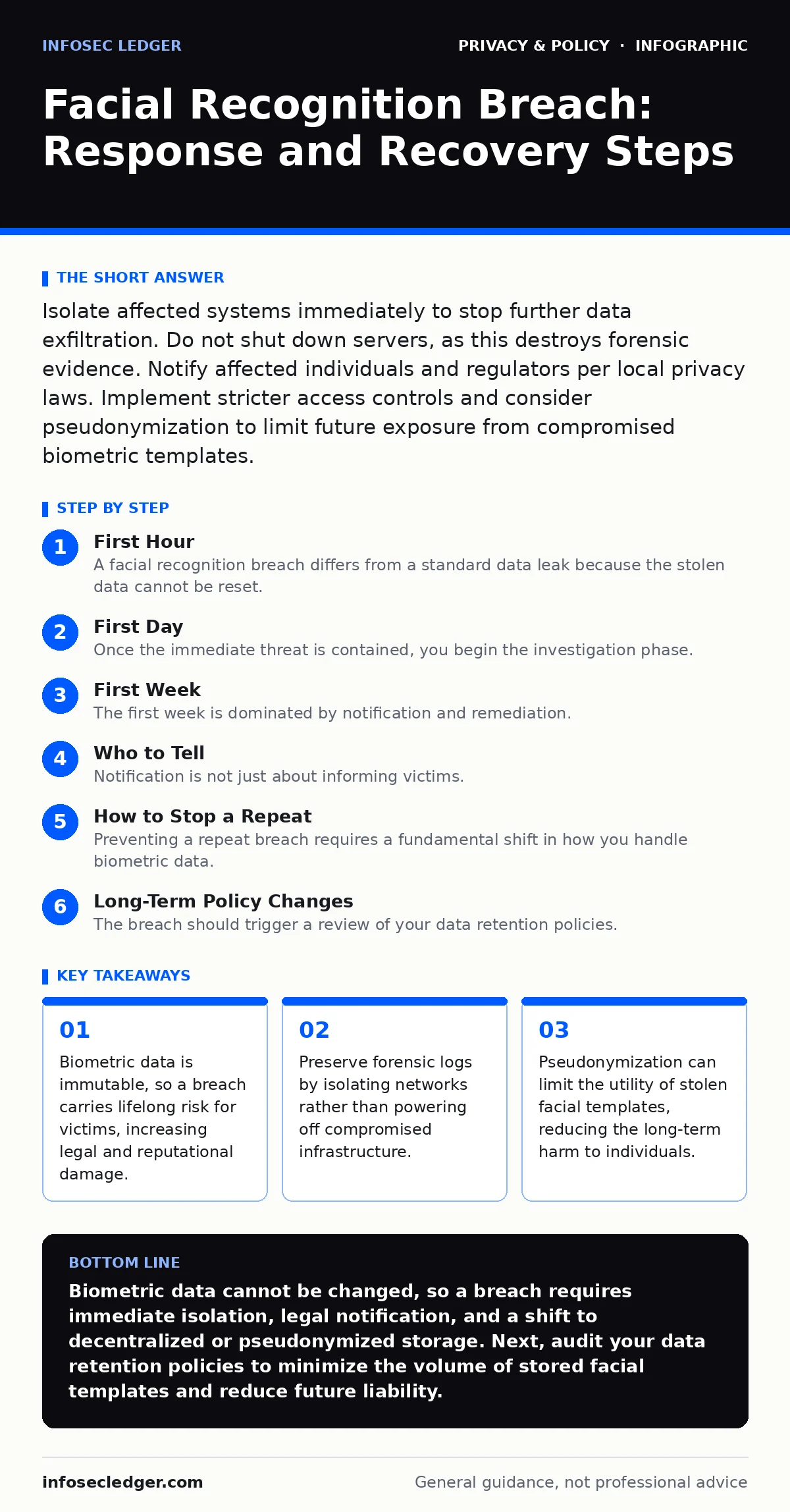
Isolate affected systems immediately to stop further data exfiltration. Do not shut down servers, as this destroys forensic evidence. Notify affected individuals and regulators per local privacy laws. Implement stricter access controls and consider pseudonymization to limit future exposure from compromised biometric templates.
First Hour
A facial recognition breach differs from a standard data leak because the stolen data cannot be reset. You cannot issue a new face to an employee or customer. This permanence changes your response strategy from damage control to permanent risk mitigation. The first priority is stopping the bleeding while preserving the ability to understand how the intrusion occurred.
- Identify the specific systems storing or processing facial templates.
- Disconnect those systems from the wider corporate network.
- Preserve current system logs and memory dumps.
- Notify internal legal and security leadership.
Containment is about creating boundaries. If the breach involves a cloud-based facial recognition service, revoke the API keys that grant access to the database. If the breach is on-premise, segment the VLANs that house the biometric servers. This prevents lateral movement where attackers use the compromised system to access other parts of your infrastructure.
You must determine the scope of the exposure. Check if raw images were stolen or just the mathematical templates derived from them. Raw images are more versatile for misuse but templates are sufficient for spoofing authentication systems. Knowing the data type dictates your next steps.
First Day
Once the immediate threat is contained, you begin the investigation phase. You need to understand the entry point. Was it a phishing attack that gave an attacker credentials? Was it a vulnerability in the facial recognition software itself? Or was it insider theft?
Engage a third-party forensic firm if your internal team lacks the specific expertise in biometric systems. They can analyze the breach without bias and provide a report that holds up in court. This report will be necessary for regulatory compliance and potential litigation.
You must also assess the integrity of your authentication systems. If the stolen templates can bypass your login screens, you must disable facial recognition as an authentication method immediately. Switch to alternative verification methods. For employees, this might mean using smart cards or PINs. For customers, it might mean reverting to traditional passwords or one-time codes.
Do not assume the breach is contained. Attackers often leave backdoors or secondary persistence mechanisms. Conduct a thorough scan of all connected devices. Look for unusual outbound traffic or new user accounts created during the breach window.
First Week
The first week is dominated by notification and remediation. You must inform affected individuals. Privacy laws like CCPA and other regional frameworks often mandate specific timelines for this notification. Delaying can result in significant fines and loss of trust.
Your notification must be clear and honest. Explain what data was taken, what it means, and what you are doing to protect them. Since facial data cannot be changed, you must offer long-term support. This might include identity monitoring services or credit protection, though these do not stop facial spoofing.
Simultaneously, you begin the technical recovery. Patch the vulnerabilities that allowed the breach. Update all facial recognition software to the latest version. Review and strengthen your access controls. Implement strict least-privilege access for anyone who can view or export biometric data.
Consider the long-term architecture of your biometric systems. Raw biometric data should never be stored in plain text. Use hashing and salting techniques to transform facial data into irreversible templates. Even better, use pseudonymization to detach the biometric data from personally identifiable information like names or employee IDs. This limits the damage if the database is breached again.
Who to Tell
Notification is not just about informing victims. You must also inform regulators, law enforcement, and potentially your cyber insurance provider. The specific entities vary by jurisdiction. In the United States, state attorneys general often need to be notified for data breaches involving residents.
Law enforcement may want to investigate if the breach involves criminal theft or espionage. Cooperate fully, but maintain control over your internal investigation to protect privileged information. Your legal counsel should guide this process to ensure you do not waive any legal protections.
If you use third-party services for facial recognition, they must also be notified. They may have their own security teams that can help identify the attack vector. They may also be required to notify their other clients if the breach affects shared infrastructure.
How to Stop a Repeat
Preventing a repeat breach requires a fundamental shift in how you handle biometric data. The centralization of facial recognition data is a single point of failure. Distribute the processing and storage if possible. On-device processing, where the facial template is stored locally on the user's phone or laptop, reduces the risk of a mass database breach.
Implement strict audit logging for all access to biometric data. Who accessed the database? When? Why? Monitor these logs for anomalies. Any bulk export or unusual access pattern should trigger an immediate alert.
Regularly test your security posture. Conduct penetration testing that specifically targets your biometric systems. Hire ethical hackers to try to spoof your facial recognition cameras or steal your templates. This proactive approach identifies weaknesses before criminals do.
See also: Privacy by Design Meaning: How to Embed Protection Early
Long-Term Policy Changes
The breach should trigger a review of your data retention policies. Do you need to store facial data forever? If not, implement automatic deletion schedules. Reduce the amount of data you hold to reduce the potential impact of a future breach.
Re-evaluate your use of facial recognition itself. Is it necessary for your business operations? If the risk outweighs the benefit, consider alternative authentication methods. For example, encrypted messaging apps often use device-based authentication that does not rely on centralized biometric databases.
Educate your staff on the risks of biometric data. They should understand that facial data is sensitive personal information. They should be trained to recognize phishing attempts and social engineering attacks that target access to biometric systems.
Recovery and Reputation
Recovering from a facial recognition breach is a long process. Trust takes years to build and seconds to break. Be transparent with your stakeholders. Share what you have learned and what you are doing to prevent future breaches.
Offer ongoing support to affected individuals. Monitor for signs of identity theft or unauthorized access to their accounts. Provide resources to help them secure their other digital identities. For example, remind them to use two-factor authentication for personal accounts to add an extra layer of security.
Learn from the incident. Update your incident response plan based on what worked and what did not. Conduct post-mortem reviews with your team to identify areas for improvement. Use the breach as a catalyst for strengthening your overall security posture.
Final Considerations
Facial recognition technology offers convenience but introduces unique risks. The immutability of biometric data means that a breach has lifelong consequences. Your response must reflect this seriousness.
Prioritize containment, preservation of evidence, and transparent communication. Invest in stronger security controls and consider alternative authentication methods. The goal is not just to recover from the breach, but to prevent it from happening again.
Remember that security is an ongoing process. There is no final state of "secure." You must continuously adapt to new threats and technologies. Stay informed about the latest developments in biometric security and privacy laws.
Key takeaways
- Biometric data is immutable, so a breach carries lifelong risk for victims, increasing legal and reputational damage.
- Preserve forensic logs by isolating networks rather than powering off compromised infrastructure.
- Pseudonymization can limit the utility of stolen facial templates, reducing the long-term harm to individuals.
Biometric data cannot be changed, so a breach requires immediate isolation, legal notification, and a shift to decentralized or pseudonymized storage. Next, audit your data retention policies to minimize the volume of stored facial templates and reduce future liability.
Frequently asked questions
Can I delete facial recognition data after a breach to stop hackers from using it?
Deleting the data from your servers does not remove it from the attacker's possession. They have already copied the data, so deletion only prevents further access from your side.
Does pseudonymization protect facial recognition data in a breach?
Pseudonymization removes direct identifiers like names, making it harder for attackers to link the biometric data to a specific person. It reduces the immediate harm but does not prevent the theft of the facial template itself.
Should I notify customers if only employee facial data was stolen?
Notification requirements depend on local privacy laws and the sensitivity of the data. If the data can be used to impersonate individuals or access systems, notification is often required regardless of employment status.
How long should I retain facial recognition logs after a breach?
Retain logs for as long as required by law and your insurance policy. These logs are critical for forensic analysis and legal defense. Do not delete them until the investigation is complete and legal hold periods have expired.
How this guide was produced: written by the InfoSec Ledger editorial team with AI assistance, checked against the public references listed below, and reviewed when the facts change. See our editorial policy or report an error.