
Threat Hunting Cyber Security: Proactive Detection That Alerts Miss
Manual threat hunting finds hidden compromises that automated tools ignore by searching for behavioral anomalies rather than known signatures.
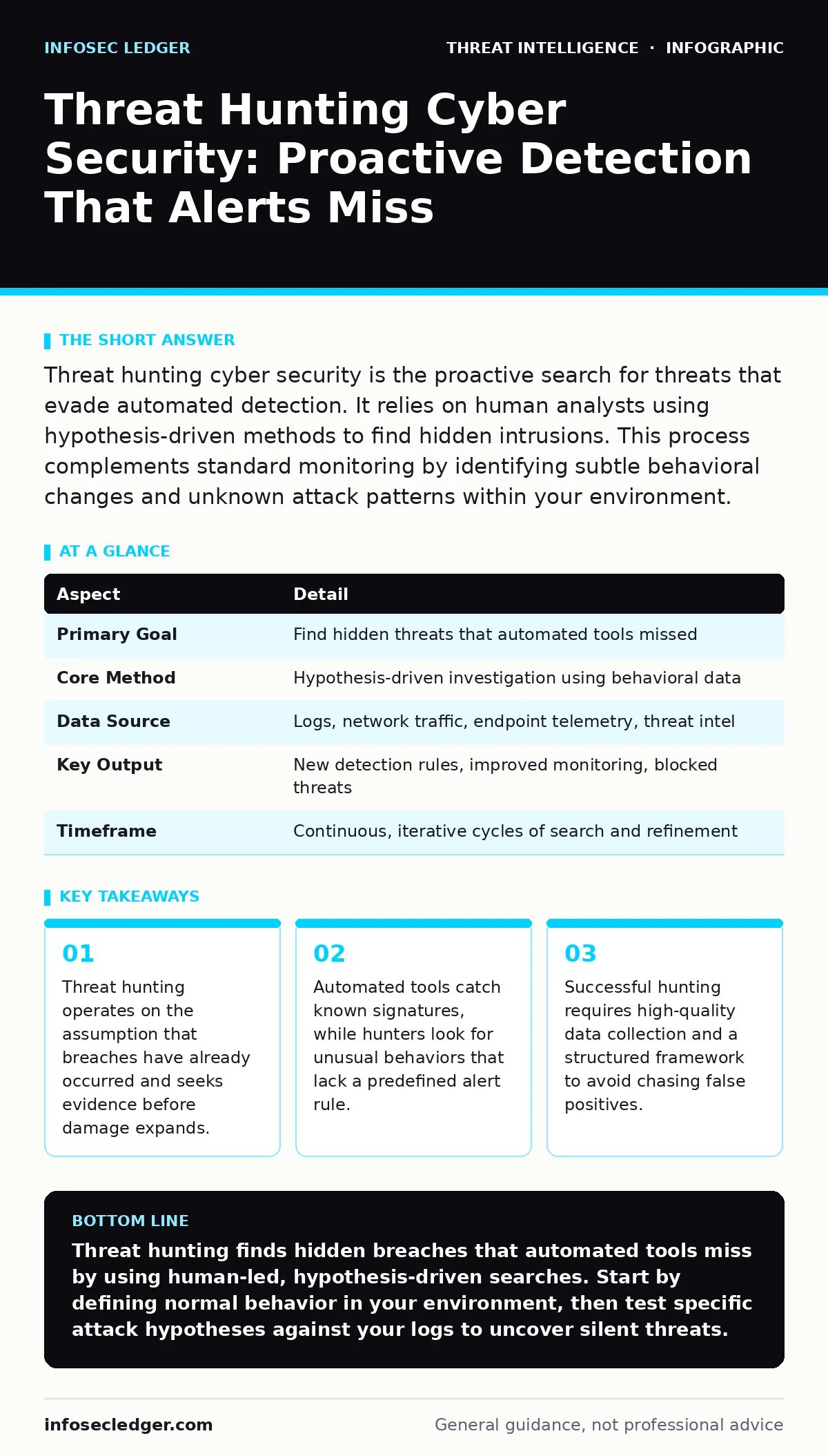
Threat hunting cyber security is the proactive search for threats that evade automated detection. It relies on human analysts using hypothesis-driven methods to find hidden intrusions. This process complements standard monitoring by identifying subtle behavioral changes and unknown attack patterns within your environment.
Everyday Analogy: The Difference Between Alarm and Patrol
Imagine a house with motion sensors. These sensors trigger an alarm when someone breaks a window. This is automated detection. Now imagine a security guard walking through the house at 3 a.m., looking for doors left slightly ajar or furniture moved from its usual place. This manual inspection is threat hunting. The guard does not wait for a break-in to signal them. They search for subtle signs that something is wrong, even if no alarm sounded. This distinction defines the core value of hunting in cyber security.
Threat hunting cyber security is the proactive, human-led search for threats that bypass automated defenses. It assumes an attacker is already inside the network. The goal is to find them before they achieve their objective. This approach shifts security from reactive incident response to proactive risk reduction. You stop waiting for tools to tell you about a problem. You actively look for the problem using context and intuition.
At a Glance: How Hunting Works
| Aspect | Detail |
|---|---|
| Primary Goal | Find hidden threats that automated tools missed |
| Core Method | Hypothesis-driven investigation using behavioral data |
| Data Source | Logs, network traffic, endpoint telemetry, threat intel |
| Key Output | New detection rules, improved monitoring, blocked threats |
| Timeframe | Continuous, iterative cycles of search and refinement |
Who It Affects and Why It Matters
You do not need a large security operations center to benefit from this practice. Small and medium-sized organizations often face fewer automated alerts, which can create a false sense of security. If your tools do not fire, you might assume you are safe. Threat hunting challenges this assumption. It reveals that silence can hide activity. Attackers often move slowly to avoid detection thresholds. This stealthy behavior requires a different lens than standard monitoring provides.
The impact extends beyond technical teams. Business leaders need to understand that hunting reduces dwell time. Dwell time is the period between intrusion and detection. Shorter dwell time limits data loss and financial damage. Hunting affects your entire security posture. It forces you to improve data collection. It drives you to understand your normal environment better. You cannot find anomalies if you do not know what normal looks like.
The Mechanics of Hypothesis-Driven Search
Effective hunting follows a structured process. It begins with a hypothesis. A hypothesis is an educated guess about how an attacker might operate. You might suspect that an insider is exfiltrating data via encrypted channels. You then gather relevant data to test this idea. This data comes from log management systems and network monitors. You analyze the data for patterns that support or refute the guess. If you find evidence, you investigate further. If not, you refine the hypothesis and try again.
This cycle mirrors the intelligence cycle. It turns raw data into actionable insights. Unlike automated tools that match known bad indicators, hunters look for deviations. A user logging in from a new country at an odd hour might trigger an alert. A user logging in from a usual location but accessing files they never touch is a hunting target. The latter is harder for machines to flag without complex behavior analytics. Human judgment fills this gap.
Common Mistakes in Threat Hunting
Many organizations make critical errors when starting this practice. The first mistake is hunting without a plan. Analysts may scroll through logs randomly, hoping to find something bad. This is inefficient and leads to burnout. You must have a specific hypothesis and a clear data source. Without focus, you waste time on noise. The second mistake is ignoring baseline behavior. You cannot identify anomalies without knowing your environment's normal state. If every user downloads large files regularly, a large download is not suspicious.
A third error is failing to act on findings. Finding a threat is useless if you do not remediate it. You must have a clear path from discovery to containment. This links hunting directly to incident response. Another hidden cost is data quality. If your logs are incomplete or poorly formatted, hunting becomes impossible. You cannot analyze what you do not collect. This often reveals gaps in your infrastructure. Fixing these gaps is a prerequisite for effective hunting.
See also: Cloud Cryptojacking: Warning Signs and Immediate Response Steps · Cyber Insurance for Small Teams: Coverage Gaps and Cost Control
What People Usually Get Wrong
People often confuse threat hunting with monitoring. Monitoring is passive; it waits for events. Hunting is active; it seeks events. This distinction matters for resource allocation. Monitoring requires tools. Hunting requires skilled analysts and good data. Another misconception is that hunting replaces automated detection. It does not. It complements it. Automated tools handle the volume. Hunting handles the nuance. They work together.
Some believe that hunting is only for advanced persistent threats. This is false. Simple malware and insider threats also evade detection. Any threat that does not match a known signature is a candidate for hunting. The MITRE ATT&CK framework helps here. It provides a catalog of tactics and techniques. Hunters use this framework to structure their hypotheses. They ask, "What would an attacker using this technique look like?" This keeps hunting focused and relevant.
Integrating Hunting with Your Security Stack
Threat hunting is not an isolated activity. It feeds back into your defenses. When hunters find a new pattern, they create detection rules for it. This is detection engineering. It turns manual findings into automated alerts. The next time that pattern appears, the tool catches it. This closes the loop. Hunting improves monitoring. Monitoring frees up hunters to look for new things. This synergy strengthens your overall posture.
You should also consider security metrics. Measure your hunt outcomes. Track the number of hypotheses tested, the time to detect, and the number of new rules created. These metrics prove value. They show that hunting is not just a cost center. It is an investment in resilience. By quantifying results, you can justify resources and improve processes. Continuous improvement is key. The threat environment changes. Your hunting must change with it.
Key takeaways
- Threat hunting operates on the assumption that breaches have already occurred and seeks evidence before damage expands.
- Automated tools catch known signatures, while hunters look for unusual behaviors that lack a predefined alert rule.
- Successful hunting requires high-quality data collection and a structured framework to avoid chasing false positives.
Threat hunting finds hidden breaches that automated tools miss by using human-led, hypothesis-driven searches. Start by defining normal behavior in your environment, then test specific attack hypotheses against your logs to uncover silent threats.
Frequently asked questions
Do I need a dedicated team for threat hunting?
You do not need a large team to start. One skilled analyst can begin with focused hypotheses. As you mature, you can expand resources or integrate hunting into existing monitoring roles.
How is threat hunting different from penetration testing?
Penetration testing is a simulated attack to find vulnerabilities. Threat hunting is a search for actual intrusions that have already occurred. Testing looks for weaknesses; hunting looks for evidence of compromise.
Can automated tools replace human threat hunters?
No. Automated tools excel at known patterns and high-volume data. They struggle with context and novel behavior. Human hunters provide the intuition and flexibility needed to find unknown threats that machines miss.
What data is most important for threat hunting?
Endpoint logs, network traffic, and identity logs are critical. These sources provide visibility into user actions, system changes, and communication patterns. Without comprehensive data collection, hunting is limited.
How this guide was produced: written by the InfoSec Ledger editorial team with AI assistance, checked against the public references listed below, and reviewed when the facts change. See our editorial policy or report an error.