
What Is MITRE ATT&CK Framework Used For: Practical Defense Mapping
The framework maps adversary behavior rather than specific tools, allowing you to detect attacks even when criminals change their software or techniques.
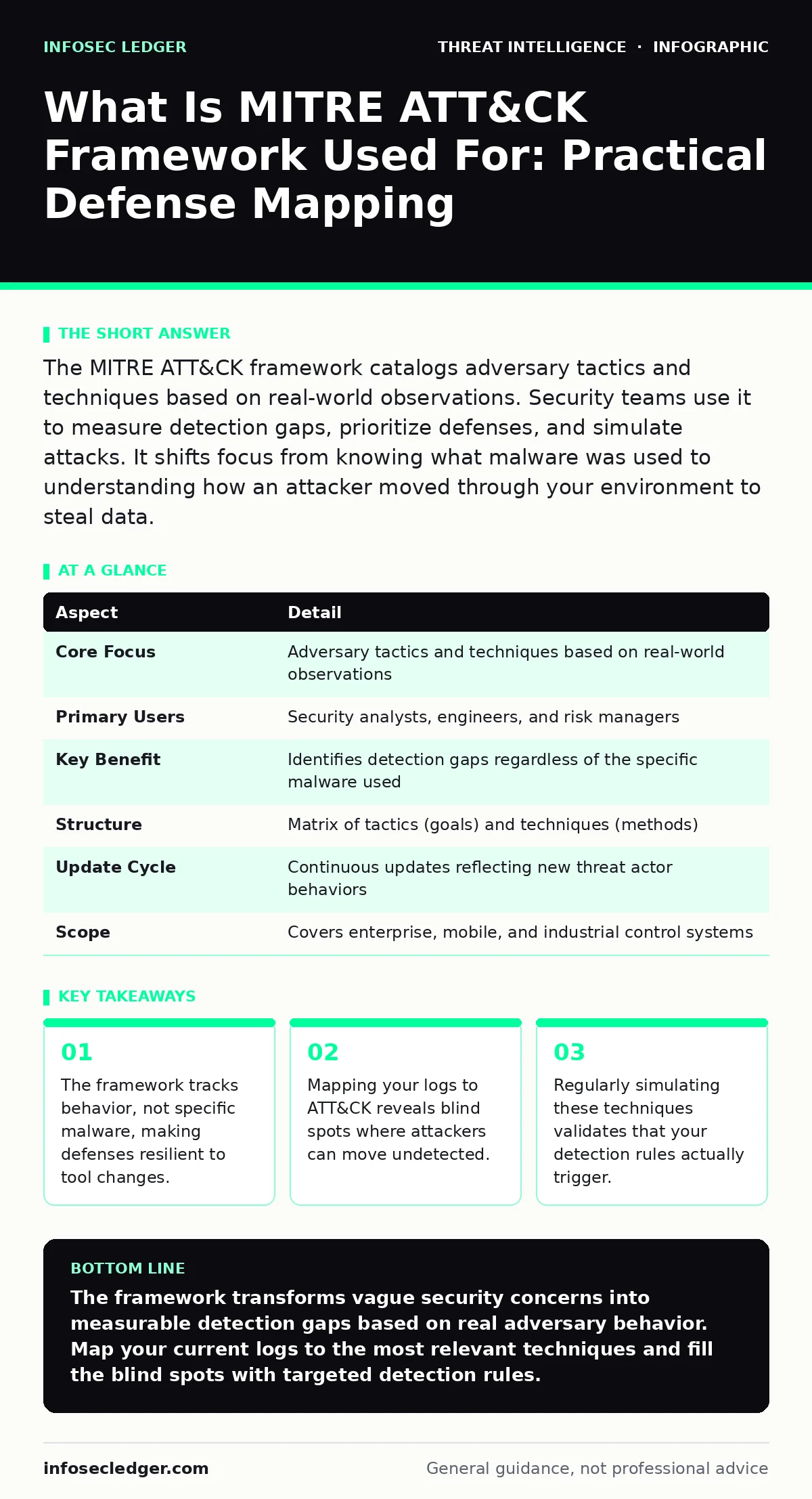
The MITRE ATT&CK framework catalogs adversary tactics and techniques based on real-world observations. Security teams use it to measure detection gaps, prioritize defenses, and simulate attacks. It shifts focus from knowing what malware was used to understanding how an attacker moved through your environment to steal data.
What Is MITRE ATT&CK Framework Used For
The MITRE ATT&CK framework is used for structuring cyber defense around observed adversary behaviors rather than specific malware signatures. It provides a shared language for describing how attackers operate across different stages of an intrusion.
Imagine a bank robbery where police only track the type of gun used. If the robber switches weapons, the system fails. Now imagine tracking the act of forcing open a door, tying up staff, and emptying vaults. The specific tool changes, but the behavior remains detectable. This framework does the same for digital intrusions. It catalogs the steps attackers take, from initial access to data exfiltration, allowing you to build defenses that catch the method, not just the tool.
| Aspect | Detail |
|---|---|
| Core Focus | Adversary tactics and techniques based on real-world observations |
| Primary Users | Security analysts, engineers, and risk managers |
| Key Benefit | Identifies detection gaps regardless of the specific malware used |
| Structure | Matrix of tactics (goals) and techniques (methods) |
| Update Cycle | Continuous updates reflecting new threat actor behaviors |
| Scope | Covers enterprise, mobile, and industrial control systems |
How the Framework Structures Behavior
The framework organizes attack steps into two layers: tactics and techniques. A tactic represents the attacker’s goal, such as gaining initial access or maintaining persistence. A technique is the specific method used to achieve that goal, such as sending a phishing email or disabling security software.
This separation matters because attackers often reuse tactics while changing techniques. If you only block one specific phishing template, the attacker simply changes the subject line. If you detect the behavior of a user clicking a malicious link and executing a script, you catch the broader pattern. The framework forces you to think about the "why" and "how" of the intrusion, not just the "what."
You map your existing security controls to these techniques. If you have a rule that detects credential dumping, you note which ATT&CK technique ID it covers. You then look for techniques with no corresponding rule. Those are your blind spots. This process turns a vague sense of insecurity into a concrete list of missing detections.
Who Uses This Knowledge
Security analysts use the framework to prioritize alerts. Not all techniques are equally dangerous or likely. By understanding which tactics matter most to your industry, you focus resources on the paths attackers actually take.
Detection engineers use it to write better rules. Instead of guessing what to look for, they reference specific techniques known to be used against their sector. They test these rules against simulations to ensure they trigger correctly. This ties directly into detection engineering, where the goal is to create reliable, low-noise alerts for specific behaviors.
Risk managers use the framework to communicate risk to leadership. Saying "we are vulnerable to phishing" is vague. Saying "we lack detection for the 'Valid Accounts' technique used in initial access" is specific. It shows exactly where the organization is exposed and what investment is needed to close that gap.
Measuring Detection Coverage
The primary operational use of the framework is to measure what you can see versus what you cannot. You create a coverage map by listing every technique relevant to your platform and marking whether you have a detection for it.
Most organizations discover they have excellent coverage for initial access but poor coverage for lateral movement. Attackers often move sideways through a network using legitimate administrative tools. If your logs do not capture command-line arguments or process lineage, you are blind to this movement. This is where log management becomes critical. You must collect the right data to map to the right techniques.
This mapping is not a one-time task. Attackers evolve, and new techniques are added to the framework regularly. You must review your coverage quarterly. When a new technique emerges, assess if it applies to your environment. If it does, build a detection or accept the risk. This continuous improvement cycle ensures your defenses stay aligned with current threats.
What People Usually Get Wrong
Many teams treat the framework as a checklist to be completed. They assume that having a detection for every technique means they are secure. This is a dangerous misconception. Having a rule that triggers is not the same as having a rule that is accurate.
A common error is mapping a generic alert to a specific technique without validation. If your firewall logs all outbound traffic, you might claim coverage for "Exfiltration Over C2 Channel." But if you cannot distinguish normal cloud backups from stolen data, your detection is useless. You are detecting noise, not the specific attack behavior. This leads to alert fatigue, where analysts ignore warnings because they are rarely true positives.
Another mistake is ignoring the Pyramid of Pain. This concept suggests that detecting high-level artifacts like file hashes is easy but easy for attackers to change. Detecting behaviors and tactics is harder for you but much harder for attackers to change. Focusing only on the bottom of the pyramid gives a false sense of security. You must aim higher, targeting behaviors that require significant effort for attackers to modify.
See also: How Detection Engineering Works: From Data to Alert · Threat Hunting Cyber Security: Proactive Detection That Alerts Miss
Integrating With Threat Hunting
Proactive threat hunting relies heavily on the framework. Instead of waiting for an alert, hunters formulate hypotheses based on specific techniques. They ask, "If an attacker used this technique, what would it look like in our logs?"
This approach shifts security from reactive to proactive. You are not just defending against known malware; you are searching for the footprints of known behaviors. This is particularly effective for finding advanced threats that bypass automated defenses. By using the framework as a guide, hunters ensure they are looking for relevant indicators rather than random anomalies.
This process also feeds back into your detection engineering. When a hunter finds a new way an attacker is hiding, they can create a new detection rule. This closes the loop, improving your automated defenses based on real-world investigation. It turns individual investigations into organizational knowledge.
Building a Sustainable Program
Sustaining a framework-based defense requires discipline. You must align your intelligence cycle with the framework. When you ingest threat intelligence, map it to ATT&CK techniques. This allows you to aggregate data from multiple sources and see which techniques are trending.
Do not try to detect everything. Focus on the techniques that matter for your specific environment. A hospital cares about ransomware persistence; a startup cares about data theft. Tailor your coverage to your risk profile. This prioritization prevents burnout and ensures resources are spent where they provide the most protection.
Regularly test your detections. Use network scanning and simulation tools to trigger the behaviors you expect to catch. If the simulation does not generate an alert, your detection is broken. Fix it before an attacker exploits the gap. This validation step is the difference between having a paper defense and a working one.
Key takeaways
- The framework tracks behavior, not specific malware, making defenses resilient to tool changes.
- Mapping your logs to ATT&CK reveals blind spots where attackers can move undetected.
- Regularly simulating these techniques validates that your detection rules actually trigger.
The framework transforms vague security concerns into measurable detection gaps based on real adversary behavior. Map your current logs to the most relevant techniques and fill the blind spots with targeted detection rules.
Frequently asked questions
Do I need to use the framework if I already have antivirus software?
Yes, because antivirus focuses on known malware signatures. The framework helps you detect new or modified malware by identifying the behaviors it exhibits, which signatures often miss.
How often should I update my ATT&CK coverage map?
You should review your coverage quarterly or whenever a significant new threat emerges. Continuous updates ensure your defenses keep pace with evolving adversary tactics and new techniques.
Can small organizations benefit from using this framework?
Absolutely. Small teams should focus on the top 10-15 techniques most relevant to their industry. This prioritization allows limited resources to protect against the most likely and damaging attack paths.
Is the framework free to use?
Yes, the MITRE ATT&CK framework is open and free for everyone. You can access the data, matrices, and documentation without any licensing fees or restrictions.
How this guide was produced: written by the InfoSec Ledger editorial team with AI assistance, checked against the public references listed below, and reviewed when the facts change. See our editorial policy or report an error.