
How Detection Engineering Works: From Data to Alert
Detection engineering reveals that most alerts fail not because of missing tools, but because the underlying data lacks the context needed to distinguish noise from noise.
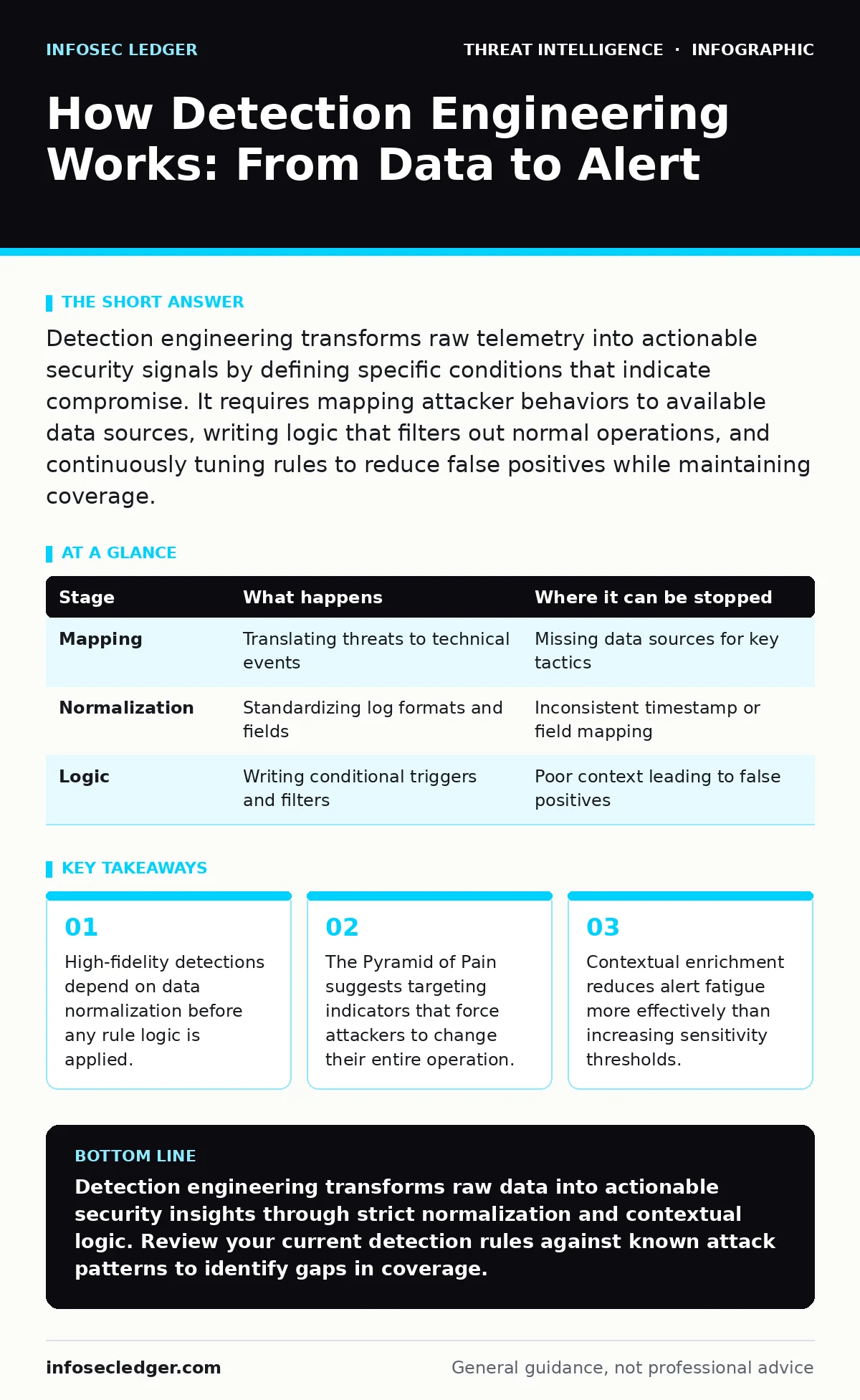
Detection engineering transforms raw telemetry into actionable security signals by defining specific conditions that indicate compromise. It requires mapping attacker behaviors to available data sources, writing logic that filters out normal operations, and continuously tuning rules to reduce false positives while maintaining coverage.
The Foundation of Observable Behavior
Detection engineering begins long before you write a single rule. It starts with the data you collect. Many organizations assume that having logging enabled is sufficient. This assumption leads to a false sense of security. The data often lacks the necessary fields to answer basic questions about who did what, where, and when.
You must first define what "normal" looks like in your environment. Without a baseline, every deviation appears suspicious, creating noise that drowns out real threats. This process requires understanding your application architecture and user workflows. If you do not know how your software communicates, you cannot detect when an attacker interrupts that communication.
Consider how log management systems aggregate data. If the logs arrive in inconsistent formats, your detection rules will fail to parse them correctly. Standardization is the invisible prerequisite for accurate detection. You must map every potential attack vector to a specific data source that can record it.
Stage 1: Attack Pattern Mapping
The first formal stage involves translating abstract threats into concrete technical actions. You cannot detect "malicious intent." You can only detect specific sequences of events that correlate with known malicious techniques. This requires breaking down high-level risks into granular behaviors.
For example, instead of looking for "ransomware," you look for rapid file encryption events followed by service shutdowns. This mapping process forces you to think like an operator, not just a defender. You identify the specific system calls, registry changes, or network packets that an attacker must generate to succeed.
This stage often reveals gaps in your data collection. You may realize you are not capturing the specific event needed to detect a certain tactic. If you cannot observe the action, you cannot detect it. This realization drives infrastructure changes, not just rule writing. It shifts the focus from tool configuration to data architecture.
Stage 2: Data Ingestion and Normalization
Once you know what to look for, you must ensure the data is usable. Raw logs from different vendors use different field names and timestamp formats. A Windows event log looks nothing like a firewall syslog. This inconsistency breaks detection logic that expects uniform inputs.
Normalization maps these disparate fields into a common schema. You convert "src_ip" and "sourceAddress" into a single, consistent field name. You standardize time zones and severity levels. This step is computationally expensive but necessary for scalable detection. Without it, you must write separate rules for every vendor’s format, which is unsustainable.
Stage 3: Rule Logic and Context Application
With normalized data, you write the logic that triggers an alert. Simple threshold rules are easy to write but prone to false positives. A rule that alerts on "more than 10 failed logins" will trigger for password sprays and for users who forget their passwords. Both generate the same signal.
Context is the filter that separates these scenarios. You enrich the event with additional data, such as user role, geographic location, or time of day. A failed login from a known internal IP during business hours is less suspicious than one from a new country at 3 AM. This enrichment adds complexity but significantly improves precision.
This stage also involves defining the scope of the detection. You must decide which assets are in scope. Applying enterprise-wide rules to personal devices often generates noise that masks critical alerts. You tailor the logic to the risk profile of the specific environment.
| Stage | What happens | Where it can be stopped |
|---|---|---|
| Mapping | Translating threats to technical events | Missing data sources for key tactics |
| Normalization | Standardizing log formats and fields | Inconsistent timestamp or field mapping |
| Logic | Writing conditional triggers and filters | Poor context leading to false positives |
Stage 4: Validation and Tuning
A detection rule is never finished when it is deployed. It is a hypothesis that must be tested against real traffic. You run the rule against historical data to see how many alerts it generates. If the number is too high, the rule is too broad. If it is zero, the rule may be too narrow or the data is missing.
Tuning involves adjusting thresholds and adding exclusions. You identify legitimate activities that mimic the attack pattern and add them to an allow list. This process is iterative. As your environment changes, so do the false positives. You must revisit rules regularly to ensure they remain accurate.
This stage highlights a hidden cost: analyst time. Every false positive consumes attention that could be spent on real incidents. Poorly tuned rules erode trust in the security team. If analysts see too many bogus alerts, they begin to ignore the dashboard entirely. This "alert fatigue" is a critical failure mode.
See also: What Is MITRE ATT&CK Framework Used For: Practical Defense Mapping · Implementing ISACs: A Practical Framework for Shared Defense
The Limits of Automated Detection
Detection engineering has inherent limitations. It relies on known patterns and observable behaviors. It struggles with novel attacks that do not follow established techniques. If an attacker uses a new method that leaves no trace in your logs, no rule can catch it.
Furthermore, detection is reactive to some extent. You are detecting actions that have already occurred. You cannot prevent the initial compromise if the attacker uses valid credentials. This is why understanding credential dumping techniques is vital; if attackers steal hashes, your login-based detections become irrelevant.
You must also consider the Pyramid of Pain. Detecting simple indicators, like file hashes, is easy for attackers to change. Detecting complex behaviors, like specific command sequences, is harder for them to alter. Focusing on high-pain indicators increases the cost for attackers, but it also requires more sophisticated detection logic.
Integrating Intelligence for Depth
Raw detection rules operate in isolation. To improve accuracy, you must integrate external intelligence. This allows you to correlate internal events with global threat data. If an internal IP connects to a domain known for malware distribution, the detection becomes high-confidence.
This integration connects your local environment to broader threat intelligence platforms. These platforms aggregate data from many sources, providing context that a single organization cannot generate alone. They help you identify if a local event is part of a wider campaign.
However, intelligence is only as good as its freshness. Outdated indicators create noise. You must validate the relevance of external data to your specific environment. Not every global threat is relevant to your industry or technology stack. Filtering this intelligence is part of the engineering process.
Sustaining the Detection Lifecycle
Detection engineering is not a one-time project. It is a continuous cycle of observation, hypothesis, testing, and refinement. As attackers evolve, your detections must evolve with them. You must regularly review your rule set to identify gaps and redundancies.
This requires a feedback loop from incident response. When analysts investigate an alert, their findings should inform rule improvements. If an alert turned out to be benign, the rule needs tuning. If it missed a real attack, the logic needs expansion. This feedback ensures that your detection posture improves over time.
You should also consider emerging threats like voice cloning scams. While these are social engineering attacks, they often leave digital footprints in email or communication logs. Adapting your detection logic to catch unusual communication patterns can help mitigate these risks.
Conclusion of the Engineering Process
The final output of detection engineering is not just a list of rules. It is a system that reliably signals compromise. This system reduces the time to detect and respond to threats. It provides visibility into the dark corners of your network.
However, it does not guarantee security. It shifts the advantage by making attacks more visible. You must combine detection with other controls, such as network scanning for vulnerabilities and user training for social engineering. Detection is one layer in a deeper defense strategy.
Remember that logic bombs and other delayed attacks may evade immediate detection. You must have long-term retention and periodic review processes to catch these slower-moving threats. The engineering process must account for both immediate and delayed risks.
Key takeaways
- High-fidelity detections depend on data normalization before any rule logic is applied.
- The Pyramid of Pain suggests targeting indicators that force attackers to change their entire operation.
- Contextual enrichment reduces alert fatigue more effectively than increasing sensitivity thresholds.
Detection engineering transforms raw data into actionable security insights through strict normalization and contextual logic. Review your current detection rules against known attack patterns to identify gaps in coverage.
Frequently asked questions
What is the difference between detection engineering and threat hunting?
Detection engineering builds automated rules to find known patterns, while threat hunting is a proactive, manual search for hidden threats that may not trigger any existing rules.
How do I reduce false positives in my detection rules?
Add context to your rules, such as user role or time of day, and tune thresholds based on historical data to filter out normal operational noise.
Can detection engineering stop zero-day attacks?
It can detect the behavior of a zero-day attack if the behavior is observable and matches a known pattern, but it cannot predict or prevent unknown code execution.
Why is data normalization so important for detection?
Normalization ensures that data from different sources uses consistent field names and formats, allowing a single rule to analyze events across the entire environment.
How this guide was produced: written by the InfoSec Ledger editorial team with AI assistance, checked against the public references listed below, and reviewed when the facts change. See our editorial policy or report an error.