
Log Management: The Hidden Cost of Visibility and When to Stop
Keeping logs forever increases your attack surface and legal liability while providing diminishing returns for incident response.
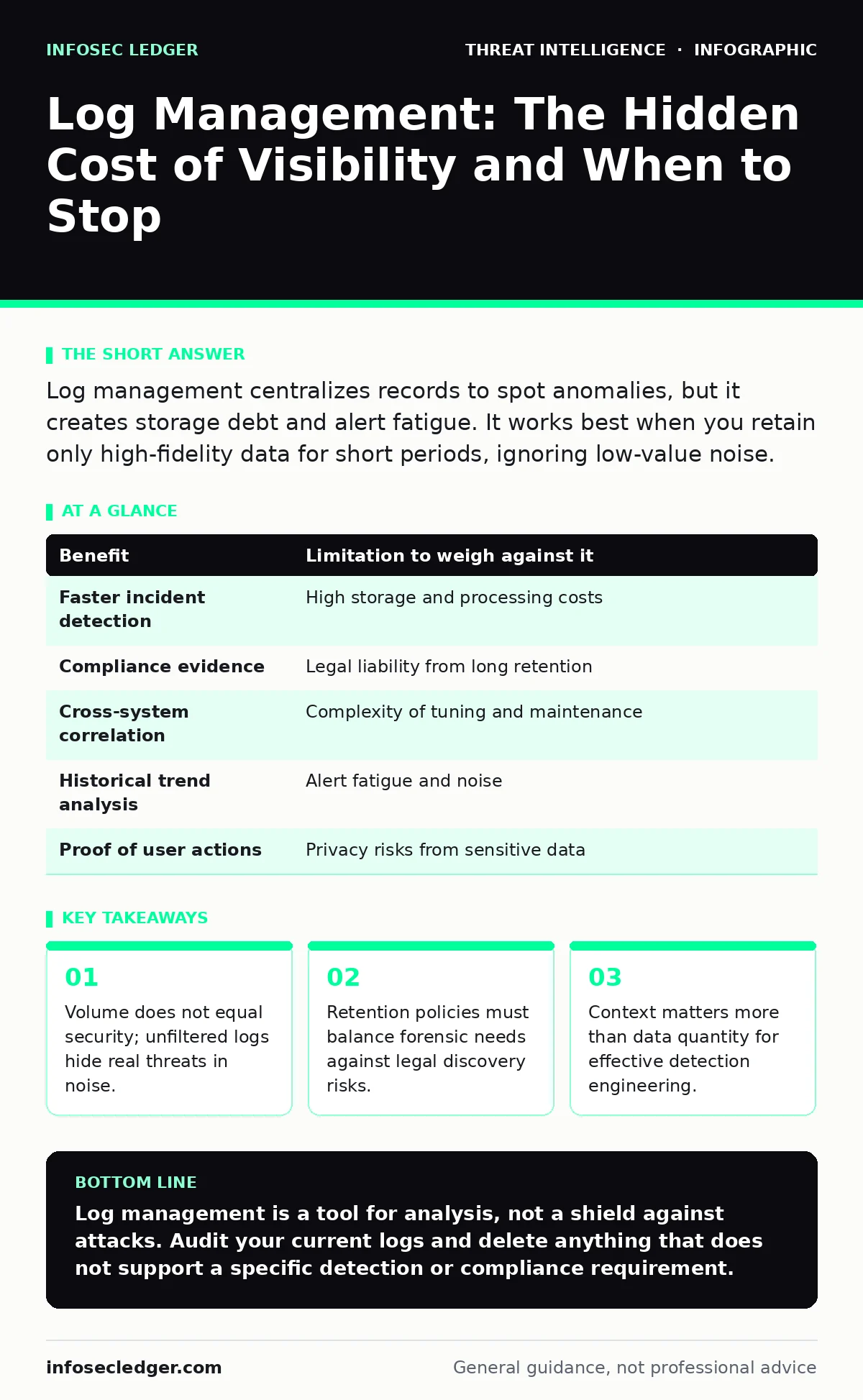
Log management centralizes records to spot anomalies, but it creates storage debt and alert fatigue. It works best when you retain only high-fidelity data for short periods, ignoring low-value noise.
The Illusion of Total Visibility
You assume that recording every action provides safety. This assumption is dangerous. Collecting raw data without context creates a false sense of security. You have more records, but you understand less about what is happening.
Imagine a server that generates ten million lines of text daily. Most of these lines are routine system checks. They add no value. They only consume storage and processing power. When a real breach occurs, finding the signal in this noise becomes nearly impossible.
This is why detection engineering focuses on quality over quantity. You must parse logs to extract meaningful events. You must correlate these events across different systems. Raw logs are just text. Processed logs are evidence.
The Storage Debt and Legal Risk
Every log you keep is a liability. Attackers know that long-term storage often lacks the same access controls as live systems. They target archives to find historical credentials or network maps.
Legal teams also view logs as evidence. In a dispute, you must produce all relevant records. If you kept everything, you produce everything. This includes private user data, internal communications, and system configurations.
This exposure creates legal risk. You may violate privacy regulations by holding data longer than necessary. You may also face higher costs during discovery. The cost of storing useless data exceeds the benefit of having it.
Alert Fatigue and Human Limits
Security teams have a limited capacity for attention. When you send every log entry to a dashboard, you create noise. Operators stop looking at the screen. They ignore alerts because most are false positives.
This phenomenon is called alert fatigue. It leads to missed detections. The serious event gets lost among hundreds of routine warnings. You are not protected by the volume of data. You are protected by the relevance of the alerts.
To fix this, you must tune your rules. You must suppress known benign activities. You must group related events into single incidents. This requires constant effort. It is not a set-and-forget task.
The Pyramid of Pain in Practice
Not all logs are equal. Some data is easy for attackers to change or hide. Other data is hard to alter. This concept is known as the Pyramid of Pain.
Low on the pyramid are file hashes and IP addresses. Attackers change these easily. They use new files and rotate IP ranges. High on the pyramid are attacker tactics and techniques. These are hard to change.
You should prioritize logging that captures high-pain indicators. Focus on user behavior, process creation, and registry changes. Ignore low-value data like routine HTTP requests. This approach makes your detection engineering more effective. It forces attackers to change their methods, not just their tools.
When It Is Worth It
Log management is worth the effort when you have specific compliance needs. Regulations often require proof of access and changes. You need centralized logs to prove who did what and when.
It is also worth it for complex environments. If you have many servers and applications, you cannot monitor each one individually. Centralization allows you to spot patterns across the entire infrastructure.
Finally, it is worth it if you have the staff to analyze the data. Logs are useless if no one reads them. You need people who can interpret the signals. Without analysis, you are just storing paper.
See also: Data Residency Explained: Where Your Files Actually Live · Threat Hunting Cyber Security: Proactive Detection That Alerts Miss
When It Is Not
Log management is not worth it if you cannot define what you are looking for. If you do not have use cases, you are collecting data for data's sake. This is a waste of resources.
It is also not worth it if you lack the budget for proper tools. Free tools often lack the parsing and correlation capabilities needed. You end up with a mess of unstructured text. This is worse than no logs at all.
If you are a small organization with simple needs, basic monitoring may suffice. You do not need a full-scale log management platform. You need to know when your systems go down or when someone logs in from a new location.
The Trade-Off Table
You must weigh benefits against limitations. Here is how to balance your strategy.
| Benefit | Limitation to weigh against it |
|---|---|
| Faster incident detection | High storage and processing costs |
| Compliance evidence | Legal liability from long retention |
| Cross-system correlation | Complexity of tuning and maintenance |
| Historical trend analysis | Alert fatigue and noise |
| Proof of user actions | Privacy risks from sensitive data |
Beyond Default Credentials
Many breaches start with weak access controls. Logging helps you spot failed login attempts. But it does not stop them. You must also address root causes.
Default credentials are a common entry point. Attackers scan for these easily. Your logs will show successful logins, but the damage is already done. You need to change defaults before they are used.
Similarly, credential dumping techniques bypass passwords. Attackers steal memory hashes. Logs may show process creation, but not the theft itself. You need additional controls like file integrity monitoring.
This is why log retention policies must be smart. Keep high-value logs longer. Delete low-value logs quickly. This balances cost, risk, and utility.
Key takeaways
- Volume does not equal security; unfiltered logs hide real threats in noise.
- Retention policies must balance forensic needs against legal discovery risks.
- Context matters more than data quantity for effective detection engineering.
Log management is a tool for analysis, not a shield against attacks. Audit your current logs and delete anything that does not support a specific detection or compliance requirement.
Frequently asked questions
How long should I keep my logs?
Keep logs long enough to meet compliance requirements and investigate incidents, usually three to six months, but no longer unless legally required.
What is the most important log to keep?
Identity and access logs are the most valuable because they show who accessed your systems and when.
Do I need a SIEM tool?
You need a tool that can parse and correlate logs. A SIEM is one option, but simpler tools may suffice for small environments.
How do I reduce alert fatigue?
Tune your rules to suppress known benign activities and group related events into single incidents.
How this guide was produced: written by the InfoSec Ledger editorial team with AI assistance, checked against the public references listed below, and reviewed when the facts change. See our editorial policy or report an error.