
Default Credentials: Why They Persist and How to Eliminate Them
Default credentials remain the leading cause of initial access because manufacturers prioritize ease of deployment over security during the product lifecycle.
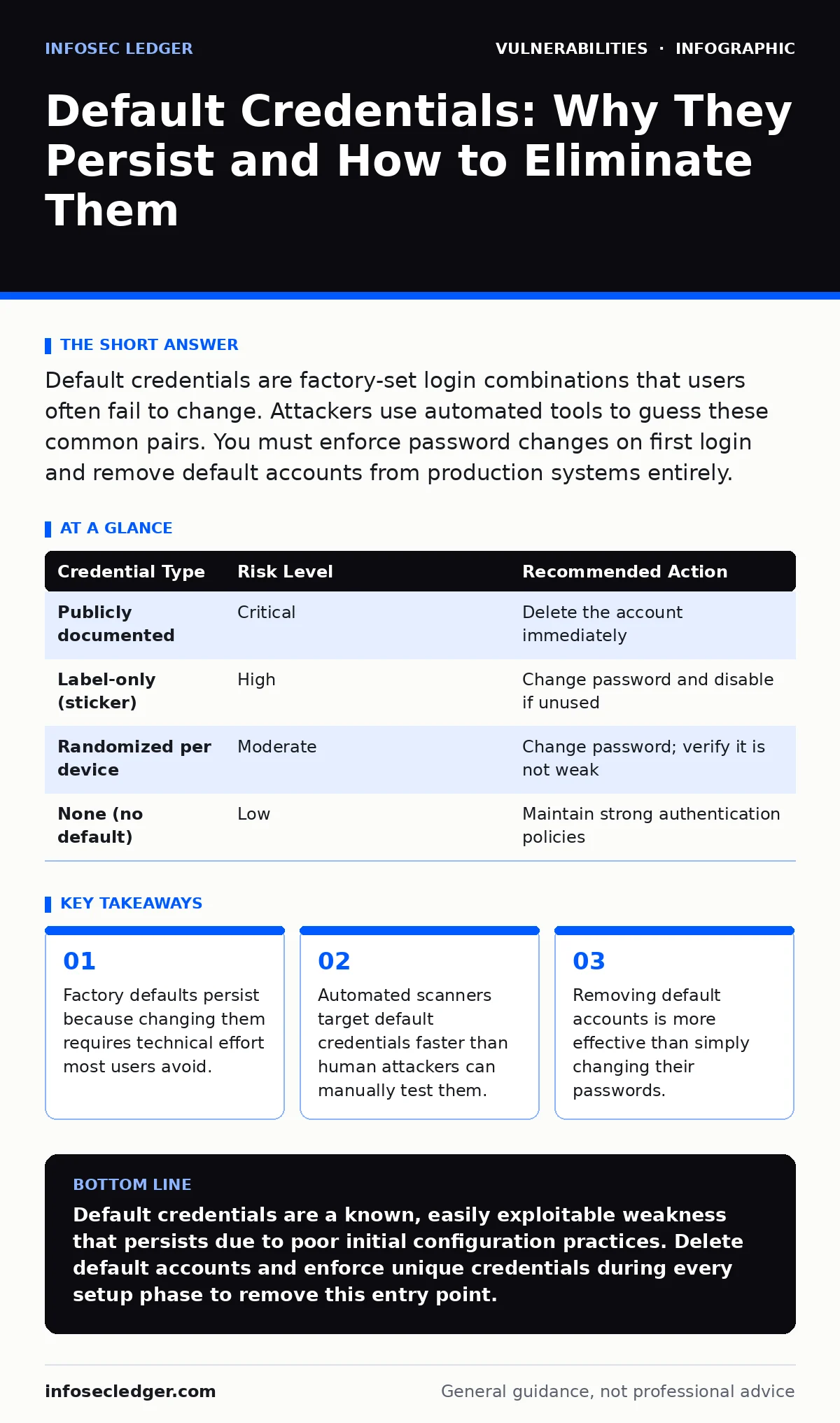
Default credentials are factory-set login combinations that users often fail to change. Attackers use automated tools to guess these common pairs. You must enforce password changes on first login and remove default accounts from production systems entirely.
What exactly are default credentials?
Default credentials are the username and password combinations pre-installed by manufacturers on hardware or software. These include simple pairs like "admin" and "password" or device-specific codes printed on labels. They exist to allow initial setup and factory testing before the product reaches you.
Why do manufacturers ship products with known passwords?
Manufacturers prioritize ease of setup and cost reduction over security in the early product lifecycle. Changing defaults requires documentation, user education, and often a more complex initial configuration screen. This design choice assumes the end user will secure the device, a assumption that rarely holds in practice.
How do attackers find these credentials so quickly?
Attackers use automated scanners that probe networks for devices responding to known default login attempts. These tools cycle through thousands of common username and password pairs in seconds. They do not need to guess; they simply check if the factory setting is still active.
What happens when a default account is left active?
An active default account provides immediate, valid access to anyone who knows the credentials. Since these pairs are public knowledge, there is no secrecy to protect. This bypasses all other security measures, rendering firewalls and encryption ineffective for that specific entry point.
Does changing the password eliminate the risk?
Changing the password mitigates the risk but does not remove the underlying vulnerability of the default account itself. If the account retains administrative privileges, it remains a high-value target for brute-force attacks. It is safer to disable or delete the default account entirely after initial setup.
| Credential Type | Risk Level | Recommended Action |
|---|---|---|
| Publicly documented | Critical | Delete the account immediately |
| Label-only (sticker) | High | Change password and disable if unused |
| Randomized per device | Moderate | Change password; verify it is not weak |
| None (no default) | Low | Maintain strong authentication policies |
Can I rely on network segmentation for protection?
Network segmentation limits the spread of an attack but does not prevent the initial compromise. If a device with default credentials sits on a monitored network, attackers can still pivot to other systems. Segmentation is a containment strategy, not a prevention method for authentication failures.
Why do default credentials persist on IoT devices?
Internet of Things (IoT) devices often lack a user interface for changing settings. Manufacturers may hardcode credentials into the firmware to ensure remote management capabilities. This creates a persistent backdoor that cannot be closed without reflashing the device firmware, as discussed in our guide on IoT device vulnerabilities.
How does this relate to unpatched software?
Default credentials are a form of configuration flaw, similar to unpatched software, but they require no external exploit code. While unpatched software contains bugs that need discovery, default credentials are known vectors from day one. Both represent failures in the security lifecycle, but default credentials are easier for attackers to exploit at scale.
What is the role of change management here?
Effective change management ensures that initial setup procedures include credential rotation as a mandatory step. Without a process to verify that defaults are changed, human error inevitably leaves accounts exposed. This procedural gap is often wider than the technical gap, making documentation and training critical. See our guide on change management for security patches for process frameworks.
How do default credentials affect cloud services?
Cloud instances often launch with default keys or root passwords if not properly initialized. Attackers scan public IP ranges for these exposed defaults. This risk is compounded by the ease of spinning up and destroying instances, allowing attackers to test many configurations rapidly. Secure your cloud initialization scripts to enforce unique credentials.
Are there any exceptions where defaults are safe?
No widely accepted exception exists for production environments. Even in isolated lab environments, default credentials pose a risk if the network topology changes. The only safe state is one where default accounts are disabled or deleted, and access is granted through unique, strong credentials. This aligns with principles found in securing AI agents, where default access must be strictly controlled.
How do default credentials interact with other vulnerabilities?
Default access allows attackers to modify configurations, potentially introducing other flaws. Once inside, an attacker might add open redirect vulnerabilities or disable HTTP security headers. This turns a simple authentication failure into a complex compromise, highlighting the need for layered security controls.
What is the long-term cost of ignoring this?
The long-term cost includes repeated breaches, loss of customer trust, and increased insurance premiums. Each incident requires forensic investigation and remediation, diverting resources from growth. Proactive elimination of default credentials is far cheaper than reactive incident response.
Key takeaways
- Factory defaults persist because changing them requires technical effort most users avoid.
- Automated scanners target default credentials faster than human attackers can manually test them.
- Removing default accounts is more effective than simply changing their passwords.
Default credentials are a known, easily exploitable weakness that persists due to poor initial configuration practices. Delete default accounts and enforce unique credentials during every setup phase to remove this entry point.
Frequently asked questions
Is it safe to use the default admin account if I change the password?
It is safer than leaving the default password, but it is still risky. The account name "admin" is predictable, making it a target for brute-force attacks. It is better to create a new admin user with a unique name and disable the default account.
How do I find devices with default credentials on my network?
Use network scanning tools that check for common default login pairs. Many security scanners include modules specifically designed to detect devices responding to factory-default credentials. Regular audits are necessary as new devices join the network.
Can I automate the removal of default credentials?
Yes, you can use configuration management tools to enforce password changes and account deletion during deployment. Scripts can verify that default accounts are disabled before the system goes live. This reduces human error and ensures consistency across all devices.
Do default credentials affect wireless networks?
Yes, many routers and access points ship with default Wi-Fi passwords. Attackers can connect to these networks if the default is unchanged. Always change the Wi-Fi password and the administrator password during initial setup.
How this guide was produced: written by the InfoSec Ledger editorial team with AI assistance, checked against the public references listed below, and reviewed when the facts change. See our editorial policy or report an error.