Implementing ISACs: A Practical Framework for Shared Defense
Information sharing and analysis centers transform raw alerts into actionable context, allowing you to defend against threats before they reach your perimeter.
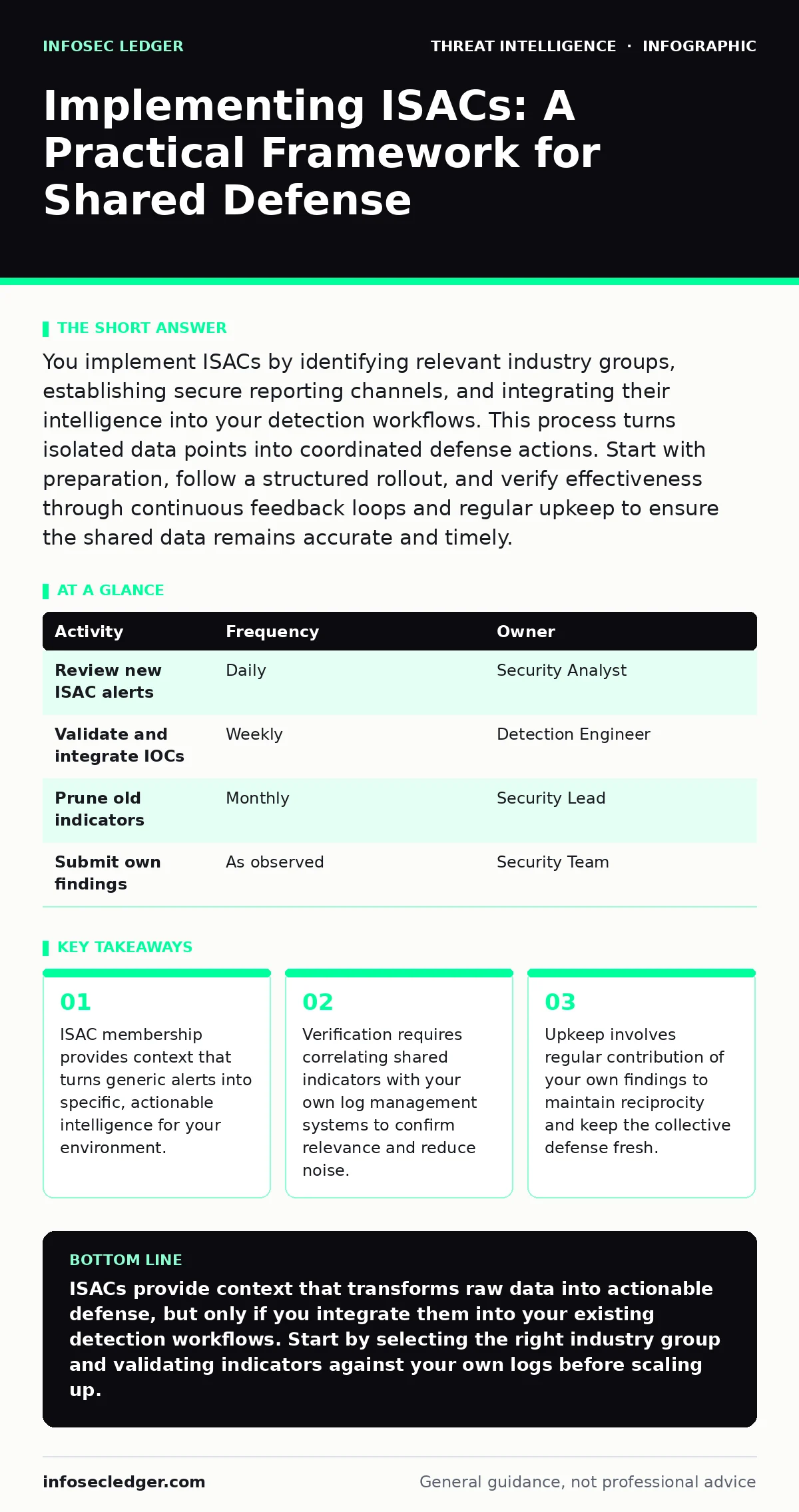
You implement ISACs by identifying relevant industry groups, establishing secure reporting channels, and integrating their intelligence into your detection workflows. This process turns isolated data points into coordinated defense actions. Start with preparation, follow a structured rollout, and verify effectiveness through continuous feedback loops and regular upkeep to ensure the shared data remains accurate and timely.
Aligning Industry Context with Technical Reality
Information Sharing and Analysis Centers (ISACs) operate on the principle that collective defense outperforms isolated effort. They are sector-specific organizations that facilitate the exchange of threat intelligence among members. For a small organization, the value lies not in the volume of data, but in the relevance. An alert about a banking protocol vulnerability is noise if you run a retail inventory system.
You must first determine which ISAC aligns with your core business function. This is not always obvious. If you provide cloud infrastructure for healthcare clients, you may belong to both healthcare and technology-focused groups. Misalignment leads to information overload. You will spend more time filtering irrelevant alerts than acting on them.
The hidden cost of joining an ISAC is the operational burden of contribution. These organizations thrive on reciprocity. If you only consume data without contributing your own findings, your access may be restricted, or the quality of shared intelligence may degrade for everyone. You must view membership as a two-way street.
Assessing Internal Readiness for Integration
Before you join, you must assess whether your security operations can handle structured intelligence feeds. Raw threat data is useless without context. You need a process to ingest, validate, and act on indicators of compromise (IOCs). An IOC is any observable artifact that indicates a potential intrusion, such as a malicious IP address or file hash.
Check your current log management capabilities. If you cannot correlate an external alert with your internal logs, the ISAC data is effectively invisible. You need a system that can search across data sources quickly. Without this, you will miss the connection between a shared threat indicator and activity on your network.
Consider your detection engineering maturity. Detection engineering is the practice of designing and testing rules that identify malicious behavior. If your team relies solely on default vendor signatures, you are not ready to implement custom rules based on ISAC feeds. You need the ability to write, test, and deploy custom detection logic.
Step 1: Selecting the Right Industry Group
Choose the ISAC that directly covers your primary revenue stream or critical infrastructure. Research the membership roster and the types of alerts they publish. Look for groups that share technical data, not just high-level policy updates. Technical data includes file hashes, domain names, and attack patterns.
Verify that the group uses standard formats for sharing. Common standards include STIX (Structured Threat Information Expression) and TAXII (Trusted Automated eXchange of Intelligence Information). These standards ensure that the data can be machine-readable. If the group only shares PDF reports, integration will be manual and slow.
How to tell it worked: You receive a sample alert or newsletter that contains specific technical indicators relevant to your technology stack. You can identify at least three indicators that apply to your environment without needing to guess.
Step 2: Establishing Secure Reporting Channels
Set up a dedicated, secure method for receiving and sending intelligence. This often involves a secure portal or an automated feed. Ensure that the communication channel is encrypted and authenticated. You must prevent unauthorized access to the shared data.
Define who within your organization has access to this information. Not every employee needs to see raw threat data. Limit access to security analysts and incident responders. Create a clear workflow for how this data moves from ingestion to action.
How to tell it worked: You successfully receive an automated feed or alert without errors. You can also submit a test report or observation through the designated channel and receive confirmation of receipt.
Step 3: Integrating Feeds into Detection Logic
Take the standardized indicators from the ISAC and feed them into your security tools. This might mean updating firewall blocklists, configuring intrusion detection systems, or enriching your threat intelligence platforms. A threat intelligence platform aggregates and analyzes data from multiple sources.
Do not blindly trust all shared indicators. False positives exist. An IP address flagged as malicious might be a shared hosting provider with a compromised tenant. You must validate indicators against your own traffic patterns. If an indicator blocks legitimate business traffic, you have a problem.
How to tell it worked: Your security tools generate alerts based on ISAC-provided indicators. You can trace an alert back to the original source in the ISAC feed. The alerts are actionable and not just noise.
See also: How Detection Engineering Works: From Data to Alert · Log Management: The Hidden Cost of Visibility and When to Stop
Step 4: Validating Effectiveness Through Correlation
Checking if the implementation works requires more than just seeing alerts. You must correlate external intelligence with internal evidence. Use network scanning to identify if any of your assets are configured in ways that the shared threats exploit.
Look for the Pyramid of Pain levels in the shared data. The Pyramid of Pain describes the difficulty for attackers to change different parts of their infrastructure. Low-level indicators like IP addresses are easy for attackers to change. High-level indicators like tools and tactics are harder. Focus your integration on higher-level indicators for more durable defense.
How to tell it worked: You detect an attempt to exploit a vulnerability mentioned in an ISAC alert. You can show that the detection rule triggered because of the specific technique described in the shared intelligence.
Step 5: Contributing Your Own Findings
Reciprocity is the engine of an ISAC. You must contribute your own findings. This does not mean sharing sensitive customer data. It means sharing anonymized indicators of compromise and attack patterns you have observed. If you see a new variant of a phishing email, share its hash.
Anonymization is key. Strip out any personally identifiable information or proprietary business data before sharing. Focus on the technical artifacts of the attack. This helps other members defend against the same threat.
How to tell it worked: You submit a report or indicator and receive acknowledgment. Other members begin to see your contributions in their feeds. Your organization becomes a recognized contributor to the community.
Maintaining Freshness and Relevance
Threat intelligence decays rapidly. An indicator that was valid last week may be irrelevant today. You must regularly review and prune your integrated indicators. Old indicators clutter your security tools and increase false positives.
Establish a review cycle. Monthly is often sufficient for most small organizations. Remove indicators that are no longer generating alerts or that have been deemed false positives. Update your detection rules to reflect new tactics shared by the ISAC.
| Activity | Frequency | Owner |
|---|---|---|
| Review new ISAC alerts | Daily | Security Analyst |
| Validate and integrate IOCs | Weekly | Detection Engineer |
| Prune old indicators | Monthly | Security Lead |
| Submit own findings | As observed | Security Team |
Avoiding Common Implementation Pitfalls
One common pitfall is assuming that ISAC data replaces your own security monitoring. It supplements it. You still need to monitor your own attack surface reduction efforts. Reducing your attack surface limits the points of entry for attackers. ISAC data helps you defend those points, but it does not eliminate them.
Another pitfall is ignoring the human element. Analysts must understand the context of the alerts. Provide training on how to interpret shared intelligence. Teach them to look for the credential dumping techniques or insecure direct object references (IDOR) that are frequently discussed in these forums.
Finally, do not let the data sit unused. If you are not acting on the intelligence, you are wasting resources. Measure the impact of ISAC integration on your incident response time and detection accuracy. Adjust your process based on these metrics.
Key takeaways
- ISAC membership provides context that turns generic alerts into specific, actionable intelligence for your environment.
- Verification requires correlating shared indicators with your own log management systems to confirm relevance and reduce noise.
- Upkeep involves regular contribution of your own findings to maintain reciprocity and keep the collective defense fresh.
ISACs provide context that transforms raw data into actionable defense, but only if you integrate them into your existing detection workflows. Start by selecting the right industry group and validating indicators against your own logs before scaling up.
Frequently asked questions
How do I know if an ISAC is worth the cost?
Evaluate the relevance of their alerts to your technology stack and the quality of their technical data. If you can act on at least one alert per month, the value is likely positive.
Can I join multiple ISACs?
Yes, if your operations span multiple industries. However, ensure you have the resources to process and act on the combined volume of intelligence.
What if I don't have a dedicated security team?
You can still benefit by using managed security service providers (MSSPs) that integrate ISAC feeds into their monitoring services. Ensure they share the relevant alerts with you.
How do I protect my data when contributing?
Anonymize all data before sharing. Remove any personally identifiable information or proprietary details. Focus only on the technical indicators of the attack.
How this guide was produced: written by the InfoSec Ledger editorial team with AI assistance, checked against the public references listed below, and reviewed when the facts change. See our editorial policy or report an error.