
Attack Surface Reduction: What It Is and How to Shrink Your Risk
Most organizations focus on strengthening walls, but true security comes from removing the doors and windows that attackers use to enter your digital property.
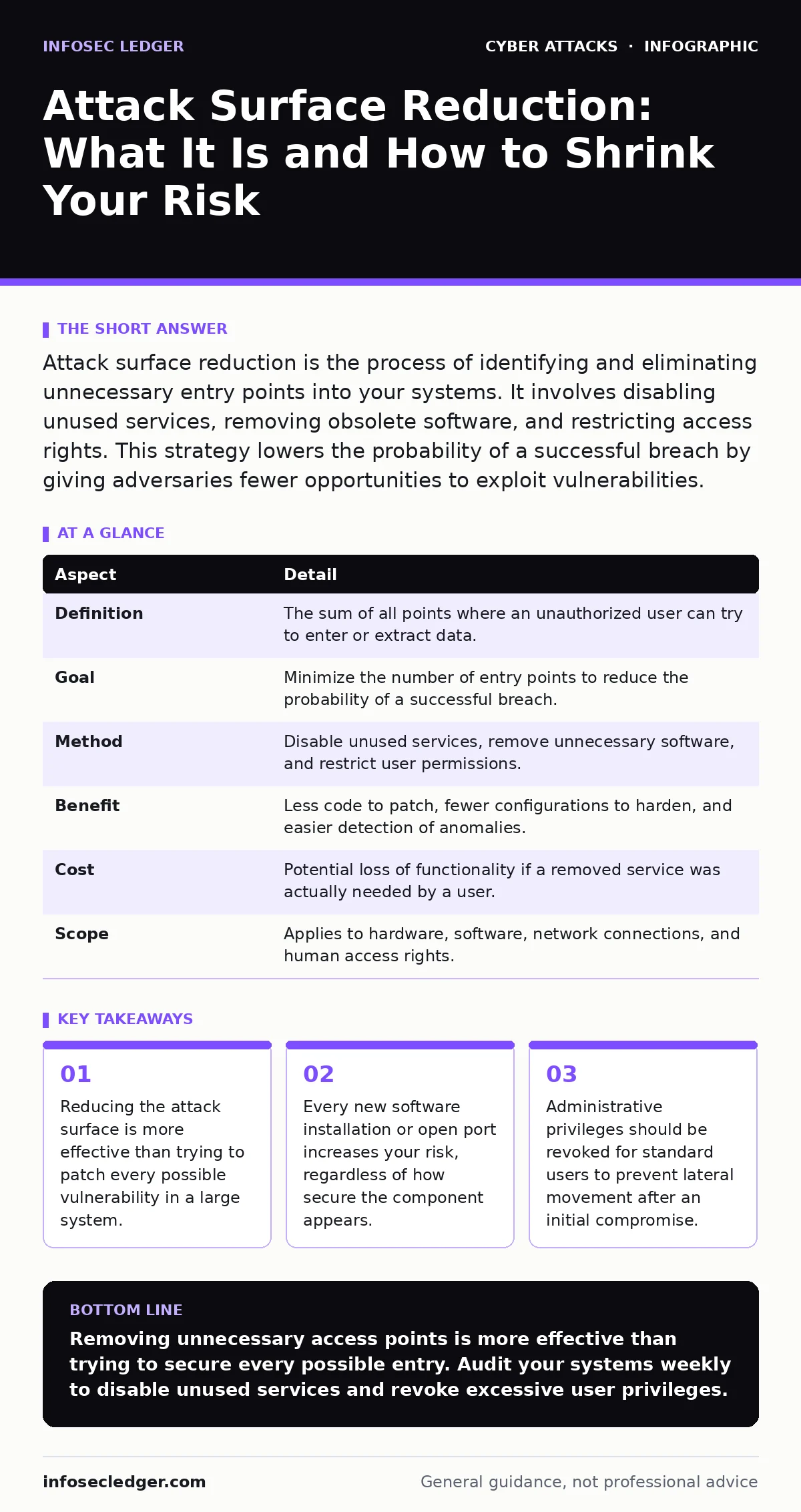
Attack surface reduction is the process of identifying and eliminating unnecessary entry points into your systems. It involves disabling unused services, removing obsolete software, and restricting access rights. This strategy lowers the probability of a successful breach by giving adversaries fewer opportunities to exploit vulnerabilities.
The Castle and the Gatehouse
Imagine you own a large estate. You could hire a thousand guards to watch every inch of the perimeter, or you could simply demolish all but one gate and lock it at night. Most security strategies focus on hiring more guards. Attack surface reduction focuses on demolishing the extra gates.
In cybersecurity, your "estate" is your network, servers, and applications. Every feature, every open port, and every user account is a potential gate. If you do not need a gate, it should not exist. This principle shifts the burden from constant monitoring to structural simplicity.
| Aspect | Detail |
|---|---|
| Definition | The sum of all points where an unauthorized user can try to enter or extract data. |
| Goal | Minimize the number of entry points to reduce the probability of a successful breach. |
| Method | Disable unused services, remove unnecessary software, and restrict user permissions. |
| Benefit | Less code to patch, fewer configurations to harden, and easier detection of anomalies. |
| Cost | Potential loss of functionality if a removed service was actually needed by a user. |
| Scope | Applies to hardware, software, network connections, and human access rights. |
Where the Term Comes From
The concept originates from military strategy, where exposing fewer sides of a fortress reduces the angles from which an enemy can fire. In computing, it translates to the total number of vulnerabilities exposed to the internet or your internal network.
Every time you install a plugin, open a port for a service, or grant an admin password, you expand this surface. A small business often installs a content management system with dozens of plugins. Only three are used. The other twenty-seven remain active, each containing code that could contain a flaw.
This is not about hiding your assets. It is about making them unreachable. If a service is not listening for connections, it cannot be exploited. If a user does not have write access to a database, they cannot inject malicious SQL commands.
Daily Operations and Maintenance
Reducing your attack surface is not a one-time project. It is a continuous cycle of removal and restriction. You must regularly audit your environment to find what has crept in. Software updates often add new features or background processes that you did not ask for.
Start with your network. Identify every device connected to your infrastructure. Ask if each device needs to communicate with the internet. If it does not, place it behind a firewall that blocks all outbound traffic except for necessary updates. This containment limits the damage if the device is compromised.
Next, review your applications. Disable any features that are not critical to your daily operations. For example, if your web server does not need to serve files directly, turn off that function. This prevents attackers from uploading malicious scripts to your server.
Finally, manage user accounts. Follow the principle of least privilege. Give employees only the access they need to do their specific jobs. A marketing employee does not need access to the financial database. If their account is stolen via social engineering, the attacker cannot move laterally to sensitive data.
What People Usually Get Wrong
Many organizations confuse attack surface reduction with hardening. Hardening involves securing a system by applying patches, configuring firewalls, and encrypting data. It assumes the system must remain open and functional. Reduction assumes the system should be closed and minimal.
You can harden a system and still have a massive attack surface. If you have fifty open services, all properly patched, you still have fifty targets. If you reduce that to five services, you have five targets. The work of keeping five services secure is far easier than keeping fifty secure.
Another common mistake is ignoring internal threats. Focus often falls on external hackers. However, an employee with excessive privileges can cause as much damage as an external intruder. Reducing the attack surface includes restricting internal movement. If a compromised laptop cannot reach the main server, the breach remains contained.
The Hidden Costs of Complexity
Complexity is the enemy of security. Every additional configuration option is a place where a mistake can be made. A misconfigured cloud storage bucket can expose millions of records. A poorly written firewall rule can leave a backdoor open.
By reducing the number of components, you reduce the chance of misconfiguration. Fewer settings mean fewer things to go wrong. This simplicity also makes incident response faster. When an alert triggers, you have fewer places to look for the cause.
Consider the impact on botnet attacks. If your devices are simple and have no unnecessary services, they are less likely to be infected and recruited into a botnet. A botnet relies on vulnerable, exposed services to spread. By removing those services, you starve the botnet of new members.
See also: Detecting AI Content: Practical Filters and Delegation for Small Teams · How AI Usage Policies Work: From Data Capture to Risk Control
Integrating with Broader Security Measures
Attack surface reduction works best when combined with other defensive layers. It is not a replacement for monitoring or user training. It is a foundation that makes those other measures more effective.
For instance, email authentication protocols like SPF and DKIM prevent spoofing. If you reduce your attack surface by ensuring only authorized servers can send email on your behalf, you make it harder for attackers to impersonate your brand. This reduces the effectiveness of adversary-in-the-middle phishing attempts, where attackers intercept and alter communications.
Similarly, session cookie theft becomes harder if your web applications are minimal and use strict security headers. If you do not serve unnecessary dynamic content, there are fewer opportunities for an attacker to inject malicious code that steals cookies.
It also complements DDoS attacks mitigation. While you cannot prevent a flood of traffic, you can ensure that your servers are not vulnerable to application-layer attacks that accompany the flood. A smaller attack surface means fewer endpoints for the attacker to target with malicious payloads.
The Long-Term Perspective
Security is not about achieving a state of zero risk. It is about managing risk to an acceptable level. Attack surface reduction is one of the most effective ways to lower that risk. It requires discipline and a willingness to say no to new features or convenience.
Every time you consider adding a new tool or service, ask if it is necessary. If it is, ensure it is configured with the minimum required permissions. Regularly review and remove what is no longer needed. This habit builds a culture of security that protects your organization for years.
This approach also simplifies compliance. Fewer systems mean fewer audits. Fewer configurations mean fewer deviations from security standards. By keeping your environment simple, you make it easier to prove that you are secure.
Remember, the goal is not to build an impenetrable fortress. It is to make the cost of attacking you higher than the potential reward. By reducing your attack surface, you make yourself a less attractive target.
Key takeaways
- Reducing the attack surface is more effective than trying to patch every possible vulnerability in a large system.
- Every new software installation or open port increases your risk, regardless of how secure the component appears.
- Administrative privileges should be revoked for standard users to prevent lateral movement after an initial compromise.
Removing unnecessary access points is more effective than trying to secure every possible entry. Audit your systems weekly to disable unused services and revoke excessive user privileges.
Frequently asked questions
How do I know which services are unnecessary?
Review your business processes and identify which systems are critical. Any service not directly supporting a core function is a candidate for removal.
Can I reduce my attack surface without hiring a security team?
Yes. Basic steps like disabling unused accounts, turning off remote desktop access, and removing old software can be done by IT staff or owners.
Does this apply to cloud environments?
Absolutely. Cloud services often have default settings that expose too much. You must configure permissions and network rules to restrict access.
What is the first step I should take?
Create an inventory of all your hardware, software, and user accounts. Identify what is not being used and plan to remove or disable it.
How this guide was produced: written by the InfoSec Ledger editorial team with AI assistance, checked against the public references listed below, and reviewed when the facts change. See our editorial policy or report an error.