
Detecting AI Content: Practical Filters and Delegation for Small Teams
Detecting AI text relies on statistical patterns rather than truth, meaning even the best tools miss sophisticated edits and cannot verify factual accuracy.
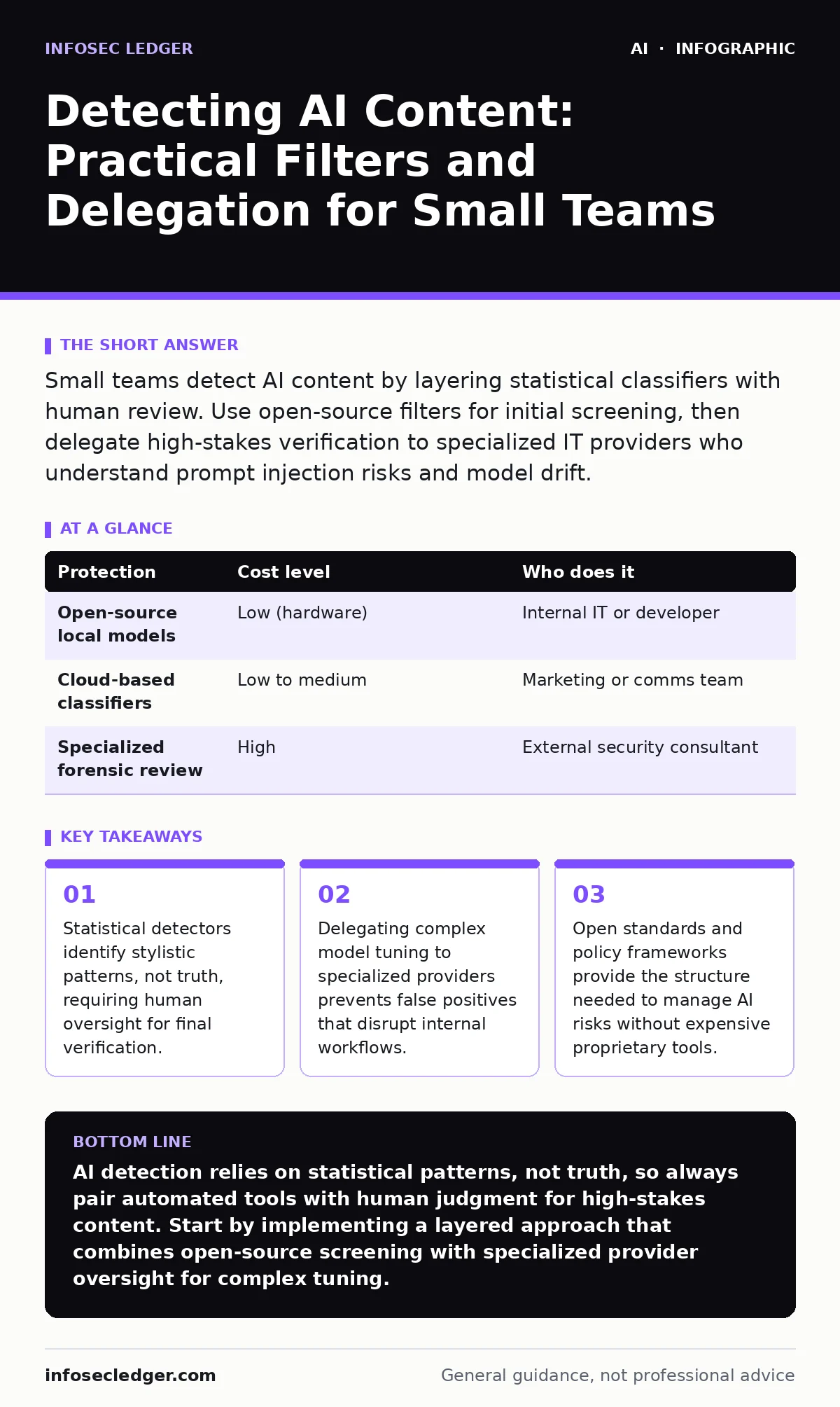
Small teams detect AI content by layering statistical classifiers with human review. Use open-source filters for initial screening, then delegate high-stakes verification to specialized IT providers who understand prompt injection risks and model drift.
The Statistical Nature of Detection
AI content detection does not scan for watermarks or hidden metadata. Most commercial models do not embed detectable signatures in their output. Instead, detection tools analyze statistical probability. They look for perplexity, which measures how predictable the text is to a language model, and burstiness, which measures the variation in sentence structure.
Human writing tends to have high burstiness. Sentences vary in length and complexity. AI writing often exhibits low burstiness. The sentences flow with a consistent rhythm and moderate perplexity. This statistical difference is the primary signal detectors use.
This approach creates a fundamental limitation. If a human writes in a monotone style, the tool may flag their work as AI. If an AI is prompted to vary its sentence structure, it may pass as human. You are not detecting the source; you are detecting a style that resembles a specific type of machine output.
Why Small Scale Requires Precision
Large enterprises can afford high false-positive rates. They have legal teams to review flagged content and processes to handle errors. Small organizations do not have that buffer. A false positive in a small team can waste hours of review time or create unnecessary conflict with employees.
Accuracy matters more when resources are tight. You need tools that balance sensitivity with precision. Overly sensitive detectors will flag almost everything, leading to alert fatigue. Your team will stop trusting the system. Overly conservative detectors will miss actual AI usage, leaving you exposed to compliance risks or brand inconsistency.
The goal is not to catch every instance of AI use. The goal is to manage risk. You need to know when AI output is being presented as original work in high-stakes contexts, such as client proposals or public statements.
Affordable Detection Methods
You do not need expensive enterprise suites to start. Several open-source models are available for local deployment. These models run on your own hardware, keeping data private. They allow you to test detection capabilities without sending sensitive documents to third-party APIs.
For text that does not contain sensitive information, cloud-based classifiers offer a quick check. These services are often free or low-cost for small volumes. They provide a baseline understanding of how much AI-generated content might be entering your workflow.
Consider using a combination of methods. Run a local open-source model for internal documents to ensure privacy. Use a cloud classifier for external-facing content where privacy is less of a concern. This layered approach reduces the risk of relying on a single point of failure.
| Protection | Cost level | Who does it |
|---|---|---|
| Open-source local models | Low (hardware) | Internal IT or developer |
| Cloud-based classifiers | Low to medium | Marketing or comms team |
| Specialized forensic review | High | External security consultant |
What to Delegate to Providers
Some aspects of AI detection are too complex for in-house handling. Model drift is a significant challenge. As AI models improve, their output becomes more human-like. Detectors trained on older data become less effective. Keeping detection models current requires constant retraining and tuning.
Delegating this maintenance to a specialized IT provider makes sense. They have the expertise to monitor model performance and adjust thresholds. They can also help you interpret results in the context of your specific industry.
You should also delegate the development of detection strategies. Providers can help you define what constitutes acceptable AI use in your organization. This aligns with broader frameworks like the NIST AI Risk Management Framework, which provides a structured approach to managing AI risks. Mentioning this framework in your provider discussions shows you understand the broader context.
Integrating Detection into Workflow
Detection should not be an afterthought. Integrate it into your content creation pipeline. Use automated checks for draft reviews. Flag high-risk content for manual verification. This reduces the burden on your team and ensures consistency.
Train your team to recognize AI-generated content. Familiarity with the style helps in identifying subtle tells. This human intuition complements statistical tools. It also helps in distinguishing between AI-assisted writing and fully AI-generated text.
Document your detection processes. This creates an audit trail. It shows clients and partners that you take quality and authenticity seriously. It also helps in resolving disputes if content is challenged.
See also: How AI Usage Policies Work: From Data Capture to Risk Control · Attack Surface Reduction: What It Is and How to Shrink Your Risk
The Limits of Current Technology
No detector is perfect. Adversarial techniques can bypass detection. Simple edits, such as changing synonyms or restructuring sentences, can significantly alter statistical signatures. This is similar to how attackers use jailbreaking AI chatbots to bypass safety filters. The underlying principles of evasion apply to detection as well.
Voice and image detection face similar challenges. Voice cloning scams are becoming more sophisticated, making it hard to distinguish real from synthetic audio. Image detectors struggle with high-quality generative models. These limitations mean you must always assume detection is probabilistic, not definitive.
Do not rely on detection as a sole control. Combine it with other measures, such as strict AI usage policies at work. These policies define acceptable use and accountability. They provide a contractual basis for action if violations occur.
Building a Resilient Strategy
A resilient strategy acknowledges the limitations of technology. It focuses on process and culture. Encourage transparency about AI use. When employees know that AI use is monitored and expected to be disclosed, they are less likely to hide it.
Regularly review and update your detection tools. The landscape of AI generation changes rapidly. What works today may fail tomorrow. Stay informed about new developments in AI model monitoring and detection techniques.
Consider the role of insecure AI plugins and agents in your detection strategy. These tools can introduce vulnerabilities that compromise the integrity of your content. Ensure that any AI tools used for content creation are secure and reliable.
Final Considerations for Implementation
Start small. Implement detection for a specific type of content, such as blog posts or client reports. Refine your processes before expanding to other areas. This allows you to identify issues and adjust without disrupting your entire workflow.
Communicate with your team. Explain why detection is in place and how it works. Transparency builds trust and reduces resistance. It also helps in gathering feedback on the effectiveness of the tools.
Remember that detection is just one part of a broader security strategy. It should be integrated with other controls, such as access management and data protection. A holistic approach ensures that you are protected against a wide range of threats.
Key takeaways
- Statistical detectors identify stylistic patterns, not truth, requiring human oversight for final verification.
- Delegating complex model tuning to specialized providers prevents false positives that disrupt internal workflows.
- Open standards and policy frameworks provide the structure needed to manage AI risks without expensive proprietary tools.
AI detection relies on statistical patterns, not truth, so always pair automated tools with human judgment for high-stakes content. Start by implementing a layered approach that combines open-source screening with specialized provider oversight for complex tuning.
Frequently asked questions
Can I detect AI-generated code in my software projects?
Code detection is more challenging than text detection because code follows strict syntax rules. Tools exist that analyze code structure and comment patterns, but they are less mature. You should focus on code review processes and static analysis tools rather than relying solely on AI detection.
How often should I update my AI detection models?
You should review your detection models at least quarterly. AI generation techniques evolve rapidly, and models trained on older data become less effective. Regular updates ensure that your detection capabilities remain relevant and accurate.
What if an employee disputes an AI detection flag?
Have a clear policy in place for handling disputes. Allow the employee to provide context or evidence of human authorship. Use the detection result as a starting point for investigation, not as definitive proof. This approach maintains trust and fairness.
Are there free tools for detecting AI-generated images?
Yes, several open-source tools are available for image analysis. They look for artifacts and inconsistencies typical of generative models. However, these tools are not foolproof and should be used as part of a broader verification process.
How this guide was produced: written by the InfoSec Ledger editorial team with AI assistance, checked against the public references listed below, and reviewed when the facts change. See our editorial policy or report an error.