
How AI Usage Policies Work: From Data Capture to Risk Control
Your usage policy fails when it ignores the invisible data exfiltration that happens before the model ever generates a response, exposing proprietary logic to public training sets.
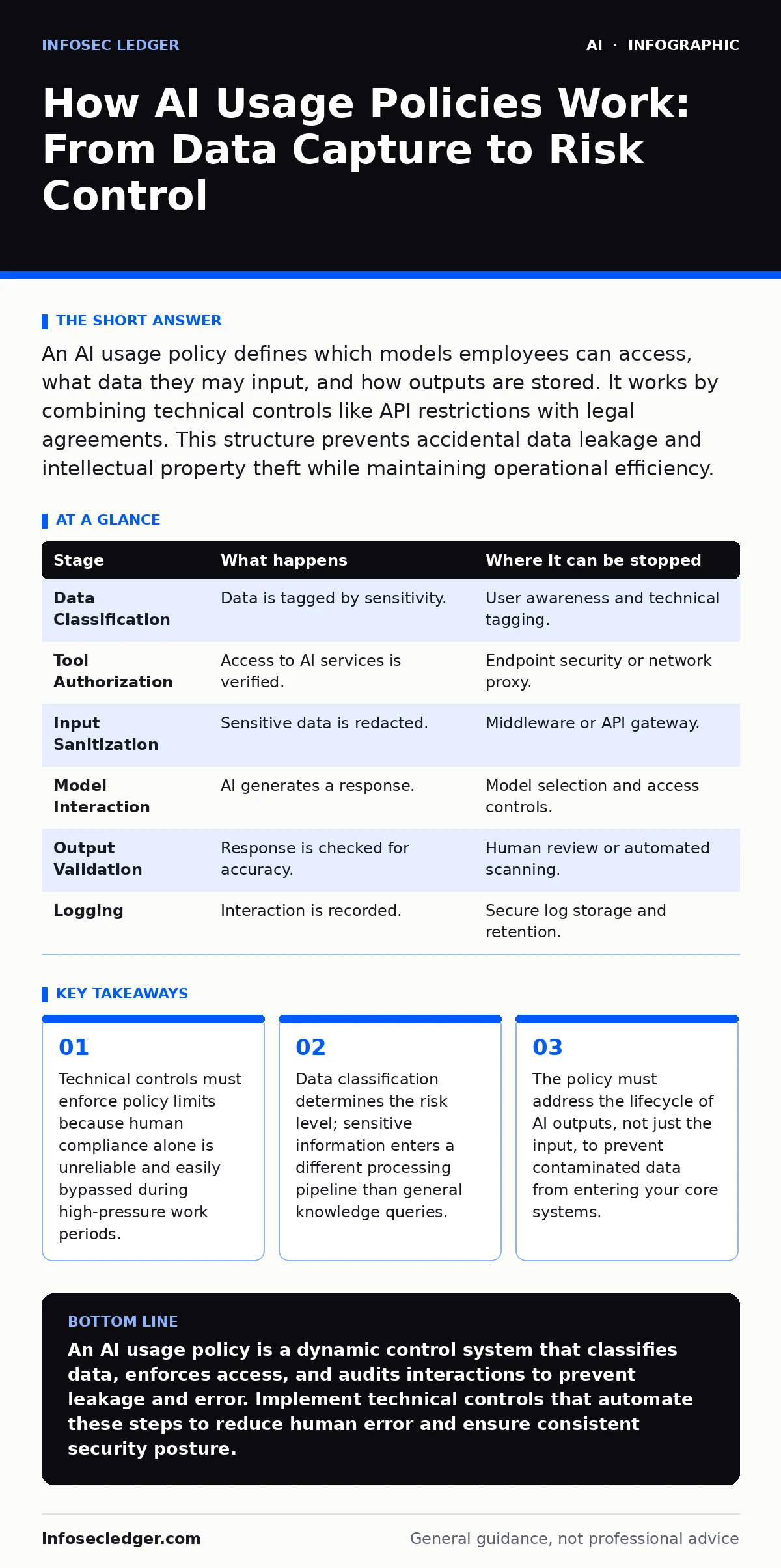
An AI usage policy defines which models employees can access, what data they may input, and how outputs are stored. It works by combining technical controls like API restrictions with legal agreements. This structure prevents accidental data leakage and intellectual property theft while maintaining operational efficiency.
The Policy Architecture
An AI usage policy is not merely a list of prohibited applications. It is a structured control framework that dictates how artificial intelligence interacts with your organization's data and systems. You must view this policy as a security boundary, similar to a firewall, but applied to cognitive processes rather than network traffic. The mechanism relies on three pillars: classification, enforcement, and auditing.
Classification assigns a risk tier to both the data and the tool. Enforcement uses technical barriers to block or monitor interactions. Auditing creates a record of what was asked and what was returned. Without all three, the policy exists only as paper. You cannot secure what you cannot define, and you cannot control what you cannot see.
Stage 1: Data Classification and Context
The first step occurs before any interaction with the AI. The system or the user must determine the sensitivity of the information being considered for input. This is where most policies fail. Users assume that if data is on their screen, it is safe to paste into a chat interface. The policy must explicitly define what constitutes confidential data, including source code, customer lists, and internal strategies.
Imagine an employee trying to summarize a contract. The policy mechanism flags the document type as "Legal." This triggers a restriction on which AI models can process it. If the model is a public, free-tier service, the interaction is blocked. If it is an approved enterprise model, the interaction proceeds to the next stage. This classification prevents accidental ingestion of trade secrets into public training datasets.
Stage 2: Tool Authorization and Access Control
Not all AI tools carry the same risk. A public chatbot operates differently from an enterprise-hosted instance. The policy maps approved tools to user roles. This mapping is enforced through endpoint security software or network proxy settings. When you attempt to access an unauthorized AI service, the system intercepts the request.
The mechanism checks the URL or API endpoint against a whitelist. If the service is not approved, the connection is terminated. If it is approved, the system logs the user identity and the timestamp. This step ensures that even if a user has sensitive data, they cannot send it to an unvetted provider. It also prevents the use of insecure AI plugins and agents that may introduce malware or data leaks.
Stage 3: Input Sanitization and Redaction
Before data reaches the AI model, it may undergo sanitization. This is a critical, often overlooked step. Advanced policy frameworks use middleware to scan input for personally identifiable information or secrets. The system redacts these fields before sending the remaining text to the model.
For example, a code snippet might have variable names or API keys stripped out. The AI receives a generalized version of the code. This allows the user to get help with syntax without exposing actual credentials. This mechanism adds latency but significantly reduces the attack surface. It addresses the hidden cost of convenience: the assumption that the AI does not retain context. Many models do retain context for training purposes unless explicitly configured otherwise.
Stage 4: Model Interaction and Inference
This is the visible part of the process. The AI model processes the sanitized input and generates a response. Behind the scenes, the model accesses its weights and biases to predict the next token. The policy controls which models are available. Some models are better at reasoning but carry higher data retention risks. Others are faster but less accurate.
The policy may restrict access to models based on the user's clearance level. A junior developer might only access a model fine-tuned for general coding assistance. A senior architect might access a model capable of complex architectural analysis. This tiered access prevents privilege escalation through AI tools. It also aligns with the NIST AI Risk Management Framework, which emphasizes managing risk across the AI lifecycle.
Stage 5: Output Validation and Risk Assessment
The response from the AI is not trusted by default. The policy requires validation before the output enters your production environment. This is where the concept of "hallucination" becomes a security issue. An AI might generate plausible but incorrect code or advice. If this output is deployed, it can create vulnerabilities.
The mechanism involves a review step. For automated pipelines, this might be a static analysis scan. For manual use, it is a human review. The policy must mandate that AI outputs are treated as unverified drafts. You must verify the logic, check for injected malicious code, and ensure compliance with internal standards. This stage prevents the automation of errors. It also mitigates risks associated with jailbreaking AI chatbots, where users attempt to bypass safety filters to generate harmful content.
Stage 6: Logging and Continuous Audit
The final stage is recording the interaction. The system logs the input, the output, the user, the model used, and the timestamp. These logs are stored securely and are immutable. They serve as evidence for audits and incident response. If a data breach occurs, these logs help reconstruct the timeline.
The audit trail also feeds back into the policy. Patterns of misuse or frequent violations trigger policy updates. Perhaps a certain model is generating too many false positives, or a specific department is consistently bypassing controls. The mechanism is adaptive. It learns from operational data to tighten or relax controls as needed. This continuous improvement is vital for maintaining security in a rapidly changing landscape.
| Stage | What happens | Where it can be stopped |
|---|---|---|
| Data Classification | Data is tagged by sensitivity. | User awareness and technical tagging. |
| Tool Authorization | Access to AI services is verified. | Endpoint security or network proxy. |
| Input Sanitization | Sensitive data is redacted. | Middleware or API gateway. |
| Model Interaction | AI generates a response. | Model selection and access controls. |
| Output Validation | Response is checked for accuracy. | Human review or automated scanning. |
| Logging | Interaction is recorded. | Secure log storage and retention. |
See also: AI Agents for Small Businesses: Secure Automation Risks · Why is anonymization a challenge of cybersecurity for your data
Limits of Policy Enforcement
No policy is foolproof. Users can take screenshots, copy-paste data into personal devices, or use shadow IT. The policy controls digital interactions, not human behavior. You must accept that some risk remains. The goal is to raise the cost of misuse and reduce the probability of large-scale leaks.
Technical controls can be bypassed by determined insiders. Therefore, the policy must include cultural elements. Training and clear consequences are necessary. However, over-reliance on technical blocks can hinder productivity. The balance is delicate. You must allow innovation while managing risk. This balance is explored further in guides on securing AI agents and machine learning for fraud detection.
Key takeaways
- Technical controls must enforce policy limits because human compliance alone is unreliable and easily bypassed during high-pressure work periods.
- Data classification determines the risk level; sensitive information enters a different processing pipeline than general knowledge queries.
- The policy must address the lifecycle of AI outputs, not just the input, to prevent contaminated data from entering your core systems.
An AI usage policy is a dynamic control system that classifies data, enforces access, and audits interactions to prevent leakage and error. Implement technical controls that automate these steps to reduce human error and ensure consistent security posture.
Frequently asked questions
Does an AI usage policy prevent all data leaks?
No, it reduces the risk by blocking unauthorized channels and sanitizing data. Determined insiders can still bypass controls through screenshots or personal devices.
How do I classify data for AI usage?
Define categories like public, internal, confidential, and restricted. Map these categories to specific AI tools and input restrictions. Use technical tools to automate tagging where possible.
Can I use free AI tools for work?
Only if your policy explicitly allows it and you ensure no sensitive data is input. Most enterprises block free tools because they lack data privacy guarantees and may use inputs for training.
Who is responsible for enforcing the policy?
IT security teams implement technical controls. Department managers enforce cultural compliance. Legal teams define the data classification and contractual obligations.
How this guide was produced: written by the InfoSec Ledger editorial team with AI assistance, checked against the public references listed below, and reviewed when the facts change. See our editorial policy or report an error.