
AI Agents for Small Businesses: Secure Automation Risks
AI agents execute actions autonomously, turning a single compromised credential into a chain of unauthorized transactions that standard firewalls cannot stop.
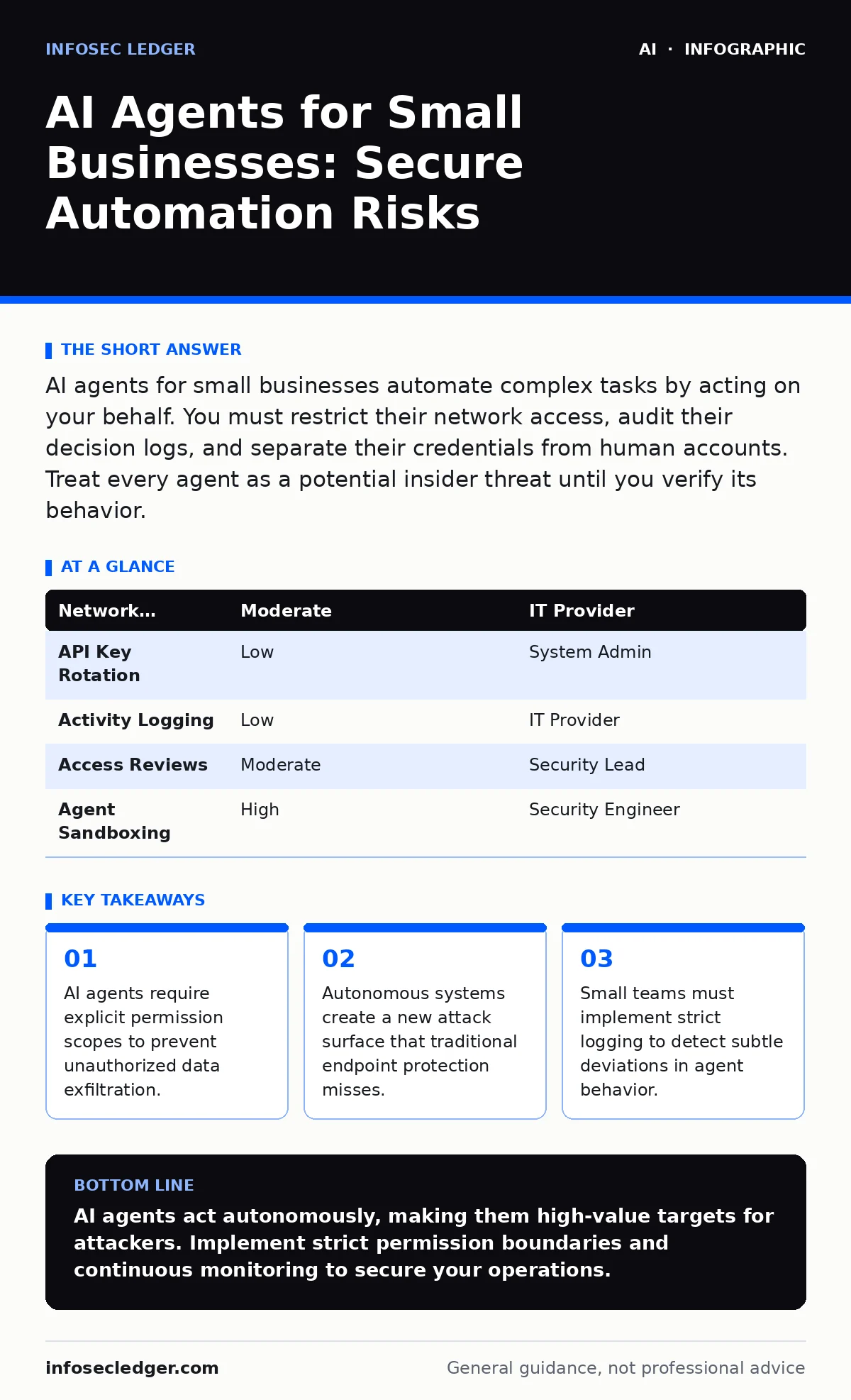
AI agents for small businesses automate complex tasks by acting on your behalf. You must restrict their network access, audit their decision logs, and separate their credentials from human accounts. Treat every agent as a potential insider threat until you verify its behavior.
Understanding AI Agent Autonomy
AI agents for small businesses operate differently from standard software. Traditional applications wait for explicit user input. An AI agent perceives its environment, makes decisions, and executes actions to achieve a goal. This autonomy creates efficiency but introduces unique security risks. The agent does not just process data. It acts on that data. If the agent misinterprets a command or is manipulated by an adversary, it performs the wrong action with full authority. You must understand that the agent is an active participant in your network, not a passive tool.
The core risk lies in the agent's ability to chain actions. One small error can trigger a series of larger failures. For instance, an agent tasked with scheduling meetings might access calendar data, then email contacts, and finally book travel. Each step requires permissions. If one step is compromised, the subsequent steps amplify the damage. You face a scenario where the boundary between a tool and a user blurs. The agent acts as a user with specific rights. Securing it requires treating it like a human employee with limited access.
Why Scale Changes the Risk Profile
Small organizations often lack dedicated security teams. This makes AI agents dangerous because there is no one to monitor their behavior in real time. Large enterprises have security operations centers. They have analysts watching logs for anomalies. Small businesses rely on automation to survive. This creates a dependency on the agent's correctness. If the agent fails, the business stops. The pressure to keep the agent running can lead to disabling security checks. You must resist this pressure. Automation should never come at the cost of oversight.
The attack surface expands when you add agents. Each agent needs credentials. It needs network access. It needs data. Each requirement is a potential entry point for attackers. Adversaries target these agents because they are often less protected than human accounts. Humans get multi-factor authentication. Agents sometimes get static API keys. These keys are easier to steal and harder to revoke. You must assume that any key given to an agent will eventually be exposed. Design your systems to minimize the damage when that happens.
Defining Permission Boundaries
The principle of least privilege is the foundation of agent security. Grant the agent only the permissions it needs to perform its specific task. Nothing more. If an agent sends emails, it should not have access to the file server. If it reads customer data, it should not be able to modify financial records. Segment the agent's access. Use separate accounts for different functions. This limits the blast radius of a compromise. If one agent is breached, the attacker cannot move laterally to other systems.
Role-based access control (RBAC) helps manage these boundaries. Define roles for your agents. Assign permissions to roles. Assign agents to roles. This structure makes it easier to audit and adjust access. Review these assignments regularly. As business needs change, agent permissions must change too. Stale permissions accumulate over time. They create hidden paths for attackers. Remove any permission that is not actively used. Document why each permission exists. This documentation helps you justify access during audits and investigations.
Monitoring and Logging Strategies
You cannot secure what you cannot see. Implement detailed logging for all agent actions. Record every decision the agent makes. Capture the input data, the reasoning process, and the final output. Store these logs in a secure, immutable location. Do not allow the agent to modify its own logs. This prevents an attacker from covering their tracks. Use a centralized logging system. Aggregate logs from all agents and human users. This provides a holistic view of activity.
Anomaly detection helps identify suspicious behavior. Baseline normal agent activity. Look for deviations from this baseline. An agent that accesses data at unusual times is a red flag. An agent that makes many small transactions is suspicious. Set up alerts for these anomalies. Investigate every alert promptly. Do not ignore them hoping they are false positives. False positives are annoying. False negatives are catastrophic. Adjust your detection rules based on your findings. Continuously refine your monitoring to stay ahead of evolving threats.
Protection | Cost level | Who does it
| Network Segmentation | Moderate | IT Provider |
|---|---|---|
| API Key Rotation | Low | System Admin |
| Activity Logging | Low | IT Provider |
| Access Reviews | Moderate | Security Lead |
| Agent Sandboxing | High | Security Engineer |
Questions for Your IT Provider
When engaging an IT provider to manage AI agents, ask specific questions. Vague answers indicate a lack of expertise. You need to know how they handle agent security. Ask these questions to evaluate their capability:
- How do you isolate AI agents from critical business data?
- What is your process for rotating API keys used by agents?
- How do you detect and respond to anomalous agent behavior?
- Can you provide a sample log of agent activity for review?
- What is the procedure for revoking agent access immediately?
These questions reveal the depth of their understanding. They also highlight potential gaps in your current setup. Use their answers to improve your security posture. Do not accept "we use standard tools" as a sufficient answer. Demand specifics. Know the mechanisms they use. Understand the trade-offs they make. This knowledge empowers you to make informed decisions about your AI strategy.
Integrating with Existing Policies
AI agents must comply with your existing security policies. Review your current policies for gaps related to automation. Update them to address AI-specific risks. Include guidelines for agent deployment, monitoring, and decommissioning. Train your staff on these policies. Everyone must understand the risks and responsibilities. Consistency is key. Apply the same standards to agents as you do to human users. This creates a unified security culture.
See our guide on insecure AI plugins and agents for details on common vulnerabilities. Refer to AI usage policies at work for broader governance frameworks. These resources help you build a solid foundation. Do not treat AI as a separate domain. Integrate it into your overall security strategy. This holistic approach reduces complexity. It ensures that new technologies do not outpace your security controls. Keep your policies current. Review them regularly. Adapt them as technology evolves.
Key takeaways
- AI agents require explicit permission scopes to prevent unauthorized data exfiltration.
- Autonomous systems create a new attack surface that traditional endpoint protection misses.
- Small teams must implement strict logging to detect subtle deviations in agent behavior.
AI agents act autonomously, making them high-value targets for attackers. Implement strict permission boundaries and continuous monitoring to secure your operations.
Frequently asked questions
How do I prevent an AI agent from leaking data?
Restrict the agent's access to only the data it needs. Use encryption for data in transit and at rest. Monitor all data access patterns for anomalies.
Can I use free AI agents safely?
Free agents often lack security features. Verify their privacy policies and security certifications. Assume they may collect your data for training.
What is the biggest risk of AI agents?
The biggest risk is unauthorized action. An agent can perform actions that violate policy or law. Ensure you have oversight and audit trails.
How often should I review agent permissions?
Review permissions quarterly. Trigger immediate reviews after any security incident or significant change in business processes.
How this guide was produced: written by the InfoSec Ledger editorial team with AI assistance, checked against the public references listed below, and reviewed when the facts change. See our editorial policy or report an error.