
AI Agents Defined: Autonomy, Risk, and Real-World Use
AI agents differ from chatbots by acting on your behalf, creating security gaps that standard access controls cannot easily monitor or restrict.
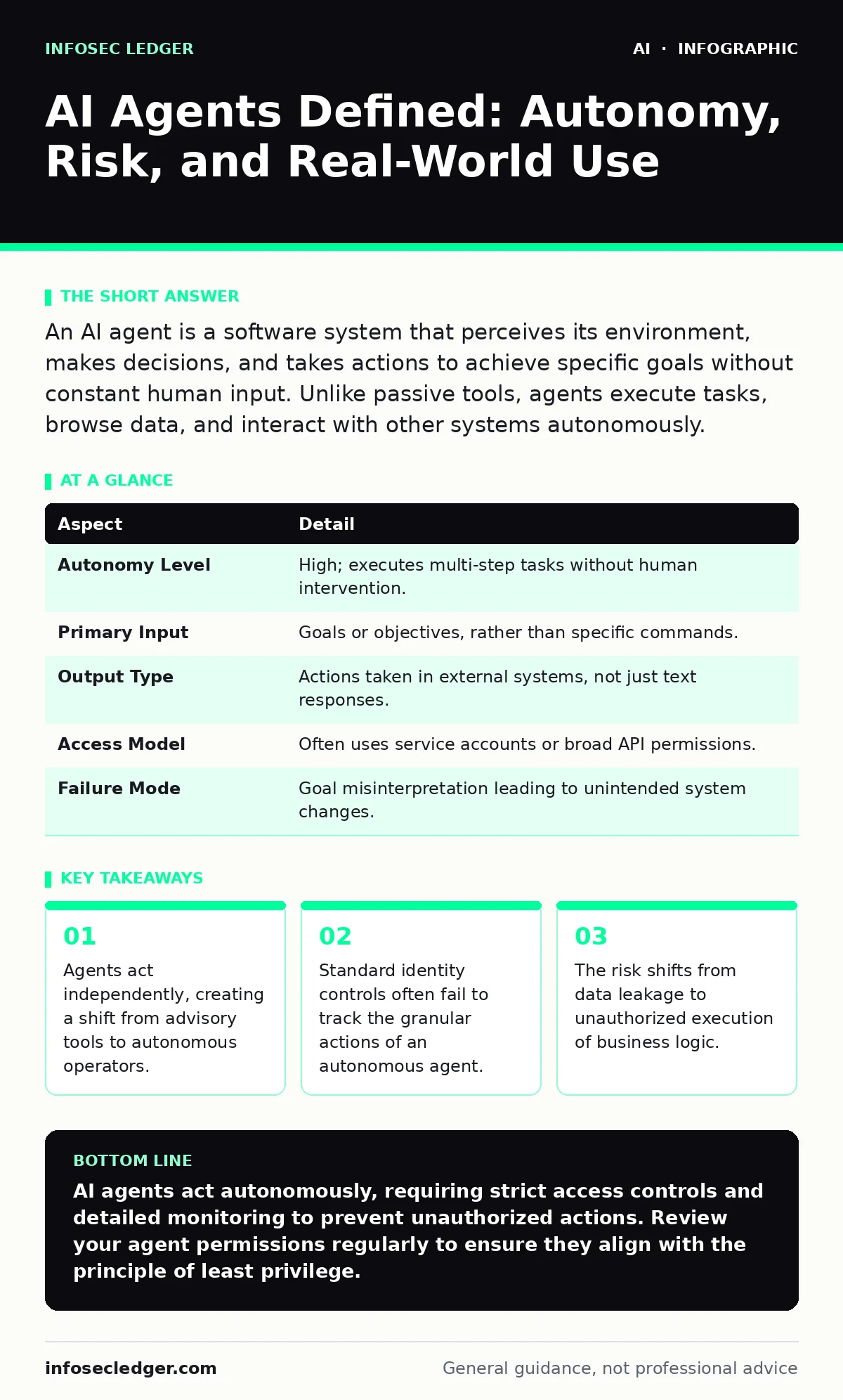
An AI agent is a software system that perceives its environment, makes decisions, and takes actions to achieve specific goals without constant human input. Unlike passive tools, agents execute tasks, browse data, and interact with other systems autonomously.
From Chatbot to Actor
Imagine a digital assistant that does not just answer questions but also books flights, negotiates prices, and files expense reports. This is the core distinction between a traditional chatbot and an AI agent. A chatbot waits for a prompt and returns a response. An agent receives a goal, plans the steps to achieve it, and executes those steps using available tools.
The term "agent" comes from computer science, where an agent is any entity that perceives its environment and acts upon it. In the context of modern artificial intelligence, this means the system can read emails, query databases, and click buttons. The shift is subtle but profound. You are no longer talking to a tool; you are delegating authority to a process.
This delegation changes how you manage security. When a human performs a task, you rely on their identity and permissions. When an agent performs a task, it often uses a service account or an API key. If that key is compromised, or if the agent misinterprets a goal, the consequences are immediate and automated.
How Agents Operate Day to Day
In a typical workflow, an agent operates in a loop. It observes the current state, decides on an action, executes that action, and then observes the result. This cycle repeats until the goal is met or a stop condition is reached.
Consider a customer support scenario. A standard bot might answer a question about return policies. An agent, however, can check the order history, verify the return window, generate a shipping label, and update the inventory system. It does not ask for permission for each step. It assumes the authority to complete the task.
This efficiency introduces complexity. The agent must understand context, handle errors, and navigate interfaces that were designed for humans, not machines. It may need to log into a portal, fill out a form, or interpret a PDF. Each of these actions requires access to systems that hold sensitive data.
| Aspect | Detail |
|---|---|
| Autonomy Level | High; executes multi-step tasks without human intervention. |
| Primary Input | Goals or objectives, rather than specific commands. |
| Output Type | Actions taken in external systems, not just text responses. |
| Access Model | Often uses service accounts or broad API permissions. |
| Failure Mode | Goal misinterpretation leading to unintended system changes. |
The Hidden Cost of Autonomy
The most unexpected consequence of using AI agents is the erosion of the "human in the loop" safety net. In traditional software, a human approves every significant change. An agent removes this checkpoint. The speed of execution outpaces the ability of a human to intervene.
This creates a hidden cost in monitoring. You cannot simply watch a screen to see what the agent is doing. You must log every API call, every data read, and every decision made. If your logging infrastructure is not designed for high-volume, automated actions, you will have blind spots.
Furthermore, agents often require broader permissions than humans need. A human employee might only access the data for their specific project. An agent that handles multiple projects may need access to a wider range of data to make decisions. This violates the principle of least privilege, which states that users and systems should only have the minimum access necessary to perform their functions.
Common Misconceptions
Many users assume that an AI agent is simply a smarter chatbot. This is incorrect. A chatbot is a interface. An agent is an operator. Confusing the two leads to poor security design. You secure a chatbot by filtering its inputs and outputs. You secure an agent by controlling its actions and its access to systems.
Another misconception is that agents are purely internal tools. In reality, they often interact with external services. An agent might book travel on a third-party site or post to social media. These external interactions introduce risks that your internal firewall cannot see. The agent acts as a bridge between your secure internal network and the open internet.
People also believe that agents are infallible because they follow logic. However, agents rely on probabilistic models. They can hallucinate, meaning they may believe a step is complete when it is not, or they may interpret a goal in a way that is technically correct but practically disastrous.
Security Gaps in Agent Design
The design of AI agents often overlooks the concept of least privilege. Developers may grant an agent full access to a database to ensure it can complete its tasks. This convenience creates a massive attack surface. If an attacker compromises the agent, they inherit all those permissions.
Another gap is the lack of audit trails. Traditional systems log user actions. Agents often operate in the background, and their actions may not be clearly attributed to a specific user or session. This makes it difficult to investigate incidents or understand the impact of a mistake.
To address these gaps, you must treat the agent as a distinct identity. It should have its own credentials, its own permissions, and its own logging. You should also implement guardrails, which are rules that limit what the agent can do. For example, an agent might be allowed to read data but not delete it.
Mitigating Risks in Practice
You can reduce risk by implementing strict access controls. The agent should only have access to the specific APIs and data sources it needs. Avoid using admin accounts for agents. Instead, create dedicated service accounts with limited permissions.
Monitoring is also critical. You need to track not just the outcomes of the agent's actions, but the decisions it made. This allows you to detect anomalies, such as an agent accessing data it never needed before. The NIST AI Risk Management Framework provides guidelines for managing these risks, emphasizing the need for transparency and accountability.
Regularly review the agent's permissions. As business needs change, the agent's access should be adjusted accordingly. Do not assume that the initial permissions are sufficient for the long term.
The Future of Agent Security
As agents become more common, the security landscape will shift. We will see new tools designed specifically to monitor and control agent behavior. These tools will need to understand the intent of the agent, not just its actions.
You will also see more emphasis on secure by design principles. Agents will be built with security constraints from the start, rather than having them added later. This includes built-in guardrails and automatic permission checks.
However, the fundamental challenge remains. Autonomy and security are often at odds. The more autonomous an agent is, the harder it is to control. You must find a balance that allows for efficiency without compromising safety.
Conclusion
AI agents represent a significant shift in how software interacts with business processes. They offer efficiency and automation but introduce new risks related to autonomy and access. Understanding the difference between an agent and a chatbot is the first step in managing these risks.
You must treat agents as distinct entities with their own security requirements. Implement strict access controls, monitor their actions closely, and regularly review their permissions. By doing so, you can harness the power of AI agents while minimizing the potential for harm.
Key takeaways
- Agents act independently, creating a shift from advisory tools to autonomous operators.
- Standard identity controls often fail to track the granular actions of an autonomous agent.
- The risk shifts from data leakage to unauthorized execution of business logic.
AI agents act autonomously, requiring strict access controls and detailed monitoring to prevent unauthorized actions. Review your agent permissions regularly to ensure they align with the principle of least privilege.
Frequently asked questions
How is an AI agent different from a chatbot?
A chatbot responds to prompts with text, while an AI agent executes actions to achieve a goal, such as booking a flight or updating a database.
Can AI agents be hacked?
Yes, if an attacker compromises the agent's credentials or exploits vulnerabilities in its code, they can control its actions and access its data.
What is the principle of least privilege for AI agents?
It means giving an agent only the minimum access necessary to perform its tasks, reducing the risk if the agent is compromised.
How do I monitor an AI agent?
Log all actions, decisions, and data accesses made by the agent, and use tools to detect anomalies in its behavior.
How this guide was produced: written by the InfoSec Ledger editorial team with AI assistance, checked against the public references listed below, and reviewed when the facts change. See our editorial policy or report an error.