
How Machine Learning Detects Fraud: Mechanisms, Limits, and Hidden Risks
Fraud detection models identify anomalies by mapping transaction patterns, yet they often flag legitimate behavior because they cannot distinguish intent from statistical deviation.
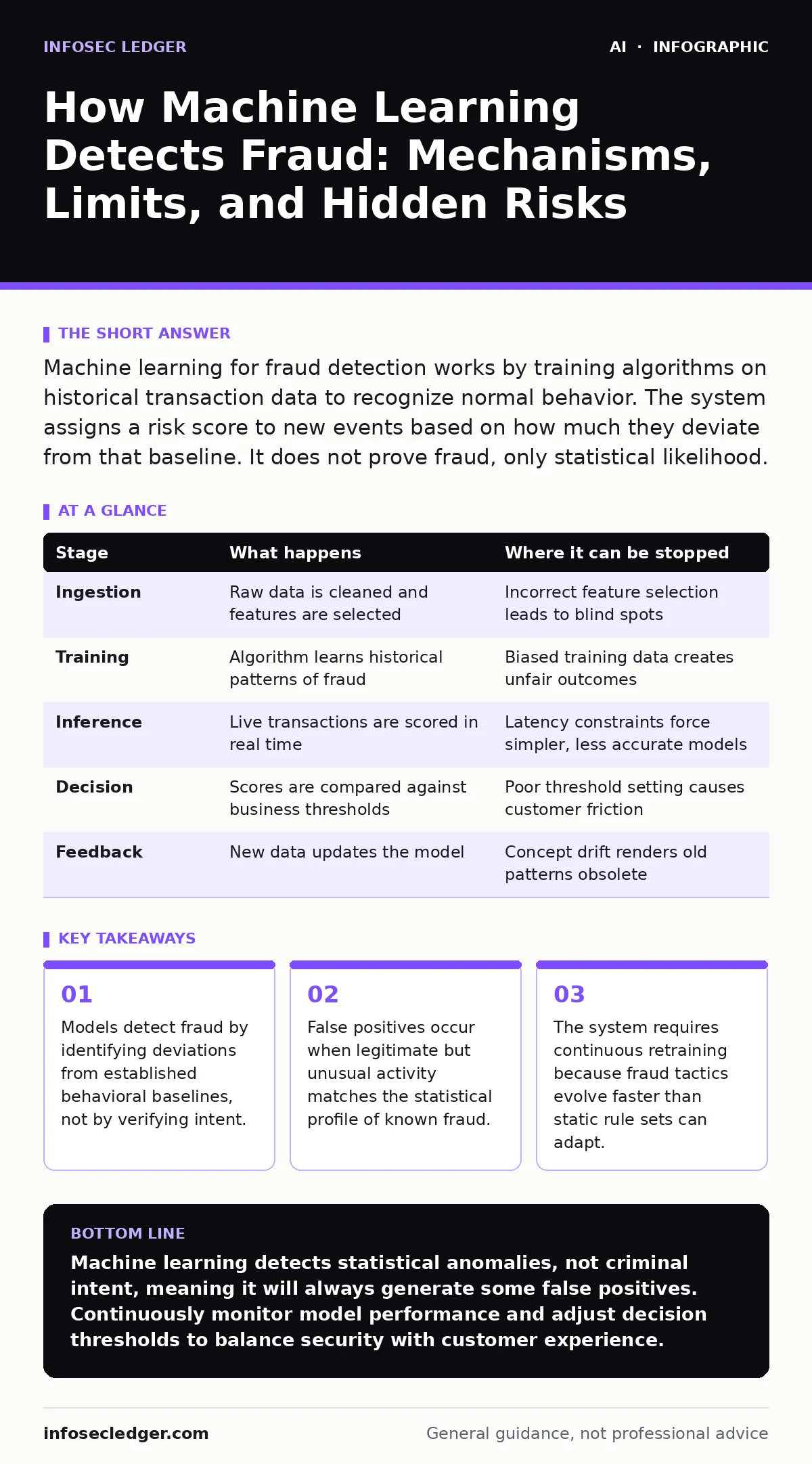
Machine learning for fraud detection works by training algorithms on historical transaction data to recognize normal behavior. The system assigns a risk score to new events based on how much they deviate from that baseline. It does not prove fraud, only statistical likelihood.
Data Ingestion and Feature Engineering
The process begins with raw data collection. The system ingests transaction records, user login times, device identifiers, and geographic locations. This data is noisy and incomplete. Engineers must clean it and select features, which are the specific data points the model will use to make decisions.
Choosing the right features determines what the model can see. If the data lacks context, such as the device’s battery level or the app version, the model operates with blinders on. A transaction from a new device is suspicious only if the system knows the user typically uses an old one. Without that historical baseline, the new device is just noise.
Model Training and Pattern Recognition
Once cleaned, the data feeds into the training phase. The algorithm examines thousands of historical transactions labeled as "legitimate" or "fraudulent." It builds a mathematical representation of normal behavior. This is not a rule set. It is a probability distribution.
The model identifies correlations that humans miss. It does not know why this is true. It only knows that the pattern predicts loss. This stage defines the baseline against which all future events are measured.
Real-Time Scoring and Inference
When a new transaction occurs, the system enters the inference stage. It extracts the same features from the live event and compares them to the trained model. The output is a risk score, usually a number between zero and one. A score near one indicates high probability of fraud.
This happens in milliseconds. The system must decide whether to approve, decline, or request additional verification before the user grows impatient. Speed is a constraint. Complex models that take longer to compute may be too slow for real-time payments. You often trade accuracy for latency, accepting a slightly higher error rate to keep checkout times short.
Decision Thresholds and Action Routing
A raw risk score is meaningless without a threshold. You must decide what score triggers a block. Setting the threshold too high misses fraud. Setting it too low blocks legitimate customers. This is a business decision, not a technical one.
Most systems use a tiered response. High-risk scores trigger an automatic decline. Medium-risk scores trigger step-up authentication, such as a one-time password. Low-risk scores pass through. This layering reduces friction for good users while catching most bad actors. The threshold shifts dynamically based on your tolerance for customer complaints versus financial loss.
The Feedback Loop and Concept Drift
Fraud evolves. Attackers change tactics to bypass current defenses. This causes concept drift, where the statistical relationship between features and fraud changes over time. A pattern that predicted fraud last month may be normal today because attackers have normalized it.
The model must be retrained with fresh data. This feedback loop incorporates new labeled examples, including false positives and missed fraud. Without this update, the model degrades. It becomes less accurate as the world changes around it. Monitoring this drift is as critical as the initial build.
| Stage | What happens | Where it can be stopped |
|---|---|---|
| Ingestion | Raw data is cleaned and features are selected | Incorrect feature selection leads to blind spots |
| Training | Algorithm learns historical patterns of fraud | Biased training data creates unfair outcomes |
| Inference | Live transactions are scored in real time | Latency constraints force simpler, less accurate models |
| Decision | Scores are compared against business thresholds | Poor threshold setting causes customer friction |
| Feedback | New data updates the model | Concept drift renders old patterns obsolete |
See also: 7 Access Control Mistakes for AI Agents and How to Fix Them
Limits and Unintended Consequences
Machine learning does not understand context. It sees numbers. A sudden large purchase from a new country is statistically identical for a traveling executive and a stolen credit card. The model cannot distinguish intent. This leads to false positives, which damage customer trust.
There is a hidden cost to accuracy. Reducing false positives often requires more manual review. This shifts the burden from automation to human analysts. You are not eliminating work; you are moving it. The system also inherits biases present in historical data. If past decisions disproportionately blocked certain demographics, the model will replicate that bias unless explicitly corrected.
See our guide on AI bias for methods to audit these outcomes. Additionally, consider how AI agents might interact with these detection systems, as automated bots can generate traffic that mimics human patterns, confusing the model. For a structured approach to managing these risks, refer to the NIST AI Risk Management Framework.
To keep the model effective, you must implement AI model monitoring to detect performance degradation. While fine-tuning can adjust a model for specific fraud types, it requires careful validation to avoid breaking existing detection capabilities. Be aware that insecure AI plugins and agents can introduce new attack vectors if they have access to transaction data. Finally, while AI content detection helps with phishing, it does not stop financial fraud directly. Watch out for voice cloning scams that bypass biometric checks, requiring separate audio verification layers.
Key takeaways
- Models detect fraud by identifying deviations from established behavioral baselines, not by verifying intent.
- False positives occur when legitimate but unusual activity matches the statistical profile of known fraud.
- The system requires continuous retraining because fraud tactics evolve faster than static rule sets can adapt.
Machine learning detects statistical anomalies, not criminal intent, meaning it will always generate some false positives. Continuously monitor model performance and adjust decision thresholds to balance security with customer experience.
Frequently asked questions
Does machine learning replace human fraud analysts?
No, it augments them. The system handles high-volume, repetitive scoring, while humans review complex edge cases and investigate false positives to improve the model.
How long does it take to train a fraud detection model?
Initial training can take days or weeks depending on data volume. However, the model requires continuous, incremental retraining as new data flows in to remain effective.
Can attackers fool machine learning fraud detection?
Yes, through adversarial attacks. Attackers may probe the system with small variations in transaction data to find patterns that the model misclassifies as legitimate.
Is historical data always sufficient for training?
No. If the historical data lacks examples of new fraud types, the model will not detect them. You must augment training data with synthetic examples or data from other sources.
How this guide was produced: written by the InfoSec Ledger editorial team with AI assistance, checked against the public references listed below, and reviewed when the facts change. See our editorial policy or report an error.