
Fine-Tuning AI Models: What It Is and Why It Matters
Fine-tuning adapts a general model to your specific data, creating a specialized tool that outperforms generic prompts in narrow tasks.
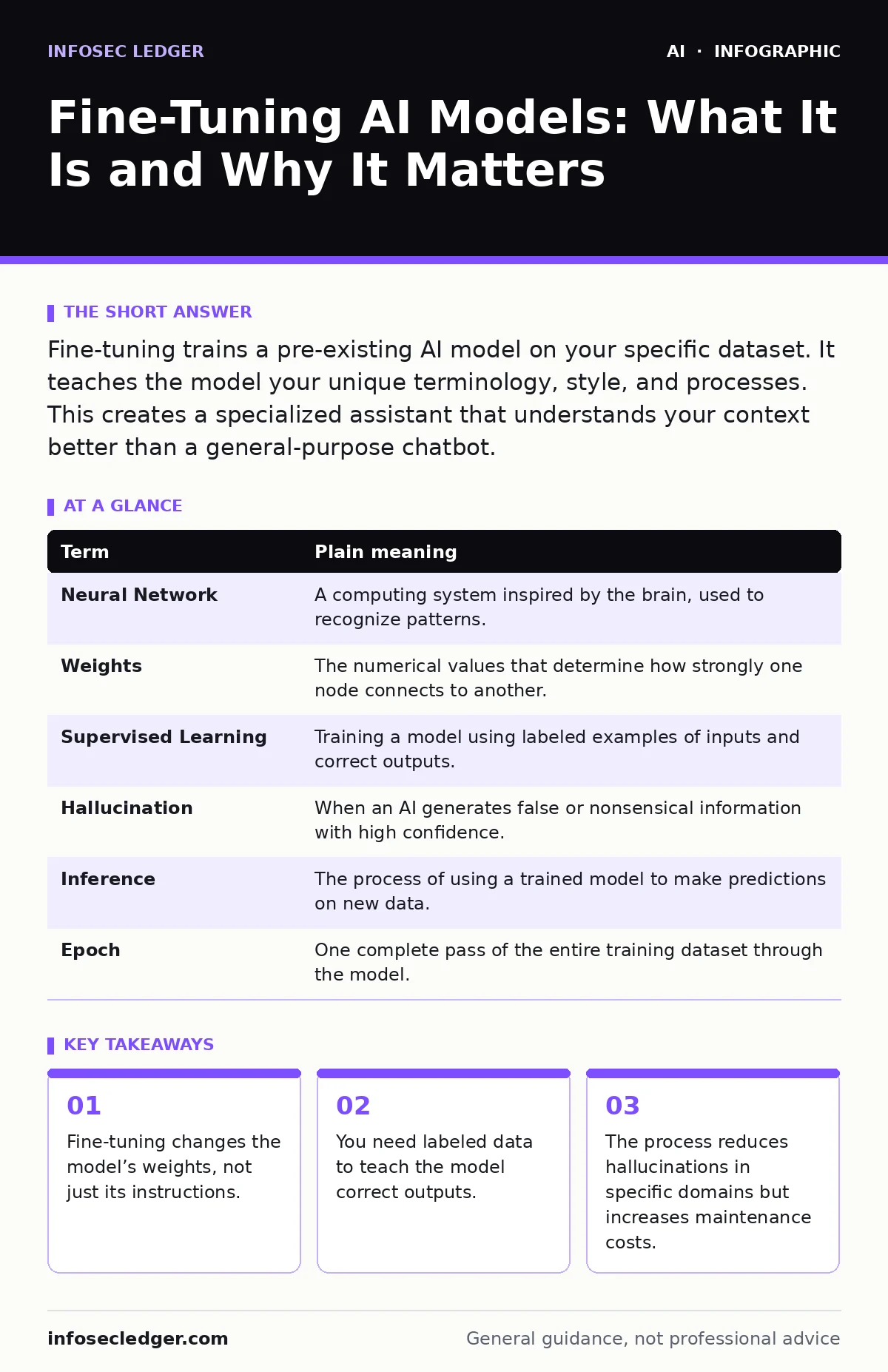
Fine-tuning trains a pre-existing AI model on your specific dataset. It teaches the model your unique terminology, style, and processes. This creates a specialized assistant that understands your context better than a general-purpose chatbot.
The Master Chef Analogy
Imagine you hire a master chef who has cooked every cuisine in the world. This chef is brilliant but generic. If you ask for a "spicy dish," they might serve Thai curry or Sichuan noodles. You do not want generic spice. You want your grandmother’s specific chili recipe.
Fine-tuning is the process of teaching that master chef your grandmother’s exact recipe. You do not teach them how to chop onions or boil water. They already know those basics. You only teach them the specific ratio of peppers, the timing of the simmer, and the secret ingredient. The chef remains a master cook, but now they specialize in your family’s flavor profile.
Weights Versus Prompts
Most people confuse fine-tuning with prompt engineering. Prompt engineering is telling the chef, "Make it spicy." It is a temporary instruction. The chef follows it this time, but forgets it next time. Fine-tuning changes the chef’s muscle memory. It alters the underlying mathematical weights of the neural network.
A neural network is a system of interconnected nodes that processes information. The weights are the strength of the connections between these nodes. When you fine-tune, you adjust these weights so the model associates your specific inputs with your desired outputs permanently. This makes the model faster and more accurate for your specific use case than a generic prompt ever could be.
The Data Requirement
You cannot fine-tune without data. But not just any data works. You need paired examples. Each example must have an input and a correct output. In our analogy, you need to show the chef the ingredients (input) and the perfect finished dish (output) many times.
This is called supervised learning. The model compares its guess to your correct answer and adjusts its weights to minimize the error. If you provide low-quality data, the model learns bad habits. This is where AI bias can enter your system. If your training data contains historical prejudices, the fine-tuned model will amplify them. You must audit your data for fairness before training begins.
Common Points of Confusion
Many assume fine-tuning replaces the need for clear instructions. It does not. You still need a system prompt to set the tone. Fine-tuning teaches the model what to say. The prompt teaches it how to say it.
Another confusion is scope. Fine-tuning is expensive in terms of compute and time. It is not worth it for one-off tasks. It is only valuable when you have thousands of similar requests. If you are building a tool that interacts with external systems, you must also consider insecure AI plugins and agents. A fine-tuned model is only as secure as the tools it is allowed to use.
The Hidden Costs
Fine-tuning creates a maintenance burden. Your business processes change. Your products change. When they do, your fine-tuned model becomes outdated. It will start giving incorrect answers based on old data. You must retrain the model periodically.
This is why AI model monitoring is critical. You need to track the model’s performance over time. If accuracy drops, you know it is time to update the training data. This ongoing cost is often overlooked in initial budgeting. It is not a one-time fix. It is a continuous cycle of data collection, training, and deployment.
See also: 7 Access Control Mistakes for AI Agents and How to Fix Them
Mini Glossary
| Term | Plain meaning |
|---|---|
| Neural Network | A computing system inspired by the brain, used to recognize patterns. |
| Weights | The numerical values that determine how strongly one node connects to another. |
| Supervised Learning | Training a model using labeled examples of inputs and correct outputs. |
| Hallucination | When an AI generates false or nonsensical information with high confidence. |
| Inference | The process of using a trained model to make predictions on new data. |
| Epoch | One complete pass of the entire training dataset through the model. |
Try This Now
- Identify a repetitive task where the current AI gives inconsistent answers.
- Collect fifty examples of the ideal input and the perfect output.
- Review the outputs for consistency and bias before considering training.
Integration With Policy
Fine-tuning creates a proprietary asset. You own the weights adjusted by your data. This raises questions about ownership and usage. You should align your technical strategy with your AI usage policies at work. Define who can access the model and how it can be used.
If you are evaluating the risks of deploying this model, refer to the NIST AI Risk Management Framework. It provides a structured way to assess potential harms. Do not skip this step. A specialized model can do more damage if it goes wrong than a generic one.
Key takeaways
- Fine-tuning changes the model’s weights, not just its instructions.
- You need labeled data to teach the model correct outputs.
- The process reduces hallucinations in specific domains but increases maintenance costs.
Frequently asked questions
Do I need a GPU to fine-tune a model?
Yes, fine-tuning requires significant computational power. Most small teams use cloud services to handle the heavy lifting.
Can I fine-tune any AI model?
No, only models that provide access to their weights or offer a fine-tuning API can be adjusted. Closed models cannot be fine-tuned.
How long does fine-tuning take?
It varies by model size and data volume. It can take hours or days. The initial setup is slower than the actual training.
Is fine-tuning better than RAG?
Retrieval-Augmented Generation (RAG) is often better for factual data. Fine-tuning is better for style and reasoning. Use both if needed.
How this guide was produced: written by the InfoSec Ledger editorial team with AI assistance, checked against the public references listed below, and reviewed when the facts change. See our editorial policy or report an error.