
How AI Bias Works: Trace Distortion From Data To Decision
Bias rarely originates in code logic. It accumulates silently through data selection and feedback loops that reinforce historical inequalities long before deployment.
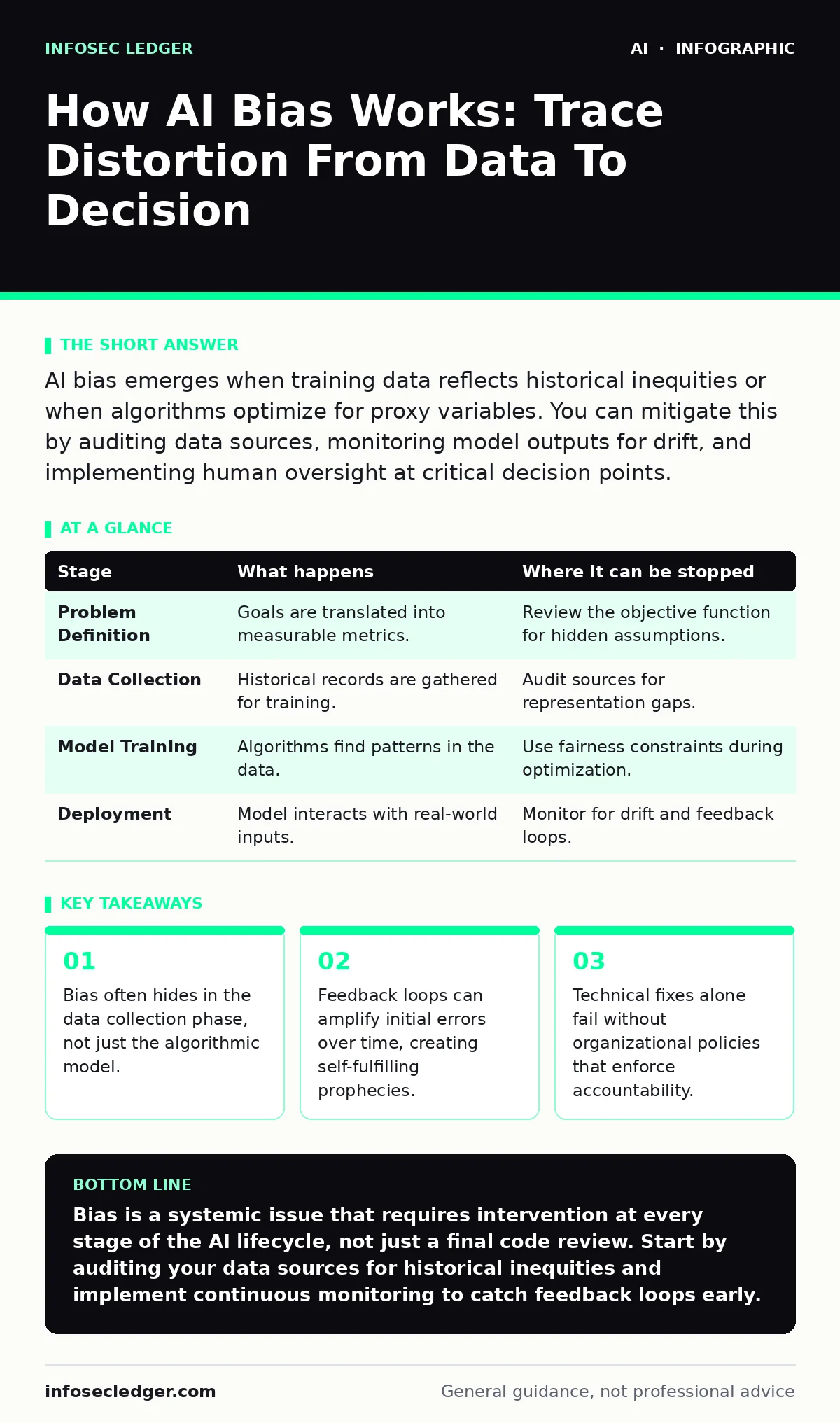
AI bias emerges when training data reflects historical inequities or when algorithms optimize for proxy variables. You can mitigate this by auditing data sources, monitoring model outputs for drift, and implementing human oversight at critical decision points.
The Anatomy of Algorithmic Distortion
Artificial intelligence systems do not possess intent. They process patterns. When those patterns reflect historical prejudices or structural gaps, the system replicates them. This is not a bug in the traditional sense. It is a feature of the optimization process. The model seeks the most efficient path to a correct answer based on the information provided. If the information is skewed, the efficiency is misplaced.
You must understand that bias is not a single event. It is a chain of decisions. Each link in the chain introduces a new potential for distortion. By the time the model makes a prediction, the original signal has been filtered through multiple layers of interpretation. Understanding where these filters exist allows you to intervene before the damage occurs.
Stage 1: Problem Definition and Scope
The first stage determines what the AI is supposed to do. This seems straightforward, but the definition itself contains assumptions. Suppose you build a model to predict job performance. You must define what "performance" means. Is it sales volume? Customer satisfaction scores? Years of tenure? Each choice excludes certain types of value.
If you define performance solely by sales volume, the model will favor traits associated with aggressive selling. It will ignore collaborative skills or long-term client retention. The bias enters here, in the translation of a complex human concept into a measurable metric. You cannot fix a biased output if the goal itself is misaligned with reality.
| Stage | What happens | Where it can be stopped |
|---|---|---|
| Problem Definition | Goals are translated into measurable metrics. | Review the objective function for hidden assumptions. |
| Data Collection | Historical records are gathered for training. | Audit sources for representation gaps. |
| Model Training | Algorithms find patterns in the data. | Use fairness constraints during optimization. |
| Deployment | Model interacts with real-world inputs. | Monitor for drift and feedback loops. |
Stage 2: Data Collection and Representation
Data is the fuel for AI. The quality of that fuel determines the engine's behavior. Most organizations rely on historical data to train their models. This data is a record of past decisions. If those past decisions were influenced by human bias, the data encodes that bias.
Imagine a hiring tool trained on ten years of resumes. If the company historically hired fewer women for technical roles, the data will show a correlation between male names and successful hires. The model learns this correlation. It does not know it is discriminatory. It sees only a pattern that predicted past success. You must identify these gaps before training begins. Collecting more data does not help if the new data comes from the same biased source.
Stage 3: Feature Selection and Proxy Variables
Not all data is created equal. Some features are direct indicators, while others are proxies. A proxy variable is a metric that correlates with the target but is not the cause. Age might proxy for experience. Zip code might proxy for race or socioeconomic status.
When you include zip code in a lending model, you think you are assessing location risk. In reality, you may be reinforcing redlining practices. The model uses the proxy to make decisions that effectively discriminate, even if race is explicitly excluded from the dataset. This is known as disparate impact. You must scrutinize every feature for its potential to act as a stand-in for protected characteristics. Removing the obvious biased features is not enough. You must hunt for the proxies.
Stage 4: Model Training and Optimization
During training, the algorithm adjusts its internal weights to minimize error. It tries to get the right answer as often as possible. If the dataset is imbalanced, the model will optimize for the majority class. It becomes very good at predicting the common case and terrible at the rare case.
Suppose a fraud detection model sees mostly legitimate transactions. It will learn to flag everything as legitimate to maximize overall accuracy. It will miss the rare fraudulent transactions because they are statistically insignificant in the training set. This is the accuracy paradox. A high accuracy score can mask a complete failure to detect the minority class. You must evaluate models using metrics that account for class imbalance, such as precision and recall, rather than just overall accuracy.
See also: AI Agents for Small Businesses: Secure Automation Risks
Stage 5: Deployment and Feedback Loops
Deployment is not the end of the process. It is the beginning of interaction. The model makes predictions, and those predictions influence the world. When the world reacts to the prediction, new data is generated. This new data is often fed back into the model for retraining.
Imagine a predictive policing tool that directs officers to certain neighborhoods. Officers find more crime there because they are looking harder. The cycle reinforces itself. This is a feedback loop. It creates a self-fulfilling prophecy. The bias grows with each iteration. Monitoring for this drift is critical. You must separate the model's predictions from the ground truth to see if the model is shaping reality rather than reflecting it.
Stage 6: Audit and Continuous Monitoring
Static audits are insufficient. Bias changes as the environment changes. You need continuous monitoring to detect when the model's behavior diverges from expectations. This involves tracking performance across different demographic groups over time.
If the model's accuracy drops for a specific group, it indicates drift. This could be due to changes in the population or changes in the model's interpretation. You must have a process to investigate these anomalies. This is where the NIST AI Risk Management Framework provides useful structure. It offers a standardized approach to identifying and mitigating risks throughout the AI lifecycle. Integrating these checks into your development pipeline ensures that bias is managed as a continuous concern, not a one-time fix.
Operationalizing Bias Mitigation
Technical measures must be paired with organizational policies. You cannot audit what you do not track. Establish clear accountability for AI decisions. Define who is responsible when a model fails. Create AI usage policies at work that specify when human review is mandatory.
Automated systems should not make high-stakes decisions without human oversight. This is particularly true for areas like hiring, lending, and healthcare. Human reviewers can catch edge cases that the model misses. They can provide context that the data lacks. However, humans are also biased. Training reviewers to recognize their own biases is part of the solution. You are building a system of checks and balances, not a replacement for human judgment.
The Hidden Cost of Fairness
Pursuing fairness often comes with trade-offs. Reducing bias in one area may increase it in another. You might improve representation for one group while decreasing accuracy for another. This is the fairness-accuracy trade-off. You must decide which metrics matter most for your specific use case.
There is no universally "fair" model. Fairness is a value judgment. It requires explicit decisions about what outcomes are acceptable. Hiding behind the algorithm avoids these difficult conversations. By understanding the mechanics of bias, you can make these decisions consciously. You can document the trade-offs and justify the choices. This transparency builds trust with users and regulators.
Key takeaways
- Bias often hides in the data collection phase, not just the algorithmic model.
- Feedback loops can amplify initial errors over time, creating self-fulfilling prophecies.
- Technical fixes alone fail without organizational policies that enforce accountability.
Bias is a systemic issue that requires intervention at every stage of the AI lifecycle, not just a final code review. Start by auditing your data sources for historical inequities and implement continuous monitoring to catch feedback loops early.
Frequently asked questions
How do I know if my AI model is biased?
Test the model's performance across different demographic groups. Look for significant disparities in accuracy, false positive rates, or false negative rates.
Can I remove bias from historical data?
You can mitigate it by reweighting samples or using synthetic data to balance representation, but you cannot erase the historical context entirely.
What is the difference between bias and variance?
Bias is a systematic error that leads to inaccurate predictions. Variance is the sensitivity of the model to fluctuations in the training data.
Does more data always reduce bias?
No. If the additional data comes from the same biased source, it will only reinforce the existing patterns and errors.
How this guide was produced: written by the InfoSec Ledger editorial team with AI assistance, checked against the public references listed below, and reviewed when the facts change. See our editorial policy or report an error.