
Initial Access Broker Prevention Checklist for Secure Operations
Initial access brokers monetize compromised credentials, making identity hygiene more valuable than perimeter firewalls for stopping ransomware before it starts.
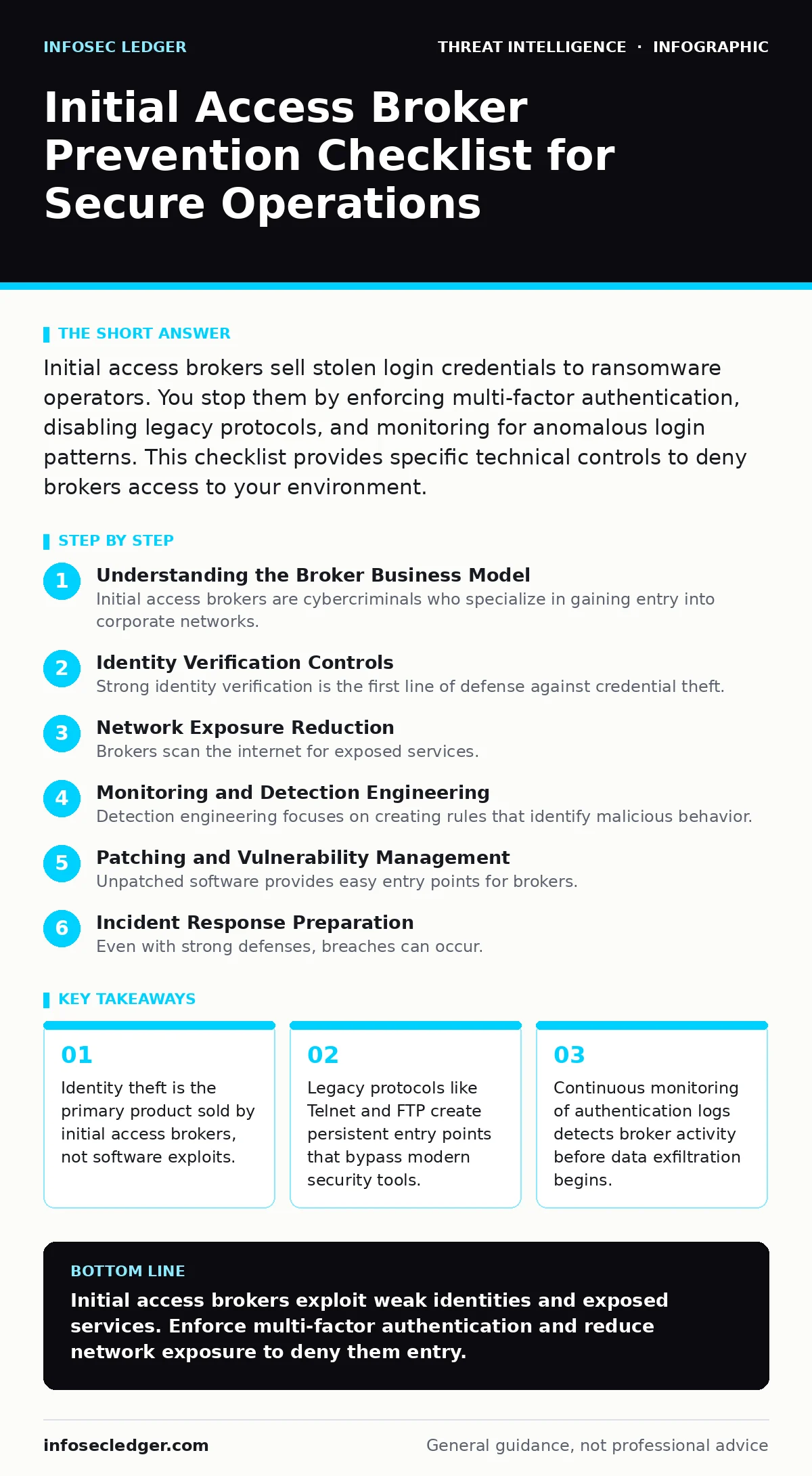
Initial access brokers sell stolen login credentials to ransomware operators. You stop them by enforcing multi-factor authentication, disabling legacy protocols, and monitoring for anomalous login patterns. This checklist provides specific technical controls to deny brokers access to your environment.
Understanding the Broker Business Model
Initial access brokers are cybercriminals who specialize in gaining entry into corporate networks. They do not typically deploy ransomware themselves. Instead, they sell verified access credentials to other criminal groups. This division of labor increases efficiency in the cybercrime ecosystem. You must understand that your perimeter is less relevant than your identity management. Brokers target weak authentication mechanisms and unpatched remote access services. They seek persistent access that survives password changes. This model shifts the attack surface from network edges to user credentials. Your defenses must reflect this shift in priority.
Identity Verification Controls
Strong identity verification is the first line of defense against credential theft. Brokers rely on stolen passwords to bypass initial security checks. Multi-factor authentication adds a layer of verification that stolen passwords cannot satisfy. This control breaks the chain of initial access. You must enforce this for all users, including administrators and service accounts. Conditional access policies allow you to restrict logins based on device health and location. This reduces the risk of unauthorized access from compromised devices.
- Enforce multi-factor authentication for all human users: Brokers cannot replicate physical tokens or biometric data.
- Disable legacy authentication protocols: Old protocols often lack modern encryption and security features.
- Implement conditional access policies: Restrict logins based on device compliance and geographic location.
- Require phishing-resistant authentication methods: Hardware keys prevent credential spoofing attacks.
- Audit service account credentials: Automated accounts often have excessive privileges and weak passwords.
Network Exposure Reduction
Brokers scan the internet for exposed services. Remote desktop protocol and virtual private networks are common targets. These services provide direct access to internal systems. Reducing your attack surface limits the opportunities for brokers. You must ensure that no administrative interfaces are directly accessible from the public internet. Network segmentation prevents lateral movement if a broker gains initial access. This containment strategy limits the damage of a successful breach. Regular network scanning helps identify forgotten or misconfigured services.
- Block remote desktop protocol from the internet: Direct exposure allows brute-force and credential stuffing attacks.
- Use a zero-trust network architecture: Verify every connection regardless of its source location.
- Segment administrative networks: Isolate management interfaces from general user traffic.
- Disable unused network services: Each open port is a potential entry point for attackers.
- Implement network access control: Ensure only authorized devices can connect to the network.
Monitoring and Detection Engineering
Detection engineering focuses on creating rules that identify malicious behavior. Brokers often move slowly to avoid triggering alarms. You need to monitor for unusual login patterns and privilege escalations. Log management systems collect data from various sources for analysis. This centralized view allows you to spot anomalies across the environment. Threat hunting proactively searches for indicators of compromise that automated tools miss. Combining these approaches improves your visibility into broker activity.
- Monitor for impossible travel logins: Users cannot log in from distant locations in short periods.
- Alert on after-hours administrative access: Unexpected admin activity often indicates a breach.
- Track privilege escalation events: Brokers attempt to gain higher access levels after initial entry.
- Analyze failed login spikes: High failure rates suggest brute-force or credential stuffing attacks.
- Review successful logins from new IPs: New sources may indicate compromised credentials.
Patching and Vulnerability Management
Unpatched software provides easy entry points for brokers. Vulnerabilities in remote access tools are frequently exploited. You must prioritize patching for internet-facing systems. Regular vulnerability assessments identify weaknesses before attackers do. This proactive approach reduces the window of opportunity for brokers. Automated patch management ensures timely updates for critical systems. Delaying updates increases the risk of exploitation.
- Prioritize patching remote access software: These tools are high-value targets for initial access.
- Automate security updates: Manual patching often leads to delays and missed updates.
- Scan for known vulnerabilities regularly: Automated tools identify weaknesses in your environment.
- Isolate vulnerable systems temporarily: Remove at-risk systems from the network during patching.
- Review vendor security advisories: Stay informed about new threats to your software stack.
See also: What Is MITRE ATT&CK Framework Used For: Practical Defense Mapping · Network Scanning Explained: How Attackers Map Your Digital Perimeter
Incident Response Preparation
Even with strong defenses, breaches can occur. You must have a plan to respond to initial access. Incident response plans outline steps for containment and recovery. Regular testing ensures your team knows their roles. This preparation reduces downtime and data loss. Coordination with industry groups like ISACs provides shared threat intelligence. This collaboration helps you stay ahead of emerging tactics.
- Define roles for incident response: Clear responsibilities speed up containment efforts.
- Test response plans regularly: Drills reveal gaps in your preparation.
- Establish communication protocols: Keep stakeholders informed during an incident.
- Document evidence collection procedures: Preserve data for forensic analysis.
- Review plans after each incident: Continuous improvement strengthens your defenses.
Key takeaways
- Identity theft is the primary product sold by initial access brokers, not software exploits.
- Legacy protocols like Telnet and FTP create persistent entry points that bypass modern security tools.
- Continuous monitoring of authentication logs detects broker activity before data exfiltration begins.
Initial access brokers exploit weak identities and exposed services. Enforce multi-factor authentication and reduce network exposure to deny them entry.
Frequently asked questions
How do initial access brokers find my company?
They use automated tools to scan the internet for exposed services and weak credentials. They also purchase data from previous breaches to target specific organizations.
Is multi-factor authentication enough to stop them?
Multi-factor authentication significantly reduces risk but is not foolproof. You must also monitor for anomalous behavior and keep software updated to maintain security.
What is the difference between a broker and a ransomware gang?
Brokers specialize in gaining initial access and selling that access. Ransomware gangs use that access to encrypt data and demand payment. They are separate entities in the cybercrime supply chain.
How often should I review my access controls?
Review access controls quarterly or after any significant change in personnel or infrastructure. Regular reviews ensure that permissions remain appropriate and secure.
How this guide was produced: written by the InfoSec Ledger editorial team with AI assistance, checked against the public references listed below, and reviewed when the facts change. See our editorial policy or report an error.