
Why is anonymization a challenge of cybersecurity for your data
True anonymization fails because modern re-identification techniques can link stripped data points back to specific individuals with alarming accuracy.
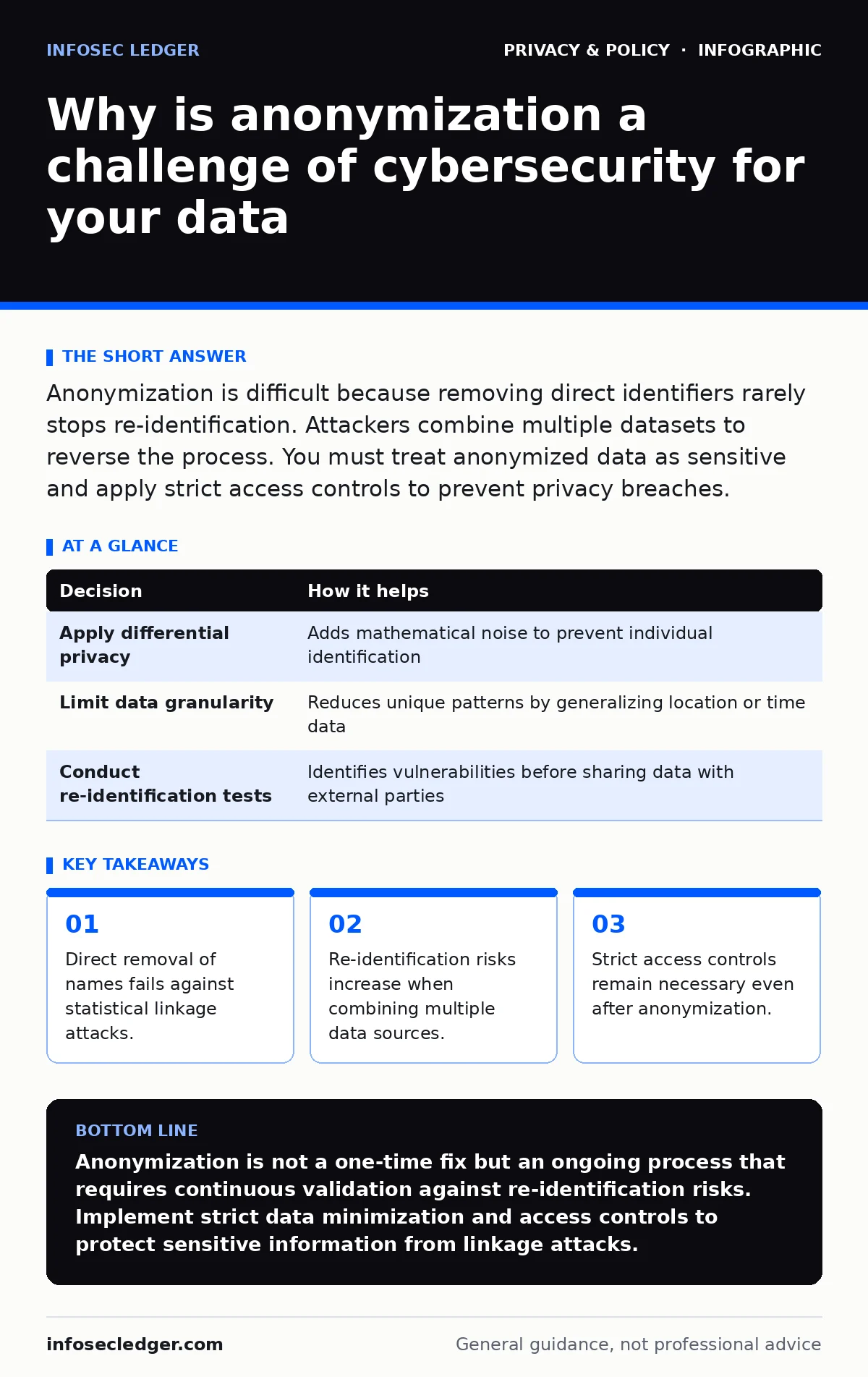
Anonymization is difficult because removing direct identifiers rarely stops re-identification. Attackers combine multiple datasets to reverse the process. You must treat anonymized data as sensitive and apply strict access controls to prevent privacy breaches.
Why is anonymization a challenge of cybersecurity
Anonymization struggles to protect data because modern computational power allows attackers to reverse the process. Removing direct identifiers like names or email addresses is insufficient. Attackers use statistical methods to link remaining data points to public records. This creates a false sense of security for organizations that believe their data is safe. The core problem is that unique patterns remain in the data even after stripping obvious labels. You cannot simply delete information and assume the risk disappears. The residual data often contains enough signal to identify individuals when combined with other sources.
The mechanics of re-identification attacks
Re-identification occurs when an attacker matches anonymized records to a separate dataset containing real identities. This process exploits the uniqueness of human behavior and attributes. Suppose a dataset contains age, zip code, and gender. These three fields alone can identify a large portion of the population uniquely. An attacker does not need to hack your server directly. They only need access to a secondary list that links those attributes to names. This secondary list might be a voter registry or a marketing database. The attack succeeds by finding the intersection between your data and the external list.
Data linkage and the power of context
Contextual information often carries more identifying power than direct identifiers. Location data, purchase history, and device fingerprints create unique signatures. Even if you remove timestamps and IP addresses, the sequence of events may remain distinct. Imagine a user who buys a specific medical prescription at a specific pharmacy. That pattern is rare enough to be unique. An attacker can observe this pattern in your anonymized dataset and match it to public health records. The challenge lies in the sheer volume of available context. Every digital interaction adds a layer of identifiable data that complicates true anonymization.
The limits of k-anonymity and differential privacy
Standard techniques like k-anonymity aim to ensure each record is indistinguishable from at least k-1 other records. This method groups data to hide individual contributions. However, it fails when an attacker has background knowledge about the target. If the attacker knows the victim belongs to a small subgroup, they can isolate that subgroup within the larger set. Differential privacy adds mathematical noise to the data to mask individual contributions. While more robust, it reduces the utility of the data for analysis. You face a trade-off between data accuracy and privacy protection. Finding the right balance requires careful tuning and ongoing assessment.
What goes wrong when anonymization fails
When anonymization fails, organizations face regulatory penalties and loss of customer trust. Data breaches involving personally identifiable information trigger strict reporting requirements. Even if the data was intended to be anonymized, regulators may classify it as personal data if re-identification is possible. This classification exposes the organization to fines under frameworks like GDPR. Beyond legal consequences, reputational damage occurs when users realize their private habits were exposed. Users may stop using your services if they perceive a lack of privacy protection. The cost of remediation often exceeds the initial effort to implement stronger privacy measures.
| Decision | How it helps |
|---|---|
| Apply differential privacy | Adds mathematical noise to prevent individual identification |
| Limit data granularity | Reduces unique patterns by generalizing location or time data |
| Conduct re-identification tests | Identifies vulnerabilities before sharing data with external parties |
See also: CCPA Compliance: 10 Answers to Complex Privacy Questions
Implementing privacy by design
You must integrate privacy controls into your system architecture from the start. Privacy by design ensures that data minimization and security are default settings. Collect only the data you absolutely need for your business function. Retain it only as long as necessary. This reduces the surface area for potential attacks. Implement access controls that restrict who can view raw data before anonymization. Use encryption to protect data in transit and at rest. Regular audits help verify that your anonymization processes remain effective against new attack methods. This proactive approach reduces risk more effectively than reactive measures.
Managing third-party data risks
Sharing data with partners introduces additional re-identification risks. Third parties may not apply the same privacy standards as your organization. They might combine your data with their own datasets, creating new linking opportunities. You need clear contracts that define how data must be handled and protected. Require partners to undergo security assessments before receiving data. Monitor their compliance regularly. If a partner suffers a breach, your data may be exposed even if your own systems are secure. Understanding these dependencies is critical for maintaining overall privacy posture.
Addressing biometric and facial recognition risks
Biometric data presents unique challenges for anonymization. Fingerprints and facial features are inherently identifying and cannot be changed like passwords. Facial recognition risks are high because these features are unique to each individual. Even if you store only a mathematical representation of a face, it can be used to identify the person. You must treat biometric data with the highest level of security. Consider whether you need to store the raw biometric data at all. Using local processing on the user’s device can reduce the need to transmit sensitive data to your servers. This approach aligns with privacy best practices for sensitive information.
Key takeaways
- Direct removal of names fails against statistical linkage attacks.
- Re-identification risks increase when combining multiple data sources.
- Strict access controls remain necessary even after anonymization.
Anonymization is not a one-time fix but an ongoing process that requires continuous validation against re-identification risks. Implement strict data minimization and access controls to protect sensitive information from linkage attacks.
Frequently asked questions
Can I anonymize data enough to share it publicly?
True public anonymization is nearly impossible due to re-identification risks. You should assume any shared data could be linked back to individuals and apply strict usage restrictions.
How do I know if my anonymization method is secure?
Conduct regular re-identification tests using simulated attacks. Compare your anonymized dataset against known public records to see if individuals can be uniquely identified.
Is differential privacy worth the loss of data accuracy?
For most business analytics, the slight loss of accuracy is acceptable given the strong privacy guarantees. It prevents attackers from isolating individual records in the dataset.
What is the difference between anonymization and pseudonymization?
Pseudonymization replaces identifiers with reversible codes, keeping the data classified as personal. Anonymization aims to make re-identification impossible, though this is difficult to achieve in practice.
How this guide was produced: written by the InfoSec Ledger editorial team with AI assistance, checked against the public references listed below, and reviewed when the facts change. See our editorial policy or report an error.