
Securing AI Agents With Information-Flow Control: The Silent Boundary
Information-flow control stops data leakage by tagging every byte, ensuring sensitive inputs never mix with public outputs in autonomous systems.
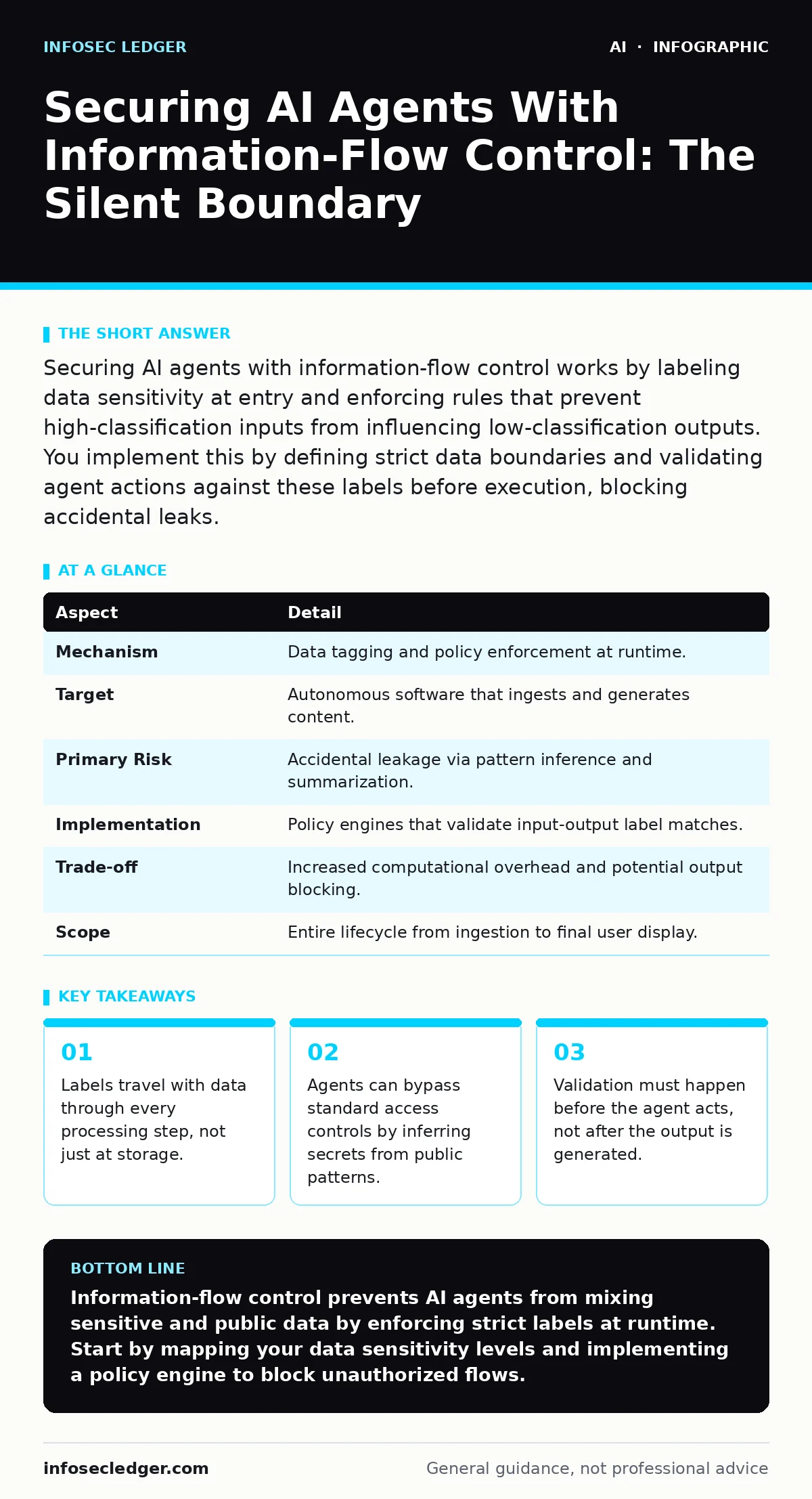
Securing AI agents with information-flow control works by labeling data sensitivity at entry and enforcing rules that prevent high-classification inputs from influencing low-classification outputs. You implement this by defining strict data boundaries and validating agent actions against these labels before execution, blocking accidental leaks.
The Post Office Analogy
Imagine a postal worker who sorts letters. The worker sees the address on every envelope. If the worker writes down addresses from confidential legal mail and uses them to address public marketing flyers, a breach has occurred. The worker did not steal the letters. The worker simply mixed information streams. AI agents operate similarly. They ingest vast amounts of text, learn patterns, and generate new text. Without strict boundaries, they blend sensitive source material into public-facing responses. This blending is the core risk.
Securing AI agents with information-flow control addresses this specific mixing problem. It treats data not as static files but as flowing streams with attached security labels. When an agent processes information, the system tracks those labels. If the agent tries to output text derived from a high-security label into a low-security channel, the system blocks the action. This prevents the "postal worker" error at scale.
| Aspect | Detail |
|---|---|
| Mechanism | Data tagging and policy enforcement at runtime. |
| Target | Autonomous software that ingests and generates content. |
| Primary Risk | Accidental leakage via pattern inference and summarization. |
| Implementation | Policy engines that validate input-output label matches. |
| Trade-off | Increased computational overhead and potential output blocking. |
| Scope | Entire lifecycle from ingestion to final user display. |
How Information-Flow Control Works
Information-flow control (IFC) assigns a security label to every piece of data. These labels represent sensitivity levels, such as public, internal, or confidential. When an AI agent reads data, it inherits the label. As the agent processes the data, the label propagates. If the agent combines public data with confidential data, the resulting context inherits the highest label. This is called label joining.
The system enforces a simple rule: data can flow from high to low only if explicitly permitted. Usually, it is not permitted. When the agent attempts to generate a response, the system checks the label of the generated text. If the text carries a confidential label, but the destination is a public chat interface, the system rejects the output. The agent never sends the message. The user sees an error or a sanitized version. This stops leakage before it leaves the system.
This mechanism differs from traditional access controls. Access controls check if a user has permission to read a file. They do not track what the user does with that file after reading it. IFC tracks the data itself. Even if the agent has permission to read confidential data, it cannot use that data to create public content. This distinction is critical for autonomous systems that operate without direct human supervision.
Who This Affects
Any organization using AI agents that handle mixed data faces this risk. Small businesses often use AI for customer support. These agents read private customer records to answer questions. They also post updates to public social media channels. If the agent confuses the two tasks, it leaks private data. Large enterprises face similar issues with internal research and public marketing.
Developers building custom agents are also affected. They must design the information flow from the start. Retrofitting IFC into an existing agent is difficult. The agent may have already learned patterns from mixed data. Those patterns become hard to remove. The risk extends to third-party plugins. An agent might use a plugin that lacks IFC. The plugin can strip labels or ignore boundaries. This creates a weak link in the chain.
See also: insecure AI plugins and agents for details on third-party risks.
What People Usually Get Wrong
Many assume that encryption solves this problem. Encryption protects data at rest and in transit. It does not protect data while the AI is processing it. The AI must decrypt the data to understand it. Once decrypted, the data is visible to the model. If the model generates output based on that data, encryption offers no protection. IFC works on the decrypted, active data.
Others believe that prompt engineering is enough. You can instruct an agent to "never share private data." This is fragile. Agents can be tricked into ignoring instructions. They can also make honest mistakes. They might summarize a private contract in a way that reveals key terms. IFC does not rely on the agent's understanding. It relies on mathematical labels. The system enforces the rule regardless of the agent's intent.
A third mistake is ignoring inference. An agent might not copy text verbatim. It might rewrite a secret using different words. IFC handles this by labeling the entire context. If the context contains secrets, any output derived from it inherits the secret label. The system does not need to recognize the specific secret. It recognizes the label. This catches paraphrasing and summarization attacks.
Implementing the Control
You start by defining your data labels. Create a clear hierarchy. Common labels include public, internal, confidential, and restricted. Map your data sources to these labels. Customer names are confidential. Company slogans are public. Financial reports are restricted. This mapping must be accurate. Garbage in, garbage out applies to labels too.
Next, integrate a policy engine. This engine sits between the agent and the data sources. It intercepts all inputs and outputs. It checks the labels. It enforces the flow rules. You must configure the engine to block high-to-low flows. You may allow low-to-high flows, as public data can safely inform confidential decisions. This directionality is key.
Finally, test the system. Try to force a leak. Feed the agent confidential data and ask it to post publicly. The system should block the action. If it does not, your policy is too loose. You must tighten the rules. This testing is ongoing. As you add new data sources, you must update the labels. As you change agent tasks, you must review the flow rules.
See also: access controls for AI agents for broader permission management.
See also: AI Generated Phishing: How Automated Fraud Bypasses Human Defense · Access Controls for AI Agents: Secure Autonomous Systems
The Hidden Costs
IFC adds latency. Every input and output requires a label check. This slows down the agent. For real-time applications, this delay might be noticeable. You must balance security with performance. Caching labels can help. You do not need to re-label data that has already been processed. But caching introduces complexity. You must ensure cached labels remain valid.
IFC also reduces flexibility. Agents cannot freely mix data. This limits their creativity. An agent cannot use a confidential customer insight to improve a public marketing campaign. This might frustrate business goals. You must accept this trade-off. Some data must remain separate. You cannot have perfect security and perfect utility. You must choose which data flows are critical.
Beyond Basic Controls
Information-flow control is not a silver bullet. It works best when combined with other measures. You need strong identity management. You need audit logs. You need human oversight. IFC handles the data flow. It does not handle the agent's behavior. An agent might leak data by deleting files or changing settings. IFC does not stop that. You need separate controls for those actions.
You must also consider model training. If you train your own model, you must apply IFC during training. The model learns from the data it sees. If it sees mixed data, it learns mixed patterns. IFC during inference does not undo that learning. You must curate your training data carefully. This is a long-term commitment.
See also: fine-tuning for details on customizing model behavior.
Final Steps
Review your current AI usage. Identify where agents handle sensitive data. Map the data flows. Implement IFC on the highest-risk paths. Start small. Add more controls as you gain confidence. Monitor the results. Adjust the policies as needed. Security is a process, not a product.
See also: AI usage policies at work for organizational guidelines.
Key takeaways
- Labels travel with data through every processing step, not just at storage.
- Agents can bypass standard access controls by inferring secrets from public patterns.
- Validation must happen before the agent acts, not after the output is generated.
Information-flow control prevents AI agents from mixing sensitive and public data by enforcing strict labels at runtime. Start by mapping your data sensitivity levels and implementing a policy engine to block unauthorized flows.
Frequently asked questions
Does information-flow control stop all data leaks?
No. It stops leaks caused by data mixing. It does not stop leaks from compromised systems or insider threats that bypass the engine. You need layered security.
Can I use IFC with public AI models?
Yes. You can apply IFC at the application layer. You label the inputs before sending them to the public model. You check the outputs before displaying them. The model itself does not need to support IFC.
How complex is implementing IFC?
It varies. Simple rule-based engines are easy to set up. Advanced systems that track complex dependencies are harder. Start with simple labels and rules. Expand as needed.
Does IFC slow down my AI agent?
Yes. Label checking adds processing time. The impact depends on your infrastructure. Use caching and efficient engines to minimize latency. Test thoroughly.
How this guide was produced: written by the InfoSec Ledger editorial team with AI assistance, checked against the public references listed below, and reviewed when the facts change. See our editorial policy or report an error.