
Access Controls for AI Agents: Secure Autonomous Systems
Standard user permissions fail for AI agents because these systems execute actions at speeds humans cannot monitor, requiring new identity and boundary management strategies.
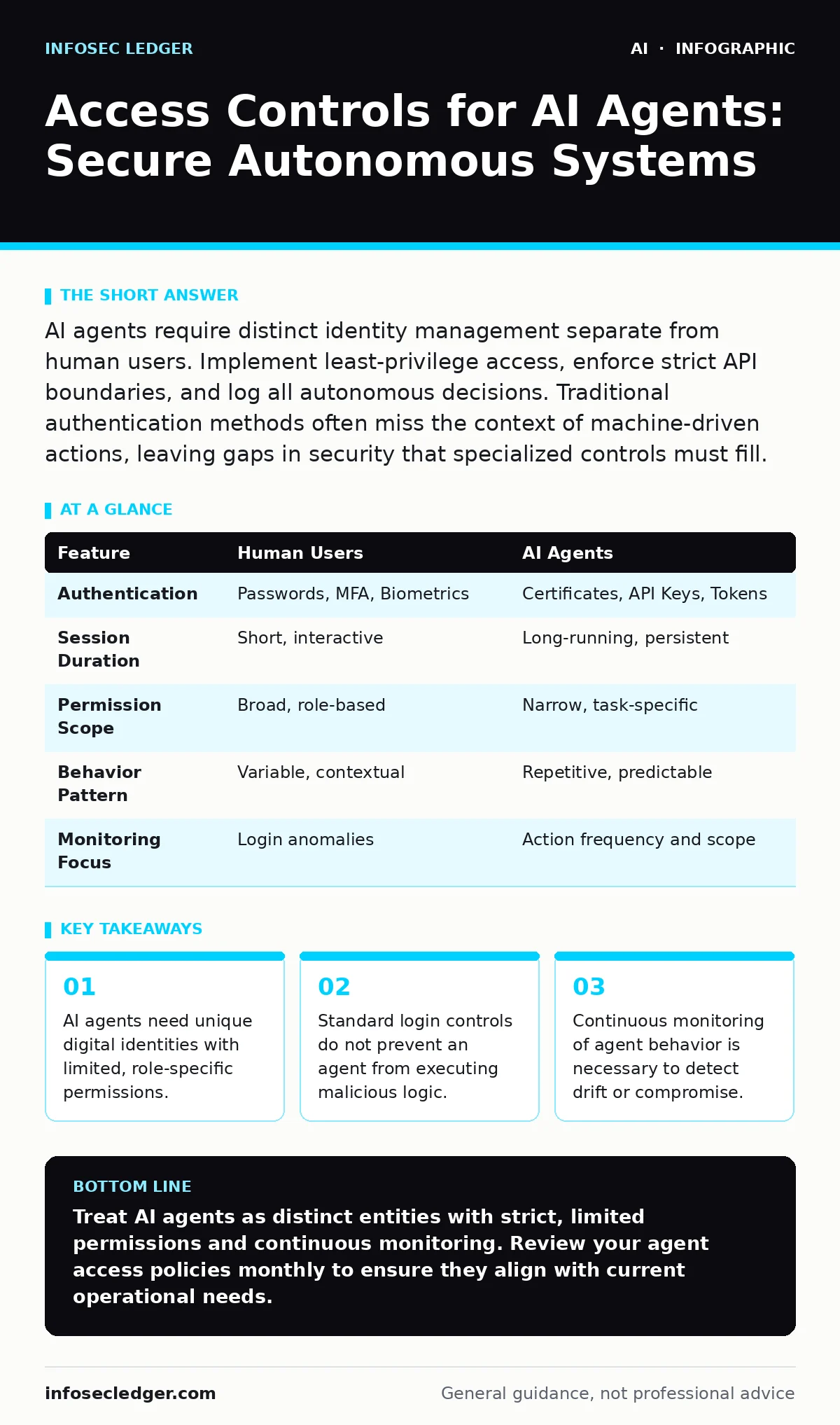
AI agents require distinct identity management separate from human users. Implement least-privilege access, enforce strict API boundaries, and log all autonomous decisions. Traditional authentication methods often miss the context of machine-driven actions, leaving gaps in security that specialized controls must fill.
What is an AI agent identity?
An AI agent identity is a distinct digital credential that separates machine actions from human users. You must treat the agent as a separate entity with its own login and permissions. This separation allows you to trace actions back to the specific software component rather than a shared account. Using shared credentials for agents and humans creates confusion during incident response and obscures the source of errors.
Why do standard user permissions fail for AI?
Standard user permissions fail because AI agents operate at machine speed and volume. A human logs in once and works at a human pace, while an agent may make thousands of decisions per minute. If an agent has the same access rights as a senior employee, it can execute harmful commands faster than any human can react. This speed amplifies the impact of any misconfiguration or malicious instruction.
How do you implement least privilege for agents?
You implement least privilege by granting the agent only the specific API endpoints and data sets it needs to function. Start by mapping the exact tasks the agent performs, such as reading emails or updating inventory. Remove all other permissions, including write access to unrelated systems. This minimizes the damage if the agent is compromised or behaves unexpectedly. Regular reviews ensure permissions remain aligned with current tasks.
What is the difference between authentication and authorization?
Authentication verifies who the agent is, while authorization determines what the agent is allowed to do. Strong authentication, such as certificate-based login, ensures the agent is genuine. Authorization, managed through role-based access controls, limits the agent's actions. Both are necessary because a verified agent can still cause harm if it has excessive permissions. Focusing only on login security ignores the risk of over-privileged accounts.
How do you secure the communication channels?
You secure communication channels by encrypting all data in transit between the agent and its target systems. Use standard protocols like TLS for every connection. Agents often interact with multiple services, creating a complex web of connections. Each connection is a potential entry point for interception or man-in-the-middle attacks. Enforcing certificate pinning ensures the agent connects only to trusted endpoints, preventing redirection to malicious servers.
See also: Securing AI Agents With Information-Flow Control: The Silent Boundary
What is agent behavior monitoring?
Agent behavior monitoring tracks the sequence and context of actions taken by the AI system. Unlike traditional logging, which records who did what, behavior monitoring looks for anomalies in how tasks are performed. For example, an agent that suddenly accesses financial data instead of customer support tickets triggers an alert. This method detects subtle deviations from expected patterns, identifying compromises that static rules might miss.
How do you handle agent-induced data leakage?
You handle data leakage by controlling the input and output of the agent’s context window. Agents process large amounts of data to make decisions, potentially exposing sensitive information. Implement data classification tags that prevent the agent from accessing or transmitting confidential records. Additionally, sanitize outputs before they are sent to external parties. This ensures that even if the agent processes sensitive data, it does not inadvertently share it.
Why is audit logging critical for autonomous systems?
Audit logging provides a permanent record of every decision and action taken by the agent. Humans can explain their reasoning, but AI agents often operate as black boxes. Detailed logs capture the input data, the logic applied, and the resulting output. This trail is essential for forensic analysis after an incident. Without granular logs, you cannot determine whether an error was a bug, a misconfiguration, or a malicious exploit.
How do access controls for AI agents differ from human access?
The following table compares key differences between human and AI agent access controls.
| Feature | Human Users | AI Agents |
|---|---|---|
| Authentication | Passwords, MFA, Biometrics | Certificates, API Keys, Tokens |
| Session Duration | Short, interactive | Long-running, persistent |
| Permission Scope | Broad, role-based | Narrow, task-specific |
| Behavior Pattern | Variable, contextual | Repetitive, predictable |
| Monitoring Focus | Login anomalies | Action frequency and scope |
What is the risk of agent-to-agent communication?
Agent-to-agent communication introduces complex dependency chains that are difficult to secure. When one agent triggers another, permissions can compound or conflict. A compromised agent can spread malicious instructions to connected peers. You must define strict boundaries for inter-agent communication, ensuring that each agent verifies the identity and intent of its partners. This prevents a single point of failure from cascading across the entire system.
How do you manage third-party AI integrations?
You manage third-party integrations by treating external agents as untrusted entities. Even reputable vendors can have vulnerabilities in their software. Isolate third-party agents in sandboxed environments with limited access to your core data. Use API gateways to filter and validate all requests from external agents. This approach prevents a breach in a partner’s system from directly impacting your internal networks. See the guide on insecure AI plugins and agents for more details on integration risks.
What is context-aware access control?
Context-aware access control adjusts permissions based on the current situation, such as time, location, or data sensitivity. An agent might be allowed to read customer data during business hours but restricted at night. This dynamic approach reduces the window of opportunity for attackers. It requires real-time assessment of the agent’s environment and intent. Implementing this adds complexity but significantly enhances security by limiting exposure during low-risk periods.
How do you prevent prompt injection attacks?
You prevent prompt injection by separating user input from system instructions. Attackers can craft inputs that trick the agent into ignoring its rules. Use structured data formats like JSON for inputs instead of free text. Validate and sanitize all external data before it reaches the agent’s logic layer. Additionally, implement allowlists for acceptable commands. This ensures the agent only executes predefined actions, regardless of the input content. Read about AI-generated phishing to understand how attackers craft deceptive inputs.
What is the role of encryption at rest?
Encryption at rest protects the data stored by the agent, including its memory and logs. If an attacker gains physical or logical access to the storage, encrypted data remains unreadable. Use strong, standard encryption algorithms for all persistent storage. Manage encryption keys separately from the data, using a dedicated key management service. This ensures that even if the agent’s storage is compromised, the underlying information remains secure. See the guide on securing AI agents for implementation details.
How do you handle agent errors and failures?
You handle errors by designing fail-safe mechanisms that default to a secure state. When an agent encounters an unexpected condition, it should stop and alert a human operator rather than guessing. Implement circuit breakers that halt operations if error rates exceed a threshold. This prevents the agent from continuing harmful actions due to faulty logic. Regular testing of these failure modes ensures they work as intended under stress.
What is the future of AI access control?
The future involves more sophisticated identity and access management systems tailored for autonomous entities. Zero-trust architectures will become standard, requiring continuous verification for every action. Machine learning will help detect anomalies in agent behavior more effectively. However, this also increases the complexity of security management. Organizations must stay adaptable, updating their controls as AI capabilities evolve. Explore machine learning for fraud detection to see how algorithms can enhance security monitoring.
Key takeaways
- AI agents need unique digital identities with limited, role-specific permissions.
- Standard login controls do not prevent an agent from executing malicious logic.
- Continuous monitoring of agent behavior is necessary to detect drift or compromise.
Treat AI agents as distinct entities with strict, limited permissions and continuous monitoring. Review your agent access policies monthly to ensure they align with current operational needs.
Frequently asked questions
Can I use the same password for my AI agent as my personal account?
No, you should never share credentials between human accounts and AI agents. Use unique API keys or certificates for agents to maintain clear separation and better security tracking.
How often should I review AI agent permissions?
Review permissions at least monthly or whenever the agent’s tasks change. Regular reviews ensure that agents do not retain unnecessary access, reducing the risk of unauthorized actions.
What happens if an AI agent is compromised?
If an agent is compromised, isolate it immediately by revoking its API keys and network access. Investigate the logs to determine the scope of the breach and restore from a known good state.
Do AI agents need multi-factor authentication?
Traditional MFA is not practical for agents. Instead, use certificate-based authentication or dynamic tokens that provide strong verification without requiring human interaction.
How this guide was produced: written by the InfoSec Ledger editorial team with AI assistance, checked against the public references listed below, and reviewed when the facts change. See our editorial policy or report an error.