
AI Generated Phishing: How Automated Fraud Bypasses Human Defense
Automated language models remove the grammatical errors that traditionally signal fraud, forcing you to verify identity through out-of-band channels rather than reading text carefully.
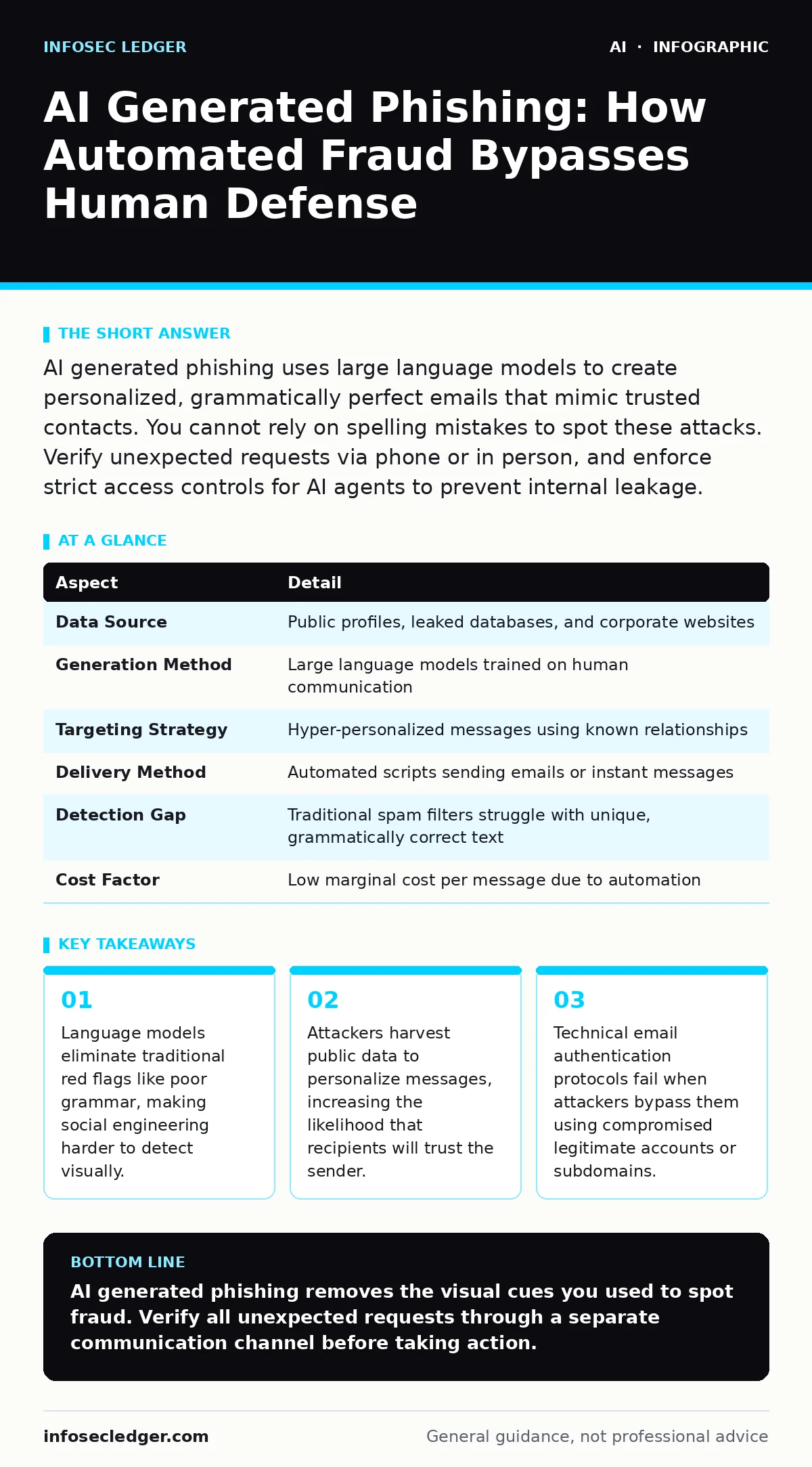
AI generated phishing uses large language models to create personalized, grammatically perfect emails that mimic trusted contacts. You cannot rely on spelling mistakes to spot these attacks. Verify unexpected requests via phone or in person, and enforce strict access controls for AI agents to prevent internal leakage.
Everyday Analogy: The Perfect Forger
Imagine a counterfeiter who previously made bills with slightly off-shading and misspelled words. You learned to spot these errors instantly. Now, suppose a machine prints currency that is pixel-perfect. The paper feels right. The ink looks correct. The only difference is that the serial number does not exist in the official ledger. You cannot trust your eyes anymore. You must check the ledger. AI generated phishing works the same way. It removes the visual errors you used to rely on for detection.
What Is AI Generated Phishing
AI generated phishing is a social engineering attack where automated language models craft deceptive messages. These messages mimic the tone, style, and urgency of trusted contacts. The technology analyzes vast amounts of public data to replicate specific voices. This creates a high degree of personalization. The goal remains the same as traditional phishing: to steal credentials, install malware, or trick you into transferring funds. The difference lies in the quality and speed of the deception.
How The Mechanism Works
Attackers use large language models to generate text at scale. These models do not need to understand the content. They predict the next likely word in a sequence. An attacker provides a prompt describing the desired outcome. The model generates an email that matches the prompt. The attacker then uses automation tools to send these emails to thousands of targets. The process is faster and cheaper than manual crafting.
| Aspect | Detail |
|---|---|
| Data Source | Public profiles, leaked databases, and corporate websites |
| Generation Method | Large language models trained on human communication |
| Targeting Strategy | Hyper-personalized messages using known relationships |
| Delivery Method | Automated scripts sending emails or instant messages |
| Detection Gap | Traditional spam filters struggle with unique, grammatically correct text |
| Cost Factor | Low marginal cost per message due to automation |
Who Is Most At Risk
Any organization with a digital presence is a target. Small businesses often lack the resources for advanced email filtering. They rely on basic security awareness. AI generated phishing bypasses this awareness by appearing legitimate. Supply chain partners are also at risk. Attackers compromise a smaller vendor to reach larger targets. The personalization makes the attack effective against experienced users. Trust is the primary vector, not technical vulnerability.
What People Usually Get Wrong
Many readers believe that reading the email carefully will stop the attack. This is incorrect. The text will be coherent and logical. Readers also assume that email authentication protocols like SPF and DKIM will catch these attacks. These protocols verify the sender's domain. They do not verify the content. If an attacker compromises a legitimate account, the authentication passes. The email appears to come from the real person. You must verify the intent, not just the sender.
See also: Securing AI Agents With Information-Flow Control: The Silent Boundary · Access Controls for AI Agents: Secure Autonomous Systems
Defensive Strategies For Your Organization
You must change how you verify requests. Out-of-band verification is the strongest defense. This means contacting the person through a different channel. If an email asks for money, call the person on a known number. Do not use the contact details in the email. Enforce strict access controls for AI agents within your systems. These agents can leak sensitive data if misconfigured. Review AI usage policies at work to ensure employees do not input sensitive information into public models.
Consider using machine learning for fraud detection. These systems analyze patterns in behavior rather than keywords. They can flag unusual transaction times or amounts. However, no system is perfect. You must maintain human oversight. Train your team to recognize the psychological triggers used in these attacks. Urgency and secrecy are common tactics. Slow down when you feel pressured.
Why Traditional Filters Fail
Traditional email filters look for known malicious signatures. They also scan for suspicious links and attachments. AI generated phishing often uses clean text and legitimate-looking links. The content is unique for each recipient. This bypasses signature-based detection. Keyword filters struggle with nuanced language. The model generates text that avoids common spam triggers. You need layered defenses. Combine technical controls with human verification. Relying on a single layer leaves you exposed.
The Hidden Cost Of Automation
The speed of AI attacks increases the volume of attempts. You will see more phishing emails. This leads to alert fatigue. Your team may start ignoring warnings. This reduces the effectiveness of your security program. You must tune your alerts to reduce noise. Focus on high-risk actions. Prioritize verification for financial requests and data access. The cost of a false negative is high. The cost of a false positive is annoyance. Balance these risks carefully.
Review your insecure AI plugins and agents regularly. These tools can become entry points for attackers. Ensure they follow least privilege principles. Limit what they can access. Monitor their activity. Anomalies in agent behavior can indicate a compromise. Stay ahead of the automation by automating your defenses where possible.
Adapting To The New Normal
The landscape of phishing has shifted permanently. You cannot return to relying on poor grammar as a warning sign. You must build a culture of verification. Encourage employees to ask questions. Make it safe to double-check requests. Integrate verification into your workflows. This slows down processes slightly. It increases security significantly. The trade-off is worth it. Prepare for continuous adaptation. Attackers will refine their techniques. You must refine your defenses.
Review fine-tuning practices if you use internal AI models. Ensure they are not trained on sensitive data. Prevent data leakage through model outputs. Secure your AI infrastructure. The attack surface has expanded. Your defenses must expand with it. Stay informed about emerging threats. Share intelligence with peers. Collective defense strengthens everyone.
Key takeaways
- Language models eliminate traditional red flags like poor grammar, making social engineering harder to detect visually.
- Attackers harvest public data to personalize messages, increasing the likelihood that recipients will trust the sender.
- Technical email authentication protocols fail when attackers bypass them using compromised legitimate accounts or subdomains.
AI generated phishing removes the visual cues you used to spot fraud. Verify all unexpected requests through a separate communication channel before taking action.
Frequently asked questions
Can I use AI to detect AI generated phishing?
Yes, machine learning models can analyze email patterns for anomalies. However, these tools are not foolproof. They should support human verification, not replace it.
Does using a strong password stop AI phishing?
No, strong passwords protect account access. They do not stop you from clicking a link. Phishing relies on social engineering. You must verify the sender's intent.
Are internal company emails safe from AI attacks?
No, attackers often compromise legitimate accounts. An email from a colleague can be fake. Always verify urgent requests through a phone call or in person.
How do I report AI generated phishing?
Forward the email to your IT security team. Do not click any links. Provide the full headers if possible. This helps them update filters and investigate the source.
How this guide was produced: written by the InfoSec Ledger editorial team with AI assistance, checked against the public references listed below, and reviewed when the facts change. See our editorial policy or report an error.