
Adversary-in-the-Middle Phishing: Risks and Protection Strategies
Traditional email filters fail here because the attacker intercepts and modifies messages in real-time, creating a seamless loop that bypasses standard authentication checks.
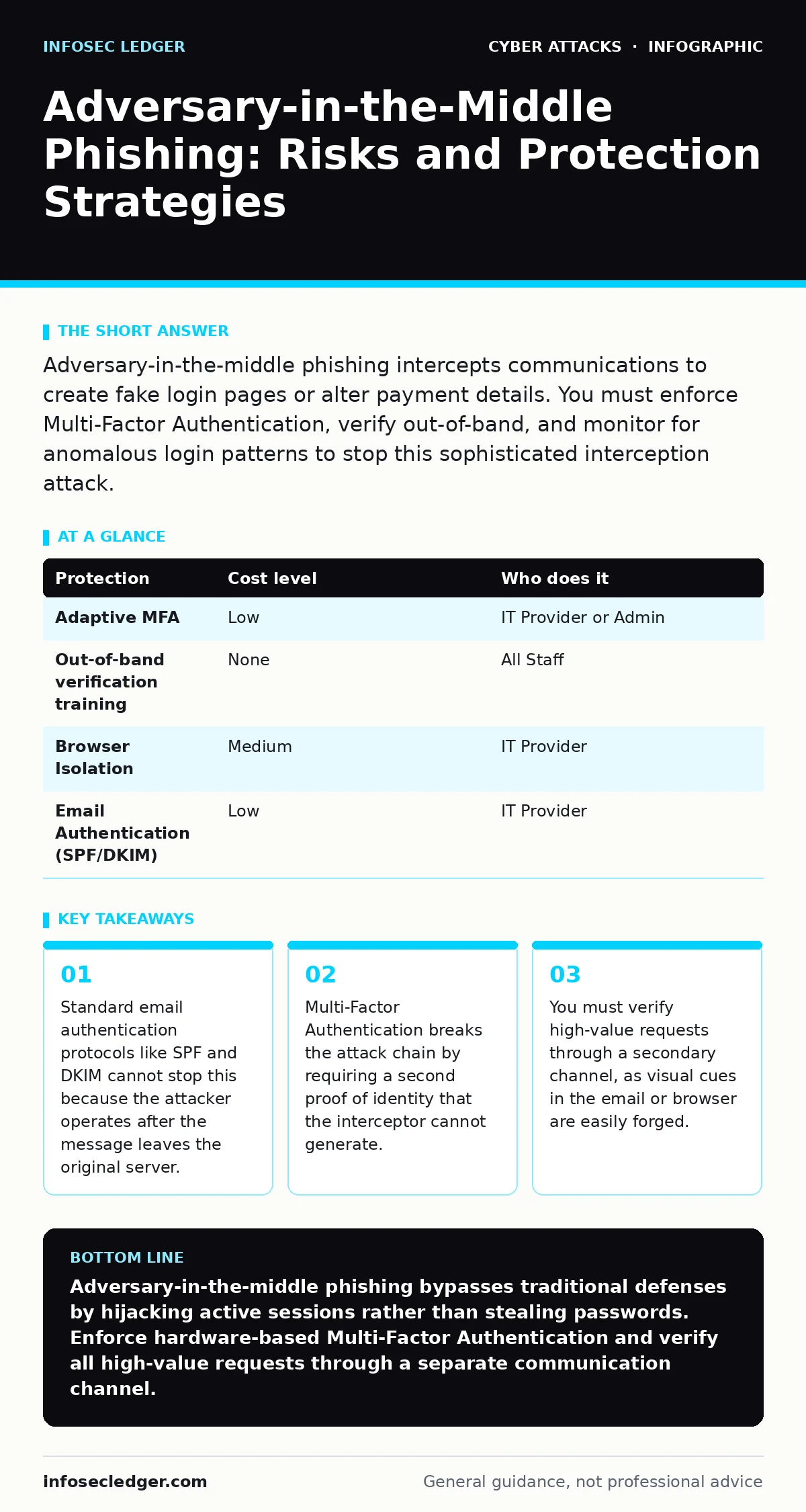
Adversary-in-the-middle phishing intercepts communications to create fake login pages or alter payment details. You must enforce Multi-Factor Authentication, verify out-of-band, and monitor for anomalous login patterns to stop this sophisticated interception attack.
Understanding the Interception Mechanism
Adversary-in-the-middle (AiTM) phishing represents a shift from static fraud to dynamic interception. Unlike traditional phishing, where an attacker sends a link to a static fake website, AiTM involves the attacker positioning themselves between you and the legitimate service. They capture your session cookies and tokens as you type them in. This allows the attacker to maintain access even if you change your password later.
The attacker uses a proxy server to relay your traffic. When you log in, the proxy forwards your credentials to the real service. The real service responds with a session token. The proxy captures this token and creates a parallel session for the attacker. You see a successful login. The attacker sees the same. This mechanism defeats many standard security controls because the traffic appears legitimate to network monitors.
This approach exploits the trust you place in familiar interfaces. The browser shows the correct URL. The SSL certificate is valid. The only difference is that your keystrokes pass through a hostile relay. This is distinct from ARP spoofing, which operates at the local network layer to intercept traffic on your immediate Wi-Fi or Ethernet segment. AiTM works over the public internet, targeting your browser session regardless of your physical location.
Why Small Organizations Become Targets
Small organizations often assume they are too small for sophisticated attacks. This assumption creates a blind spot. Attackers target small businesses because they typically lack dedicated security operations centers. The return on investment for the attacker is high. A successful compromise might yield access to customer databases, financial accounts, or internal communications.
Small teams often rely on shared credentials or weak Multi-Factor Authentication (MFA) setups. MFA is a security process requiring two or more verification factors to authenticate a user's identity. If your MFA relies solely on SMS codes or static tokens, AiTM proxies can sometimes bypass these checks by capturing the session token after the first factor is verified. Even if MFA is required, the proxy presents the MFA prompt to you. You approve it. The proxy captures the resulting session.
Furthermore, small businesses often have flat network structures. Compromising one user’s account can provide visibility into the entire organization’s email and file shares. This increases the potential damage from a single interception. You are exposed not because you are wealthy, but because you are accessible and less likely to detect the subtle signs of an ongoing session hijack.
The Limits of Standard Defenses
Many organizations believe that implementing email authentication protocols like SPF, DKIM, and DMARC provides complete protection. These protocols verify that an email actually came from the domain it claims to be from. They are effective against spoofed sender addresses. However, AiTM phishing often uses legitimate accounts. The attacker compromises a real user’s account or uses a look-alike domain that passes authentication checks.
When the email originates from a legitimate account, SPF and DKIM validate correctly. The message arrives in your inbox without spam flags. The danger lies in the content, not the header. The link in the email points to the attacker’s proxy server. This server mimics the real service perfectly. Traditional web filters may not flag the proxy because it is dynamically generated and uses valid certificates.
This is why session cookie theft is the core threat. Cookies are small pieces of data stored by your browser that allow websites to remember your login status. If an attacker steals the cookie, they do not need your password. They simply present the cookie to the service. The service accepts the request as if it came from you. This bypasses password policies and complexity requirements entirely.
Low-Cost Protection Strategies
You can implement several defenses without significant financial investment. The most critical step is enforcing adaptive Multi-Factor Authentication. Standard MFA asks for a code. Adaptive MFA analyzes the context of the login attempt. It looks at device fingerprints, location, and behavior. If a login comes from a new device or an unusual location, it requires additional verification.
Another low-cost measure is user training focused on out-of-band verification. Train your team to never trust payment changes or sensitive requests found in email. Instead, call the sender using a known, trusted phone number. Do not use the contact details provided in the suspicious email. This breaks the attacker’s ability to relay instructions.
You should also restrict browser permissions and use browser isolation where possible. Some security tools run web pages in a separate container. This prevents the proxy from accessing your local machine’s resources. While not always feasible for all workflows, it adds a layer of separation between your user environment and the web content.
| Protection | Cost level | Who does it |
|---|---|---|
| Adaptive MFA | Low | IT Provider or Admin |
| Out-of-band verification training | None | All Staff |
| Browser Isolation | Medium | IT Provider |
| Email Authentication (SPF/DKIM) | Low | IT Provider |
What to Ask Your IT Provider
Your IT provider is your first line of defense. You need to ensure they understand the specific mechanics of AiTM. Do not settle for vague promises of "better security." Ask specific questions about their monitoring capabilities.
- Do you monitor for impossible travel? This detects logins from two distant locations in a short timeframe.
- How do you handle session token anomalies? Can you detect if a single account has multiple active sessions from different devices?
- What is your process for incident response plans when a compromise is suspected? Speed matters in these cases.
- Do you enforce hardware-based security keys? These are physical devices that provide a higher level of MFA than software apps.
- How do you train staff to recognize the subtle signs of AiTM, such as slight delays in page loads or unexpected MFA prompts?
Also, discuss attack surface reduction. This involves minimizing the number of entry points an attacker can use. This might mean disabling unnecessary remote access protocols or limiting the permissions of standard user accounts. A smaller attack surface makes it harder for an attacker to establish the initial foothold needed for AiTM.
See also: Malicious Bot Traffic: Detection, Mitigation, and Hidden Costs
Integrating Broader Security Hygiene
AiTM phishing rarely occurs in isolation. It is often part of a broader campaign. Attackers might use social engineering to prepare the target, making the phishing email more believable. They might gather information from social media to craft a convincing pretext. Understanding this context helps you defend against the psychological manipulation aspect of the attack.
You should also be aware of other threats that can compound the damage. If an attacker gains access via AiTM, they might install malware that turns your devices into part of a botnet attacks network. This botnet could then be used to launch DDoS attacks against your competitors or customers. While these are distinct threats, they share the same initial vector: compromised credentials.
Regularly reviewing your incident response plans ensures you are ready to act quickly. If you suspect an AiTM attack, immediate action includes forcing a password reset and revoking all active sessions. This invalidates the stolen cookies. Communicate with your users to inform them of the breach and prevent further interaction with the attacker.
Long-Term Resilience and Verification
Building resilience against AiTM requires a shift in mindset. You must assume that any email could be intercepted. This does not mean you stop using email. It means you add layers of verification for high-risk actions. Implement a policy where any financial transaction or data export requires secondary approval.
Consider implementing hardware security keys for all administrative accounts. These keys are resistant to phishing because they cryptographically bind the authentication to the specific domain. An attacker cannot trick the key into signing a request for a proxy server. This is a powerful defense against session hijacking.
Finally, stay informed about evolving tactics. Attackers constantly refine their proxies to mimic legitimate services more accurately. What works today may fail tomorrow. Regular security assessments and updates to your incident response plans are necessary to maintain your defensive posture. By understanding the mechanics of AiTM, you can implement controls that address the root cause rather than just the symptoms.
Key takeaways
- Standard email authentication protocols like SPF and DKIM cannot stop this because the attacker operates after the message leaves the original server.
- Multi-Factor Authentication breaks the attack chain by requiring a second proof of identity that the interceptor cannot generate.
- You must verify high-value requests through a secondary channel, as visual cues in the email or browser are easily forged.
Adversary-in-the-middle phishing bypasses traditional defenses by hijacking active sessions rather than stealing passwords. Enforce hardware-based Multi-Factor Authentication and verify all high-value requests through a separate communication channel.
Frequently asked questions
Can antivirus software detect adversary-in-the-middle phishing?
Traditional antivirus focuses on known malware signatures and is generally ineffective against AiTM, which operates through legitimate web traffic and session manipulation. You need behavioral monitoring instead.
Does Two-Factor Authentication stop this attack?
Standard SMS or app-based Two-Factor Authentication can be bypassed if the attacker captures the session token after the second factor is verified. Hardware security keys or adaptive MFA provide stronger protection.
How do I know if my account has been compromised?
Look for login alerts from unfamiliar devices or locations. Check for unauthorized changes to email rules or forwarding settings. Monitor for unexpected MFA prompts when you are not logging in.
Is email authentication enough to prevent this?
No. Protocols like SPF and DKIM verify the sender's identity but cannot detect if the content contains a link to a malicious proxy server. They are necessary but not sufficient for AiTM defense.
How this guide was produced: written by the InfoSec Ledger editorial team with AI assistance, checked against the public references listed below, and reviewed when the facts change. See our editorial policy or report an error.