
Malicious Bot Traffic: Detection, Mitigation, and Hidden Costs
Automated scripts generate more web traffic than humans, masking data theft behind legitimate-looking requests that standard filters miss.
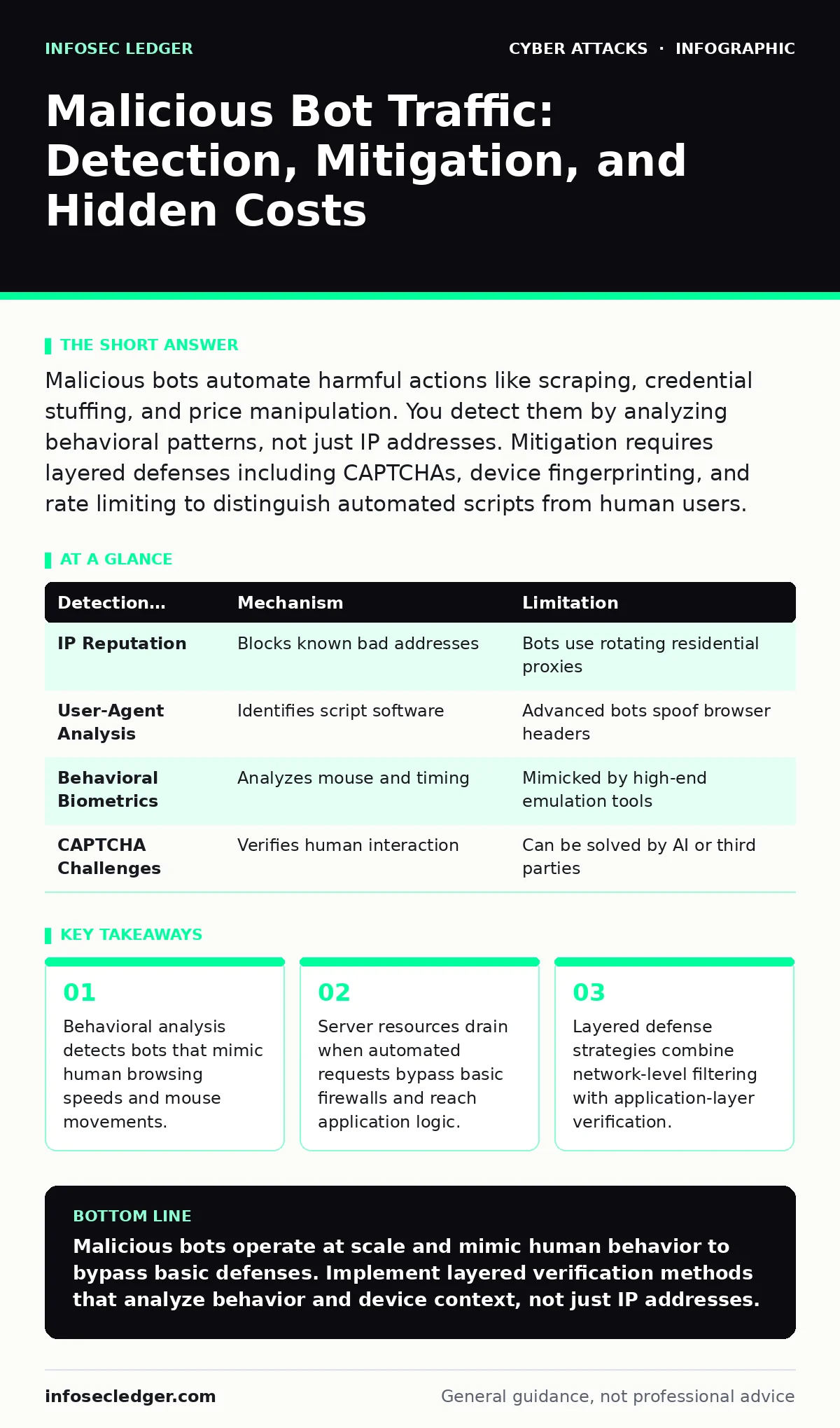
Malicious bots automate harmful actions like scraping, credential stuffing, and price manipulation. You detect them by analyzing behavioral patterns, not just IP addresses. Mitigation requires layered defenses including CAPTCHAs, device fingerprinting, and rate limiting to distinguish automated scripts from human users.
What defines malicious bot traffic?
Malicious bot traffic consists of automated software scripts that interact with web servers to perform harmful actions rather than assist users. These programs execute code repeatedly without human intervention to scrape data, submit fraudulent transactions, or probe for vulnerabilities. Unlike legitimate crawlers that index content for search engines, malicious bots aim to disrupt operations, steal intellectual property, or compromise account security. They operate continuously, ignoring standard user interface cues that humans naturally follow.
How do bots differ from human users?
Bots differ from humans in timing, consistency, and navigation patterns. Human users exhibit irregular intervals between clicks, variable mouse movements, and occasional pauses for reading. Automated scripts execute requests with millisecond precision and follow rigid, predictable paths through site structures. A bot might request 50 pages in one second, whereas a human takes minutes to browse the same content. This mechanical consistency creates a digital fingerprint that detection systems can identify and block.
Why is bot traffic harder to detect now?
Modern malware-as-a-service platforms provide sophisticated tools that mimic human behavior with high fidelity. Script kiddies no longer write simple loops; they rent advanced agents that randomize request timing, rotate IP addresses through residential proxies, and simulate realistic mouse trajectories. These advanced bots bypass basic rate limits and IP blacklists because they appear as distinct, legitimate users. The barrier to entry for creating convincing bot traffic has lowered significantly, making detection reliant on behavioral heuristics rather than static signatures.
What damage do automated scripts cause?
Automated scripts cause resource exhaustion, data theft, and revenue loss. They overwhelm server capacity by requesting heavy resources repeatedly, leading to slower response times for legitimate visitors. Scraping bots harvest pricing data, inventory levels, or proprietary content for competitors. Credential stuffing attacks use leaked username-password pairs to gain unauthorized access to accounts. This traffic generates false metrics, distorting analytics and leading to poor business decisions based on inflated engagement numbers.
How do you detect suspicious automation?
Detection relies on analyzing request patterns and device characteristics rather than just source IP addresses. You examine the User-Agent string, which identifies the software making the request, for inconsistencies or missing fields. Device fingerprinting collects data about browser version, screen resolution, and installed fonts to create a unique profile. Anomalous behavior, such as navigating to non-existent pages or submitting forms with identical data, triggers alerts. Integrating intrusion prevention systems helps block known malicious signatures at the network edge.
| Detection Method | Mechanism | Limitation |
|---|---|---|
| IP Reputation | Blocks known bad addresses | Bots use rotating residential proxies |
| User-Agent Analysis | Identifies script software | Advanced bots spoof browser headers |
| Behavioral Biometrics | Analyzes mouse and timing | Mimicked by high-end emulation tools |
| CAPTCHA Challenges | Verifies human interaction | Can be solved by AI or third parties |
See also: Online Tracking Risks: How Small Firms Lose Data and Regain Control · How Session Cookie Theft Works: The Step-by-Step Breakdown
Can you block all malicious bots?
You cannot block all malicious bots because they constantly evolve to bypass static rules. Overly aggressive blocking risks denying service to legitimate users, automated monitoring tools, or search engine crawlers. The goal is risk-based mitigation, not total elimination. You prioritize protecting high-value endpoints like login pages and checkout flows. Lower-value public content may tolerate some scraping to avoid impacting user experience. This balance requires continuous tuning of detection thresholds.
What is the cost of ignoring bots?
Ignoring bot traffic leads to degraded performance, increased infrastructure costs, and potential data breaches. Server resources are consumed by processing fraudulent requests, forcing you to scale up capacity unnecessarily. Scraped data can be used to undercut your pricing or replicate your offerings. Credential stuffing can compromise customer accounts, leading to fraud charges and reputational damage. The hidden cost includes the engineering time spent analyzing false positives and tuning detection rules.
How do you mitigate advanced threats?
Mitigation requires a layered approach combining network filtering, application verification, and behavioral analysis. Use Web Application Firewalls to filter out common attack patterns. Deploy JavaScript challenges that require execution capabilities often missing in simple scripts. Monitor for sudden spikes in traffic from specific geographic regions or user agents. Regularly update your incident response plans to include bot-specific scenarios, such as mass account creation or scraping campaigns. This depth of defense ensures that if one layer fails, others remain active.
Should you use managed bot protection?
Managed bot protection services provide specialized expertise and global threat intelligence that is difficult to maintain in-house. These services analyze traffic across millions of domains to identify emerging bot behaviors. They offer real-time blocking and detailed analytics on bot types and origins. While this reduces the operational burden, it introduces a third-party dependency and potential privacy considerations regarding data sharing. Evaluate the trade-off between convenience and control when selecting a provider.
Key takeaways
- Behavioral analysis detects bots that mimic human browsing speeds and mouse movements.
- Server resources drain when automated requests bypass basic firewalls and reach application logic.
- Layered defense strategies combine network-level filtering with application-layer verification.
Malicious bots operate at scale and mimic human behavior to bypass basic defenses. Implement layered verification methods that analyze behavior and device context, not just IP addresses.
Frequently asked questions
Do bots slow down my website?
Yes, bots consume server resources by processing requests, which can increase latency and reduce availability for legitimate users during high-traffic periods.
Are search engine bots malicious?
No, search engine crawlers are legitimate and follow specific rules defined in robots.txt, though they can still impact performance if not managed correctly.
Can email authentication stop bots?
Email authentication protocols like SPF and DKIM verify sender identity, reducing spoofing, but they do not stop bots that interact with web interfaces or APIs.
Is DDoS protection the same as bot management?
No, DDoS protection focuses on volumetric attacks to exhaust bandwidth, while bot management targets application-layer abuse and fraudulent interactions.
How this guide was produced: written by the InfoSec Ledger editorial team with AI assistance, checked against the public references listed below, and reviewed when the facts change. See our editorial policy or report an error.