
Warning Signs of Insecure Direct Object References (IDOR) in Web Apps
IDOR flaws let users access private data by simply changing a number in the URL, often bypassing standard login screens without triggering any alerts.
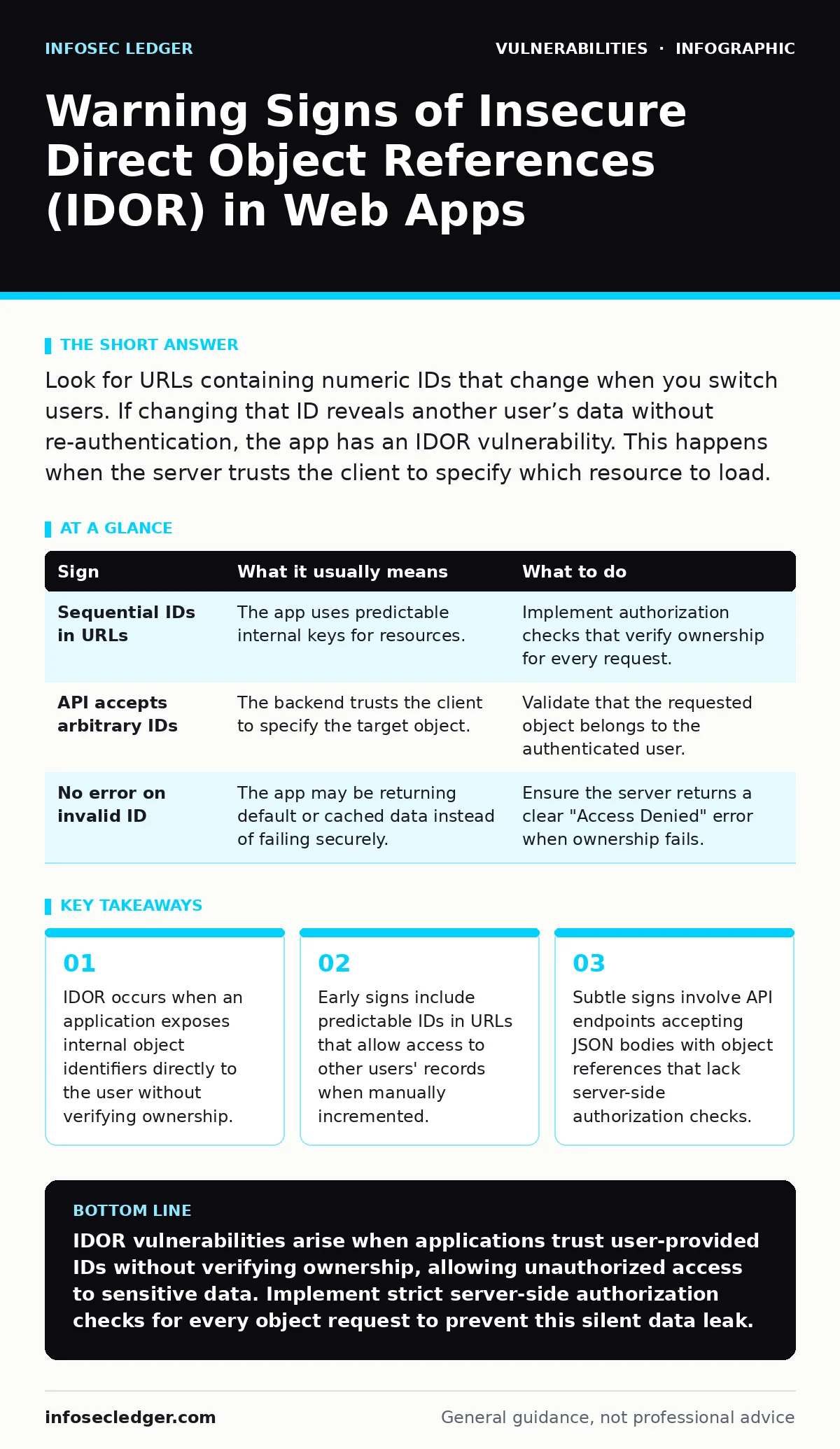
Look for URLs containing numeric IDs that change when you switch users. If changing that ID reveals another user’s data without re-authentication, the app has an IDOR vulnerability. This happens when the server trusts the client to specify which resource to load.
The Mechanics of Broken Access Control
Insecure Direct Object References, or IDOR, occur when an application uses user-supplied input to access objects directly. The system relies on the identifier provided by the client rather than validating if the user owns that object. Imagine a banking app that uses a simple integer to track accounts. If the URL contains account_id=101, a user might change it to 102 to view someone else’s balance. The server processes this request as valid because it trusts the input source. This is not a bug in the database or the network. It is a logic error in how the application handles permissions.
This vulnerability exists because developers often assume that if a user is logged in, they should see the data associated with their session. The session confirms identity, but it does not confirm ownership of the specific resource being requested. You must distinguish between authentication, which proves who you are, and authorization, which proves what you can access. IDOR fails the authorization step while passing the authentication step.
Obvious Warning Signs in User Interfaces
The first signs of IDOR are often visible in the browser address bar. You notice them when navigating between different records or profiles. The URL structure changes in a predictable pattern, usually by incrementing a number. If you view your own profile and see user/1001, then view a friend’s public profile and see user/1002, the system is exposing internal identifiers. These identifiers are direct references to objects in the database.
Another obvious sign is the lack of obfuscation. When internal IDs are sequential integers, they are easy to guess. A user does not need hacking tools to exploit this. They only need to change a digit in the URL. If the application returns data from a different user without error, the vulnerability is present. This behavior indicates that the server is missing a critical check. It is fetching data based on the ID alone, ignoring the user’s relationship to that data.
Subtle Indicators in API Responses
Not all IDOR vulnerabilities appear in the address bar. Modern applications use APIs that send data in the background. These requests often hide the object reference inside the body of the HTTP request, not the URL. You might see a JSON payload containing {"record_id": "55432"}. If you can modify this value and receive different data, you have found an IDOR. This is harder to spot because the URL remains static.
Developers often secure the URL but neglect the API endpoint. They think the frontend prevents users from seeing other IDs, so the backend does not need to verify ownership. This is a false sense of security. An attacker can intercept the API call and modify the ID before it reaches the server. The server processes the request and returns the data associated with the new ID. This is a silent failure. No error message appears. The application behaves exactly as requested, just for the wrong owner.
| Sign | What it usually means | What to do |
|---|---|---|
| Sequential IDs in URLs | The app uses predictable internal keys for resources. | Implement authorization checks that verify ownership for every request. |
| API accepts arbitrary IDs | The backend trusts the client to specify the target object. | Validate that the requested object belongs to the authenticated user. |
| No error on invalid ID | The app may be returning default or cached data instead of failing securely. | Ensure the server returns a clear "Access Denied" error when ownership fails. |
The Hidden Cost of Broken Logic
The most dangerous aspect of IDOR is that it often bypasses other security measures. You might have strong encryption and secure passwords, but IDOR renders them ineffective for data isolation. An attacker does not need to steal a password. They only need a valid session, which they might obtain through phishing or session hijacking. Once they have a session, they can iterate through IDs to harvest large amounts of data.
This vulnerability also complicates incident response. Because the requests look legitimate, they do not trigger intrusion detection systems. The traffic resembles normal user activity. You might only discover the breach when users complain about data exposure. By then, the damage is done. The cost of remediation is high because you must audit every endpoint that accepts an object reference. You cannot simply patch a library. You must rewrite the authorization logic.
Immediate Steps for Mitigation
When you suspect an IDOR, stop testing immediately to avoid unauthorized data access. Document the endpoint and the method used to trigger the exposure. Then, focus on the backend logic. The fix is not in the frontend. You cannot prevent IDOR by hiding IDs in JavaScript. You must enforce authorization on the server. Every request that accesses an object must verify that the authenticated user has permission to view that specific object.
Use a consistent authorization framework. Do not write custom checks for each endpoint. A centralized module can verify ownership before any data is fetched. This reduces the chance of missing a check. If you are using microservices, ensure that the authorization logic is present in the service that owns the data, not just the gateway. This prevents bypasses if the gateway fails.
See also: Online Tracking Risks: How Small Firms Lose Data and Regain Control · How Session Cookie Theft Works: The Step-by-Step Breakdown
Aligning with Secure Development Practices
Preventing IDOR requires a shift in how you view data access. You must treat every object reference as untrusted. This aligns with the principles of shift-left security, where security is integrated early in the development process. Developers should design authorization models before writing code that fetches data. This prevents the common mistake of adding security checks as an afterthought.
Regular code reviews should focus on these access patterns. Look for places where user input is used to query a database. Ensure that the query includes a filter for the current user’s ID. Do not rely on the frontend to filter data. The backend must enforce the restriction. This approach complements other security measures, such as Content Security Policy, which prevents cross-site scripting attacks that might try to exploit these endpoints.
Maintaining Long-Term Security
IDOR vulnerabilities often reappear when new features are added. A new endpoint might bypass existing authorization checks. This is why change management for security patches is vital. Any change to data access logic must undergo rigorous testing. Automated tests should verify that users cannot access objects they do not own. These tests should run before every deployment.
You should also consider the impact of unpatched software in your supply chain. If you use third-party libraries for API management, ensure they handle authorization correctly. Some libraries provide default access controls that may be too permissive. Review the documentation and configuration settings. Do not assume that the library is secure by default. Verify that it enforces ownership checks for every request.
Key takeaways
- IDOR occurs when an application exposes internal object identifiers directly to the user without verifying ownership.
- Early signs include predictable IDs in URLs that allow access to other users' records when manually incremented.
- Subtle signs involve API endpoints accepting JSON bodies with object references that lack server-side authorization checks.
- Remediation requires implementing strict authorization checks on every request that references an internal object.
IDOR vulnerabilities arise when applications trust user-provided IDs without verifying ownership, allowing unauthorized access to sensitive data. Implement strict server-side authorization checks for every object request to prevent this silent data leak.
Frequently asked questions
Does using UUIDs instead of integers fix IDOR?
No, UUIDs make guessing harder but do not prevent IDOR. An attacker can still access data if they obtain a valid UUID, so ownership checks are still required.
Can IDOR affect mobile applications?
Yes, mobile apps often use APIs that are vulnerable to IDOR if the backend does not verify ownership. The attack method is the same as for web apps.
How do I test for IDOR safely?
Use your own account data to test. Change the ID in a request and verify that you cannot see another user's data. Never test on production systems with real user data.
Is IDOR the same as cross-site scripting?
No, XSS involves injecting malicious scripts, while IDOR involves unauthorized access to data through manipulated identifiers. They are distinct vulnerabilities.
How this guide was produced: written by the InfoSec Ledger editorial team with AI assistance, checked against the public references listed below, and reviewed when the facts change. See our editorial policy or report an error.