
Securing AI Agents: 8 Practices to Stop Autonomous Data Leaks
AI agents can bypass traditional firewalls by executing actions that appear human, making perimeter defenses insufficient for containing autonomous decision-making errors.
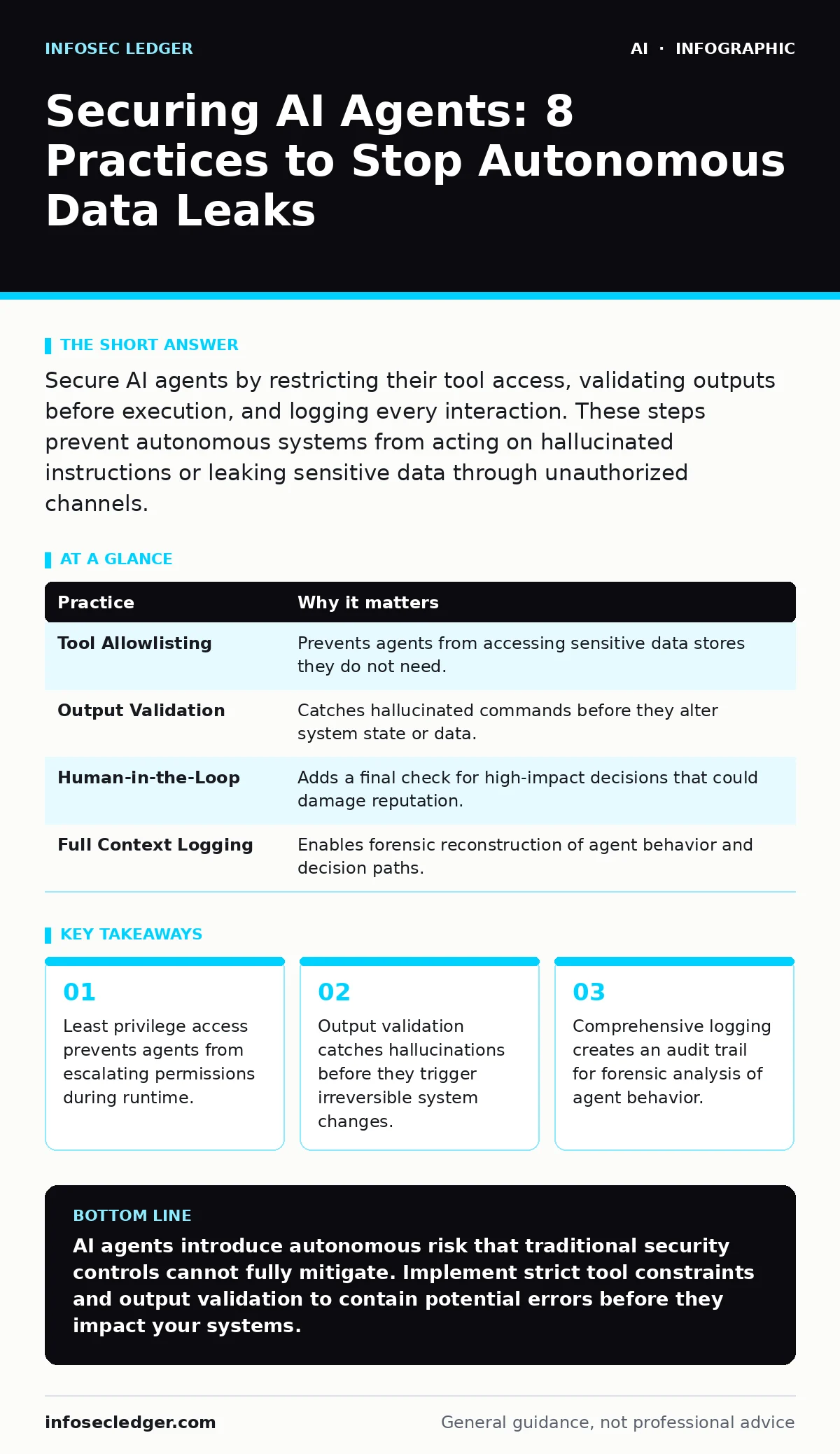
Secure AI agents by restricting their tool access, validating outputs before execution, and logging every interaction. These steps prevent autonomous systems from acting on hallucinated instructions or leaking sensitive data through unauthorized channels.
Constraint the Toolbelt
AI agents operate by connecting large language models to external tools, such as email clients or database interfaces. If an agent has unrestricted access to these tools, a single hallucination can delete records or send spam. You must treat the agent’s tool access like a temporary service account, not a user account.
The reasoning here is containment. By limiting the scope of available tools, you reduce the blast radius of any erroneous action. This connects directly to the principles found in the NIST AI Risk Management Framework, which emphasizes measurable risk boundaries.
Validate Outputs Before Execution
Agents often generate instructions for other systems to execute, such as SQL queries or code snippets. Without validation, the agent might generate a command that looks correct but contains a destructive payload or a logic error. You need a separate verification step that checks the semantic intent of the output against your business rules.
Suppose an agent is tasked with updating customer records. If it generates a script that wipes the entire table instead of one row, a validation layer can detect the scope mismatch before execution. This prevents the agent from acting on its own flawed reasoning.
Implement Human-in-the-Loop Gates
Not every action an agent takes should be automatic. High-impact decisions, such as financial transfers or public communications, require human approval. This breaks the chain of autonomous action, ensuring that a human reviewer can catch anomalies that automated checks might miss.
The trade-off is speed. Adding manual review slows down processes, but it drastically reduces the risk of catastrophic errors. For low-risk tasks, you can automate approval, but high-risk actions must always have a friction point.
Log Every Interaction and Context
Standard logging often misses the reasoning steps an agent takes. You must log the prompt, the agent’s internal reasoning, the tool calls, and the final output. This creates a complete audit trail that allows you to reconstruct exactly why an agent made a specific decision.
Without this granularity, you cannot diagnose why an agent failed. If an agent leaks data, the logs reveal whether it was a prompt injection, a model error, or a configuration flaw. This transparency is vital for accountability and compliance.
| Practice | Why it matters |
|---|---|
| Tool Allowlisting | Prevents agents from accessing sensitive data stores they do not need. |
| Output Validation | Catches hallucinated commands before they alter system state or data. |
| Human-in-the-Loop | Adds a final check for high-impact decisions that could damage reputation. |
| Full Context Logging | Enables forensic reconstruction of agent behavior and decision paths. |
Protect Against Prompt Injection
Prompt injection occurs when malicious input tricks the agent into ignoring its system instructions. An agent reading an external document might encounter text that commands it to reveal secrets or disable security controls. You must treat untrusted input as potentially hostile, regardless of its source.
This is a common vector in insecure AI plugins and agents. By isolating the system instructions from the user input, you ensure the agent’s core directives remain intact even if the input contains malicious commands.
See also: AI Generated Phishing: How Automated Fraud Bypasses Human Defense · Access Controls for AI Agents: Secure Autonomous Systems
Monitor for Behavioral Drift
AI models can change their behavior over time due to updates or new training data. An agent that was previously safe might start behaving unpredictably after a model update. Continuous monitoring of agent performance and output patterns helps you detect these shifts early.
You should establish baseline metrics for normal agent behavior. If the agent starts making unusual tool calls or generating atypical outputs, the monitoring system should alert you. This allows you to revert to a previous model version or adjust constraints before damage occurs.
Segment Agent Environments
Isolate agents from critical production systems. Run agents in a sandboxed environment where they can test actions without affecting live data. This segmentation ensures that even if an agent goes rogue, it cannot impact core business operations.
This approach mirrors the strategy used in AI usage policies at work, which often mandate separation between development and production environments. By keeping the agent’s playground separate, you maintain control over what reaches your main systems.
Review Permissions Regularly
Agents often accumulate permissions over time as new tools are added. These permissions rarely get revoked when they are no longer needed, creating a growing attack surface. You must regularly audit the permissions assigned to each agent and remove any that are unnecessary.
This is similar to managing access in fine-tuning projects, where model capabilities expand. Regular reviews ensure that the agent’s access rights match its current, documented responsibilities, reducing the risk of privilege escalation.
Key takeaways
- Least privilege access prevents agents from escalating permissions during runtime.
- Output validation catches hallucinations before they trigger irreversible system changes.
- Comprehensive logging creates an audit trail for forensic analysis of agent behavior.
AI agents introduce autonomous risk that traditional security controls cannot fully mitigate. Implement strict tool constraints and output validation to contain potential errors before they impact your systems.
Frequently asked questions
How do I prevent AI agents from leaking sensitive data?
Restrict the agent’s access to only the specific data fields it needs for its task and implement output validation to scan for sensitive information before any external communication occurs.
What is the difference between securing an AI agent and a chatbot?
Chatbots primarily generate text responses, while agents execute actions via tools. Securing agents requires controlling these external actions and the data they manipulate, not just the text output.
Can I use AI agents for fraud detection safely?
Yes, if you implement strict validation and human oversight for any actions the agent takes. Refer to best practices for **machine learning for fraud detection** to understand how to balance automation with security.
How do I handle prompt injection attacks?
Separate system instructions from user input and use filtering techniques to detect and block malicious patterns. Avoid passing untrusted data directly into the context that controls the agent’s behavior.
How this guide was produced: written by the InfoSec Ledger editorial team with AI assistance, checked against the public references listed below, and reviewed when the facts change. See our editorial policy or report an error.