
Cloud Cryptojacking: Warning Signs and Immediate Response Steps
Resource spikes in cloud environments often indicate unauthorized mining processes that evade standard monitoring by mimicking legitimate workload patterns.
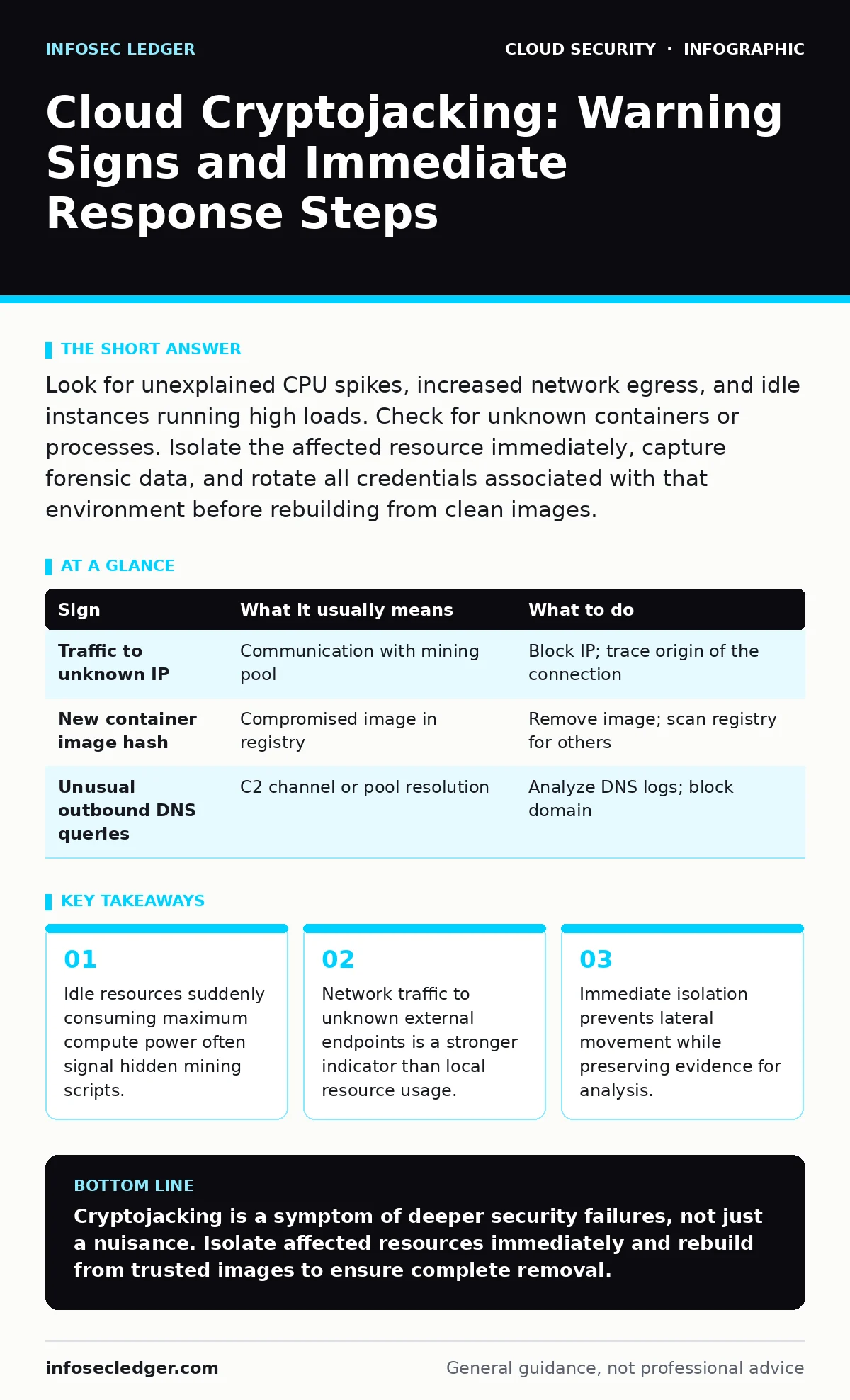
Look for unexplained CPU spikes, increased network egress, and idle instances running high loads. Check for unknown containers or processes. Isolate the affected resource immediately, capture forensic data, and rotate all credentials associated with that environment before rebuilding from clean images.
The Silence Before the Spike
Cloud cryptojacking occurs when attackers hijack your compute resources to mine cryptocurrency. They do this to generate profit without paying for the hardware or electricity. In a cloud environment, the cost falls on you, but the theft is often silent. You might not notice until your bill arrives or performance degrades.
Attackers prefer low-and-slow methods to avoid detection. They throttle the mining process to stay below alert thresholds. This makes the intrusion harder to spot than a brute-force attack. You are looking for subtle deviations in normal behavior, not loud alarms.
Obvious Indicators of Compromise
Some signs are immediate and difficult to ignore. These usually occur when the attacker is aggressive or the environment is small. You will see these metrics change rapidly in your monitoring dashboards.
- This happens even when user traffic is low.
- Unexplained Network Egress: Your instance sends data to an IP address you do not recognize. Mining pools require constant communication with external servers to submit work.
- Process Anomalies: You see unfamiliar processes running with high priority. These processes often have generic names like "system-update" or "node-helper" to blend in.
If you see these, the infection is likely active and consuming significant resources. The financial impact is immediate, but the security risk is greater. The attacker has already gained access to your infrastructure.
Subtle Signs That Slip Past Monitoring
Sophisticated attackers use techniques that mimic legitimate cloud operations. They know that security teams watch for obvious spikes. Instead, they distribute the load or hide in plain sight. These signs require deeper inspection of logs and configurations.
- Micro-Spikes in Compute: The CPU usage spikes for short intervals, then drops. This pattern averages out in standard monitoring tools. You need high-resolution metrics to see the jagged edge of this activity.
- New Container Images: In containerized environments, attackers inject mining code into new images. These images look similar to legitimate ones but contain extra layers. Check the image hashes against your known good repository.
- Idle Instance Activity: A server that should be sleeping or handling minimal background tasks shows consistent network activity. Idle resources are prime targets because they attract less scrutiny.
These indicators are easy to miss because they resemble normal cloud elasticity. Auto-scaling groups launch new instances, and traffic fluctuates. You must define what "normal" looks like for each specific workload. Without a baseline, anomalies blend into the noise.
Immediate Containment Actions
When you suspect cryptojacking, speed is critical. The goal is to stop the resource drain and prevent the attacker from moving laterally. Do not shut down the instance immediately, as this destroys volatile memory evidence. Instead, isolate it.
- Network Isolation: Disconnect the instance from the internal network and the internet. Use security groups or network ACLs to block all traffic. This stops the mining pool communication and prevents data exfiltration.
- Credential Rotation: Assume the attacker has access to any credentials stored on the instance. Rotate API keys, database passwords, and SSH keys immediately. This limits the damage if the attacker tries to use stolen credentials elsewhere.
- Forensic Capture: Take a snapshot of the disk and export logs. If possible, capture the memory dump. These artifacts help you understand how the attacker entered the system.
Refer to your cloud incident response plan for detailed steps. Acting without a plan can lead to incomplete evidence collection.
| Sign | What it usually means | What to do |
|---|---|---|
| Traffic to unknown IP | Communication with mining pool | Block IP; trace origin of the connection |
| New container image hash | Compromised image in registry | Remove image; scan registry for others |
| Unusual outbound DNS queries | C2 channel or pool resolution | Analyze DNS logs; block domain |
Investigating the Root Cause
Once contained, you must determine how the attacker gained access. Cryptojacking is rarely the end goal; it is often a byproduct of a larger breach. The attacker found a way in and decided to monetize it.
Check for exposed Kubernetes dashboards or misconfigured storage buckets. These are common entry points. Attackers often use stolen credentials to launch new instances. Review your cloud identity governance policies to see if there are overly permissive roles.
Look for secrets in source code repositories. If a private key was committed to a public repo, the attacker could have used it to authenticate. This is a frequent vector for cloud account takeover. Ensure your development pipelines scan for hardcoded secrets.
See also: CASB for Small Business: Control Cloud Access Without the Headache · Cloud Incident Response: Definition, Purpose, and Execution Strategy
Rebuilding and Hardening
Do not attempt to clean an infected instance. It is safer and faster to rebuild from a known good state. The attacker may have installed rootkits or backdoors that are difficult to remove. Trust nothing on the compromised system.
Use immutable infrastructure practices. Build images from a central, secure repository. Do not allow developers to install software directly on production instances. This reduces the attack surface significantly.
Implement cloud-native security tools that monitor for anomalous behavior. These tools can detect when a process tries to access resources it should not. Combine this with least-privilege access controls. Limit what each instance can do within the cloud environment.
Preventing Future Infiltration
Prevention requires a shift in how you manage cloud resources. Assume breach is a valid strategy. Design your environment so that a single compromise does not cascade.
Use cloud access security brokers (CASB) to monitor shadow IT and unauthorized applications. These tools provide visibility into what is running in your cloud accounts. They can alert you when new resources are created outside of standard processes.
Ensure proper data residency controls are in place. This limits where data can be processed and stored. While primarily a compliance measure, it also restricts where attackers can move data.
Regularly audit your cloud landing zones. These are the foundational architectures for your cloud accounts. Misconfigurations here can expose entire environments. Keep your security baselines updated to reflect new threats.
Key takeaways
- Idle resources suddenly consuming maximum compute power often signal hidden mining scripts.
- Network traffic to unknown external endpoints is a stronger indicator than local resource usage.
- Immediate isolation prevents lateral movement while preserving evidence for analysis.
Cryptojacking is a symptom of deeper security failures, not just a nuisance. Isolate affected resources immediately and rebuild from trusted images to ensure complete removal.
Frequently asked questions
Can cryptojacking steal my data?
While the primary goal is compute resources, the access required to install miners often allows attackers to view or exfiltrate data. Treat it as a full breach.
How do I distinguish mining from legitimate high load?
Legitimate loads correlate with user activity or scheduled jobs. Mining occurs independently of business logic and often targets idle resources.
Does encryption prevent cryptojacking?
Encryption protects data at rest and in transit, but it does not prevent unauthorized use of compute resources. You need runtime protection and access controls.
Should I block all outbound traffic?
Blocking all outbound traffic breaks many legitimate services. Instead, allowlist specific destinations and monitor for connections to unknown IPs.
How this guide was produced: written by the InfoSec Ledger editorial team with AI assistance, checked against the public references listed below, and reviewed when the facts change. See our editorial policy or report an error.