
CASB for Small Business: Control Cloud Access Without the Headache
Cloud Access Security Brokers enforce policies between users and cloud services, preventing data leaks even when employees use personal devices or shadow IT applications.
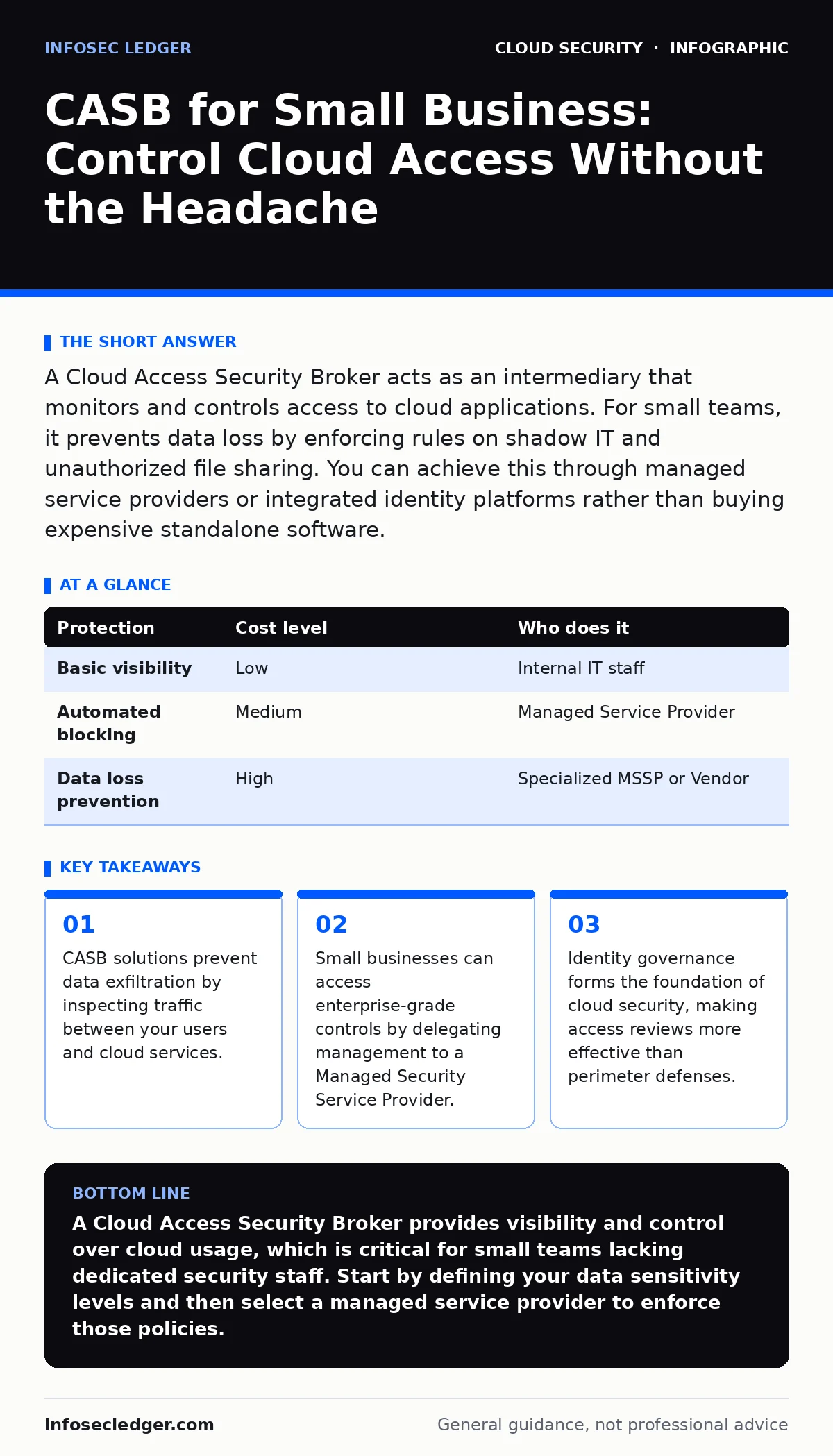
A Cloud Access Security Broker acts as an intermediary that monitors and controls access to cloud applications. For small teams, it prevents data loss by enforcing rules on shadow IT and unauthorized file sharing. You can achieve this through managed service providers or integrated identity platforms rather than buying expensive standalone software.
The Visibility Gap in Small Teams
Small organizations often assume that restricting internet access secures their data. This assumption fails because cloud applications bypass traditional network perimeters. Employees use personal devices and approved apps like email or collaboration tools to move data. You cannot protect what you cannot see.
A Cloud Access Security Broker (CASB) sits between your users and the cloud. It inspects traffic to identify which applications are in use. It also determines whether that usage violates your security policies. This visibility reveals shadow IT, which is software used without your knowledge or approval.
Why Scale Changes the Equation
Large enterprises have dedicated security teams to monitor logs and block threats. Small teams do not have that luxury. The challenge is not the technology itself, but the operational overhead of managing it. A standalone CASB generates alerts that require immediate human analysis.
If you lack staff to review alerts, the tool becomes a liability. You will ignore warnings, creating a false sense of security. The value of a CASB for smaller operations lies in automation and delegation. You need controls that enforce policy without constant manual intervention.
Affordable Implementation Strategies
You do not need to purchase a standalone enterprise product to gain these benefits. Many modern identity providers include basic CASB capabilities. These features allow you to enforce conditional access policies based on user behavior.
Another viable path is outsourcing. Managed Security Service Providers (MSSPs) offer CASB as part of a broader package. They handle the configuration, monitoring, and incident response. This shifts the cost from capital expenditure to a predictable operational fee. It also provides access to expertise you cannot hire in-house.
| Protection | Cost level | Who does it |
|---|---|---|
| Basic visibility | Low | Internal IT staff |
| Automated blocking | Medium | Managed Service Provider |
| Data loss prevention | High | Specialized MSSP or Vendor |
Delegating the Heavy Lifting
Delegation is not about ignoring security. It is about focusing on outcomes rather than tools. When you outsource CASB management, you must define clear rules of engagement. Specify which applications are approved and which are blocked.
You should also define how sensitive data is handled. Does the provider scan files for credit card numbers or social security numbers? Ensure the contract includes regular reporting. This keeps you informed without requiring you to watch the dashboard daily.
The Hidden Cost of Over-Blocking
A common mistake is configuring strict rules that break legitimate workflows. If a CASB blocks a necessary collaboration tool, employees will find a workaround. They might use unmonitored messaging apps to share files. This increases risk rather than reducing it.
Balance security with usability. Start with monitoring mode before enforcing blocks. This allows you to see how employees actually use cloud services. You can then adjust policies to fit real-world needs.
See also: Data Residency Explained: Where Your Files Actually Live · Cloud Incident Response: Definition, Purpose, and Execution Strategy
Integrating with Identity Governance
Cloud Access Security Brokers work best when paired with strong identity controls. Identity governance ensures that only the right people have access to the right resources. Without this, a CASB is just filtering traffic from unauthorized accounts.
Regular access reviews are part of this process. You must periodically verify that employees still need their current permissions. This prevents privilege creep, where users accumulate more access than they need over time.
Questions for Your IT Provider
When selecting a partner to manage your cloud security, ask specific questions. Vague answers indicate a lack of expertise or a one-size-fits-all approach. You need a partner who understands your specific business context.
- How do you detect and respond to shadow IT applications?
- What is your process for tuning alerts to reduce false positives?
- How do you handle data residency requirements for your clients?
- Can you demonstrate how you prevent data exfiltration via approved apps?
Beyond the Broker
A CASB is a layer of defense, not the entire strategy. It does not protect against compromised credentials if those credentials are weak. It does not stop malware that lives inside a legitimate cloud application.
You must combine it with other controls. Multi-factor authentication adds a layer of verification. Endpoint detection ensures devices accessing the cloud are secure. Regular training helps employees recognize phishing attempts that steal credentials.
Key takeaways
- CASB solutions prevent data exfiltration by inspecting traffic between your users and cloud services.
- Small businesses can access enterprise-grade controls by delegating management to a Managed Security Service Provider.
- Identity governance forms the foundation of cloud security, making access reviews more effective than perimeter defenses.
A Cloud Access Security Broker provides visibility and control over cloud usage, which is critical for small teams lacking dedicated security staff. Start by defining your data sensitivity levels and then select a managed service provider to enforce those policies.
Frequently asked questions
Do we need a CASB if we only use one cloud provider?
Yes, because a single provider often offers many applications. A CASB helps you manage risk across all those apps, including those you may not have explicitly approved.
Can a CASB stop a ransomware attack?
It can help detect unusual behavior associated with ransomware, such as mass file encryption or exfiltration. However, it is not an antivirus tool and should not be relied upon as the sole defense.
How long does it take to implement a CASB?
Basic visibility can be enabled quickly, often within days. Full enforcement and tuning may take weeks or months as you refine policies to avoid disrupting business operations.
Is a CASB the same as a firewall?
No, a firewall controls network traffic at the perimeter. A CASB controls application-level access and data movement, regardless of the network connection.
How this guide was produced: written by the InfoSec Ledger editorial team with AI assistance, checked against the public references listed below, and reviewed when the facts change. See our editorial policy or report an error.