Cloud Incident Response: Definition, Purpose, and Execution Strategy
Cloud incident response shifts from containing physical networks to isolating ephemeral resources and managing shared liability across provider boundaries.
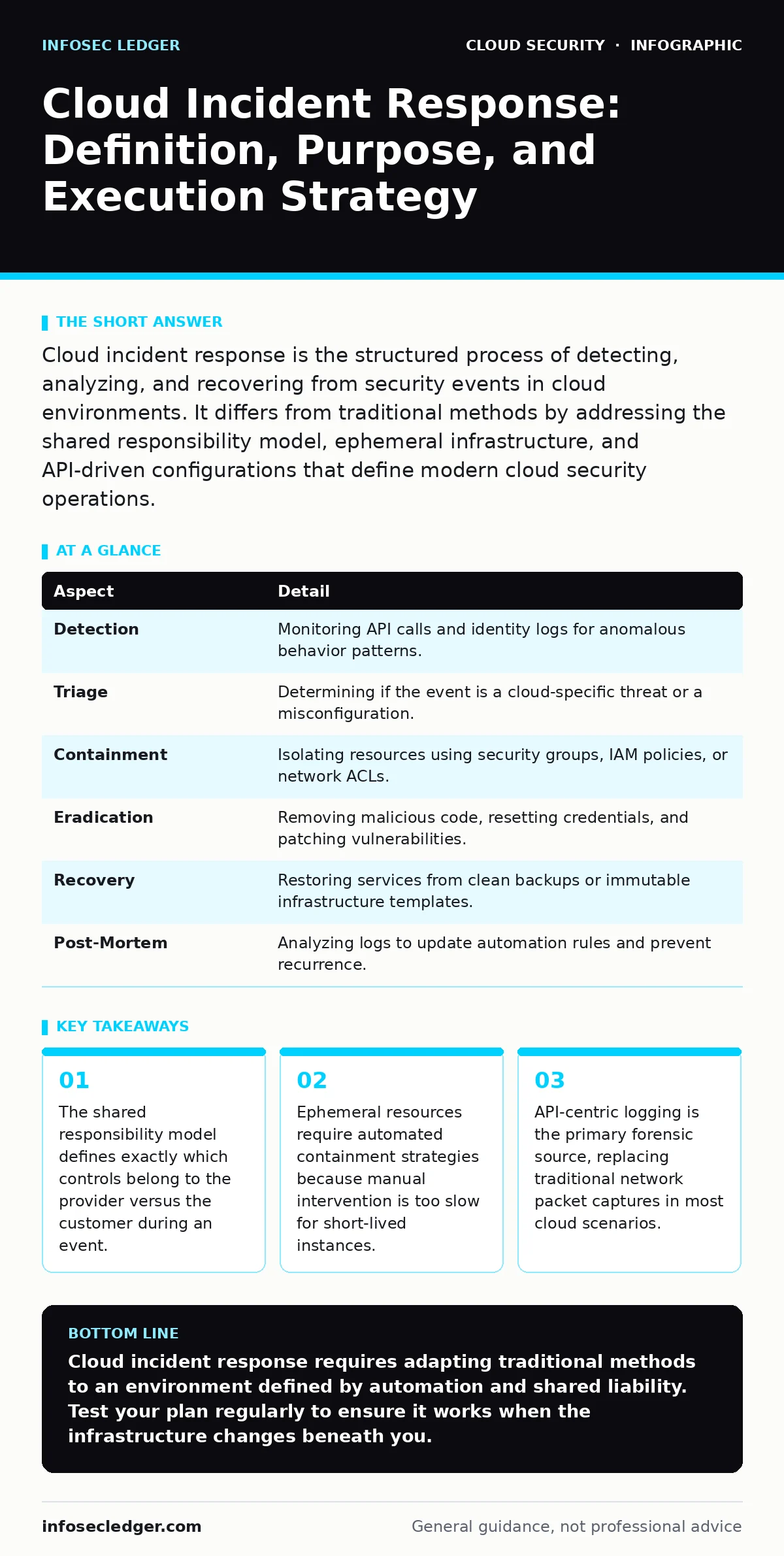
Cloud incident response is the structured process of detecting, analyzing, and recovering from security events in cloud environments. It differs from traditional methods by addressing the shared responsibility model, ephemeral infrastructure, and API-driven configurations that define modern cloud security operations.
The Digital Firebreak Analogy
Imagine a traditional office building where a fire breaks out. You close the doors, evacuate the staff, and wait for the fire department. The walls are static. The structure does not change while you fight the blaze. Now imagine that same building is made of Lego bricks. As you try to contain the fire, the walls move. Rooms appear and disappear. The floor plan changes every minute. This is the cloud environment.
In a traditional data center, you secure a physical perimeter. In the cloud, the perimeter is logical and fluid. Your infrastructure scales up and down automatically. When an incident occurs, the attack surface shifts in real time. Standard containment methods fail because the target moves faster than your response team can react.
Cloud incident response adapts to this volatility. It relies on software-defined controls rather than physical barriers. You cannot lock a door that does not exist. Instead, you revoke permissions, isolate virtual networks, and terminate compromised instances. The speed of response must match the speed of cloud automation.
Defining the Scope and Purpose
Cloud incident response is the organized approach to handling security breaches within cloud infrastructure. Its primary purpose is to minimize damage and restore normal operations while preserving evidence for analysis. Unlike on-premises responses, this process must account for the shared responsibility model.
The shared responsibility model divides security tasks between the cloud provider and the customer. The provider secures the underlying hardware, network, and physical facilities. You secure the data, applications, and access controls. During an incident, this division becomes critical. You must know exactly where your responsibility ends and the provider’s begins.
If a hypervisor is compromised, the provider handles the response. If your application code is exploited, you handle the response. Confusion here leads to delays. A clear definition of roles ensures that both parties act in parallel rather than waiting for each other.
Core Components of the Process
A functional response plan consists of distinct phases that adapt to cloud dynamics. Each phase relies on specific cloud-native tools and processes.
| Aspect | Detail |
|---|---|
| Detection | Monitoring API calls and identity logs for anomalous behavior patterns. |
| Triage | Determining if the event is a cloud-specific threat or a misconfiguration. |
| Containment | Isolating resources using security groups, IAM policies, or network ACLs. |
| Eradication | Removing malicious code, resetting credentials, and patching vulnerabilities. |
| Recovery | Restoring services from clean backups or immutable infrastructure templates. |
| Post-Mortem | Analyzing logs to update automation rules and prevent recurrence. |
Detection in the cloud rarely involves traditional intrusion detection systems on network edges. Instead, you monitor identity and access management logs. An unusual login from a new region or a sudden spike in API calls often signals a compromise before data exfiltration begins.
Triage requires distinguishing between a true attack and a misconfiguration. Many cloud alerts stem from open storage buckets or overly permissive roles. These are errors, not necessarily malicious acts, but they require immediate remediation to prevent exploitation.
Containment must be granular. You cannot shut down the entire cloud account. Instead, you isolate the affected resource. You might detach a network interface or disable a specific user role. This limits the blast radius without disrupting other services.
Where It Fits in Your Defense Stack
Cloud incident response does not operate in a vacuum. It is the final layer of a broader security strategy. If earlier defenses fail, the response plan determines the severity of the impact.
Preventive controls reduce the likelihood of an incident. For example, implementing cloud identity governance ensures that users have only the permissions they need. This limits the damage if credentials are stolen. Similarly, cloud access security brokers (CASB) monitor data movement and enforce policies in real time.
When prevention fails, detection triggers the response. Cloud-native security tools provide visibility into the cloud environment itself. They detect threats that traditional tools miss because they understand cloud APIs and services.
Response also informs future prevention. After an incident, you update your cloud landing zones. These are standardized, secure foundations for cloud deployment. By baking security controls into the landing zone, you ensure that future deployments are secure by default. This reduces the need for manual remediation later.
The Hidden Cost of Ephemeral Infrastructure
One insight many overlook is the forensic challenge of ephemeral resources. In the cloud, servers can start and stop in seconds. Containers spin up and down based on demand. If you wait too long to investigate, the evidence disappears.
Traditional forensics relies on disk images and memory dumps. In the cloud, the disk may be deleted when the instance terminates. You must capture logs and metadata before the resource vanishes. This requires automated logging pipelines that send data to a secure, immutable storage location.
Another hidden cost is the complexity of multi-cloud environments. If you use multiple providers, your response plan must account for different APIs and logging formats. A unified view is difficult to achieve. You need tools that can aggregate data from all sources into a single dashboard.
See also: Data Residency Explained: Where Your Files Actually Live · CASB for Small Business: Control Cloud Access Without the Headache
Common Misconceptions and Errors
Many organizations treat cloud incident response as a scaled-up version of on-premises procedures. This is a fundamental error. The mechanics of the cloud are different.
One common mistake is relying on network segmentation alone. In the cloud, resources can communicate via APIs without traversing traditional network boundaries. An attacker can pivot from one service to another using identity tokens. You must secure identity, not just the network.
Another error is ignoring the provider’s support process. During a major incident, you may need the provider’s assistance. Knowing how to contact them and what information they require is critical. Delaying this step can extend the resolution time significantly.
Integrating with Broader Security Practices
Effective response requires integration with other security disciplines. Shift-left security moves security checks earlier in the development process. This reduces the number of vulnerabilities that reach production. Fewer vulnerabilities mean fewer incidents to respond to.
However, some incidents are inevitable. Cloud cryptojacking is a common threat where attackers use your resources to mine cryptocurrency. Detection relies on monitoring for unusual compute usage. Response involves terminating the affected instances and scanning for persistence mechanisms.
Similarly, exposed Kubernetes dashboards are a frequent entry point. If your cluster management interface is accessible to the public, attackers can gain administrative control. Response requires immediate access revocation and audit of cluster configurations.
Building a Resilient Response Plan
Your response plan must be tested regularly. Tabletop exercises simulate incidents and reveal gaps in your procedures. Involve all stakeholders, including development, operations, and legal teams.
Document the steps clearly. Include contact information for the cloud provider. Define the criteria for escalation. Ensure that everyone knows their role.
Finally, review and update the plan after every incident. The cloud environment changes constantly. Your response strategy must evolve with it. By treating response as a continuous improvement process, you build resilience against future threats.
Key takeaways
- The shared responsibility model defines exactly which controls belong to the provider versus the customer during an event.
- Ephemeral resources require automated containment strategies because manual intervention is too slow for short-lived instances.
- API-centric logging is the primary forensic source, replacing traditional network packet captures in most cloud scenarios.
Cloud incident response requires adapting traditional methods to an environment defined by automation and shared liability. Test your plan regularly to ensure it works when the infrastructure changes beneath you.
Frequently asked questions
How does cloud incident response differ from on-premises response?
Cloud response focuses on identity and API logs rather than network traffic, and must account for ephemeral resources that disappear quickly.
What is the first step in a cloud incident response?
The first step is detection and triage, determining if the event is a true security incident or a misconfiguration.
Who is responsible for responding to a cloud security incident?
Responsibility depends on the shared responsibility model; the provider handles infrastructure issues, while the customer handles data and application issues.
Can automated tools handle cloud incident response?
Automation can speed up containment and eradication, but human judgment is required for triage and complex decision-making.
How this guide was produced: written by the InfoSec Ledger editorial team with AI assistance, checked against the public references listed below, and reviewed when the facts change. See our editorial policy or report an error.