
Cloud-Native Security FAQs: Architecture, Identity, and Runtime Risks
Cloud-native security fails when organizations treat dynamic infrastructure like static servers, ignoring the ephemeral nature of containers and the complexity of distributed identity.
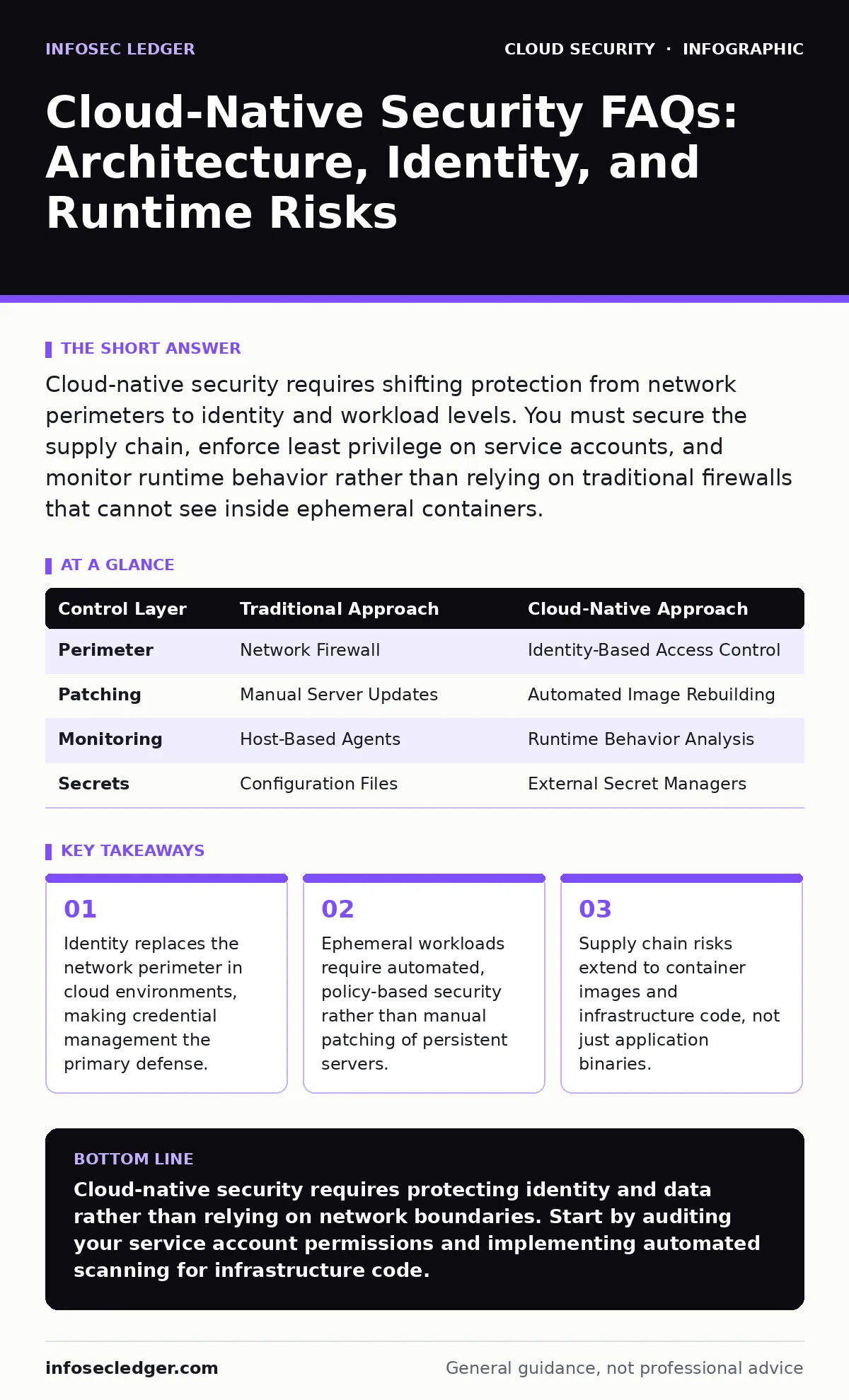
Cloud-native security requires shifting protection from network perimeters to identity and workload levels. You must secure the supply chain, enforce least privilege on service accounts, and monitor runtime behavior rather than relying on traditional firewalls that cannot see inside ephemeral containers.
What defines cloud-native security?
Cloud-native security is a set of practices designed to protect dynamic, distributed, and ephemeral workloads that traditional perimeter-based security cannot address. It shifts focus from protecting a static network boundary to securing the identity, data, and workload itself. This approach acknowledges that resources spin up and down automatically, often in seconds, making manual configuration impossible. You must embed security controls directly into the deployment pipeline and runtime environment.
Why do traditional firewalls fail in the cloud?
Traditional firewalls inspect traffic at the network edge, but cloud-native applications communicate internally across microservices using encrypted traffic. This internal east-west traffic is invisible to perimeter devices that only monitor north-south flows. If a compromised container communicates with a database, the firewall sees only encrypted noise. You need microsegmentation, which restricts communication between services based on identity rather than IP address, to stop lateral movement.
How does identity replace the network perimeter?
In cloud environments, trust is established through identity tokens rather than physical location or IP whitelisting. Every service, user, and workload must authenticate before accessing resources. This is often handled by service accounts, which are machine identities used by applications to interact with cloud services. If you do not enforce least privilege on these accounts, a single compromised service can escalate privileges across the entire environment. Review related concepts in our guide on cloud identity governance.
What is the risk of ephemeral workloads?
Ephemeral workloads are containers or serverless functions that exist only for the duration of a task before being destroyed. Because they disappear quickly, traditional antivirus or host-based intrusion detection often misses threats that run briefly. Attackers exploit this by deploying malicious code that exfiltrates data or mines cryptocurrency before the instance terminates. This connects to the broader issue of cloud cryptojacking, where resources are hijacked for unauthorized computation.
How do you secure the container supply chain?
The supply chain includes every dependency, base image, and configuration file used to build your application. A vulnerability in a base image propagates to every container built from it, creating a widespread risk. You must scan images for known vulnerabilities before deployment and verify the integrity of the build process. This practice is part of shift-left security, which moves testing earlier in the development lifecycle.
| Control Layer | Traditional Approach | Cloud-Native Approach |
|---|---|---|
| Perimeter | Network Firewall | Identity-Based Access Control |
| Patching | Manual Server Updates | Automated Image Rebuilding |
| Monitoring | Host-Based Agents | Runtime Behavior Analysis |
| Secrets | Configuration Files | External Secret Managers |
See also: Data Residency Explained: Where Your Files Actually Live · CASB for Small Business: Control Cloud Access Without the Headache
Where do secrets usually leak?
Secrets such as API keys, database passwords, and private keys are often hardcoded into source code by developers for convenience. When this code is committed to version control, the secrets become permanently exposed in the repository history. This is a critical failure point because attackers can clone public repositories and harvest these credentials. You must use a dedicated secrets management system to inject credentials at runtime. See our guide on secrets in source code for remediation strategies.
What is the danger of exposed management interfaces?
Cloud providers offer management dashboards and APIs to control infrastructure, but misconfigurations can leave these interfaces accessible to the public internet. An exposed Kubernetes dashboard, for example, allows unauthorized users to view or modify cluster resources without authentication. This creates a direct path for account takeover and data exfiltration. Regular audits of public-facing endpoints are necessary to detect these exposures. Refer to our analysis on exposed Kubernetes dashboards for specific hardening steps.
How does infrastructure as code introduce risk?
Infrastructure as code (IaC) allows you to define your cloud environment using text files, but these files can contain security misconfigurations. If a storage bucket is defined as public in the code, every deployment will recreate that vulnerability. You must scan IaC templates for security issues before they are applied to the environment. This ensures that security policies are codified and enforced automatically, supporting the creation of secure cloud landing zones.
What happens when a breach occurs in the cloud?
Cloud breaches require different response tactics because you often lack direct access to the underlying hardware or network logs. You must rely on cloud-native logging and monitoring tools to trace the attack path. The response process must be automated to scale with the dynamic nature of cloud resources. A structured approach to cloud incident response helps contain threats before they spread across accounts.
Key takeaways
- Identity replaces the network perimeter in cloud environments, making credential management the primary defense.
- Ephemeral workloads require automated, policy-based security rather than manual patching of persistent servers.
- Supply chain risks extend to container images and infrastructure code, not just application binaries.
Cloud-native security requires protecting identity and data rather than relying on network boundaries. Start by auditing your service account permissions and implementing automated scanning for infrastructure code.
Frequently asked questions
Do I still need a firewall in the cloud?
You need a different type of firewall. Traditional perimeter firewalls are insufficient, but you should use network security groups or cloud-native firewalls to filter traffic between segments.
Is serverless more secure than containers?
Serverless reduces your attack surface by removing OS management, but it does not eliminate application vulnerabilities or misconfigured permissions.
How do I prevent privilege escalation?
Enforce least privilege by granting only the minimum permissions required for each service account and regularly auditing access logs.
What is the biggest risk in cloud migration?
The biggest risk is misconfiguration. Moving legacy applications to the cloud without re-architecting them often leads to exposed data and weak identity controls.
How this guide was produced: written by the InfoSec Ledger editorial team with AI assistance, checked against the public references listed below, and reviewed when the facts change. See our editorial policy or report an error.