
Patch Management vs Vulnerability Management: The Critical Distinction
Patching is a single remediation step, whereas vulnerability management is the continuous cycle of identifying, prioritizing, and treating all security weaknesses.
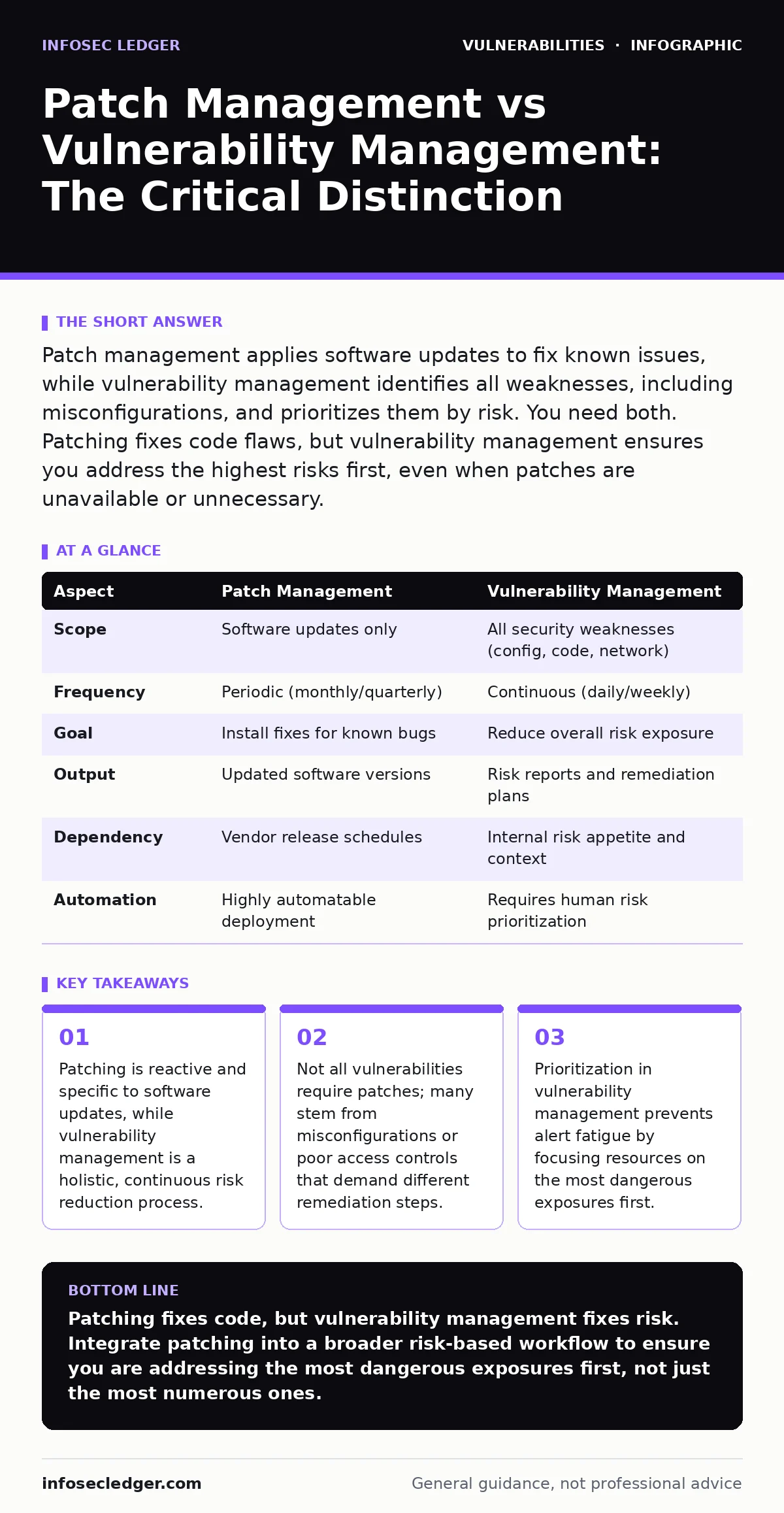
Patch management applies software updates to fix known issues, while vulnerability management identifies all weaknesses, including misconfigurations, and prioritizes them by risk. You need both. Patching fixes code flaws, but vulnerability management ensures you address the highest risks first, even when patches are unavailable or unnecessary.
The Core Difference Between Patch and Vulnerability Management
Patch management is the systematic process of acquiring, testing, and installing software updates or patches. These updates address known security flaws, bugs, or feature requests in operating systems and applications. Vulnerability management is a broader, continuous cycle that identifies, classifies, prioritizes, and remediates security weaknesses across your entire IT environment. While patching is a specific action, vulnerability management is the strategy that determines which actions matter most.
Patching fixes code-level defects. If a developer introduces a flaw in version 2.0, version 2.1 contains the patch. Vulnerability management looks at that flaw, assesses its exploitability in your specific context, and decides whether to patch, mitigate, or accept the risk. It also covers issues that patches cannot fix, such as default credentials left on devices or insecure direct object references (IDOR) in web applications.
What Is Patch Management?
Patch management focuses exclusively on software integrity. It involves scanning systems for missing updates, downloading those updates from vendors, testing them in a isolated environment to ensure they do not break existing functionality, and deploying them to production. This process is linear and repetitive.
The primary goal is to close known security gaps in software code. However, patching has a hidden cost: downtime and compatibility issues. A patch might resolve a critical security flaw but introduce a new bug that crashes your application. This is why testing is non-negotiable. Without rigorous testing, patch management can cause more operational disruption than the vulnerabilities it seeks to fix.
What Is Vulnerability Management?
Vulnerability management is a risk-based approach to security hygiene. It begins with discovery, using scanners and manual audits to find weaknesses. These weaknesses include missing patches, but also misconfigured servers, weak encryption protocols, and poor network segmentation. The next step is prioritization. Not all vulnerabilities are equal. A flaw in an internal-only server is less risky than the same flaw in a public-facing web server.
Remediation in vulnerability management is flexible. You might apply a patch, but you might also change a configuration, implement a Content Security Policy to block malicious scripts, or add HTTP security headers to restrict browser behavior. This flexibility allows you to address risks that do not have a software fix. For example, if a vendor discontinues support for an application, you cannot patch it. Vulnerability management dictates that you isolate that system or replace it.
Patch Management vs Vulnerability Management: A Point-by-Point Comparison
| Aspect | Patch Management | Vulnerability Management |
|---|---|---|
| Scope | Software updates only | All security weaknesses (config, code, network) |
| Frequency | Periodic (monthly/quarterly) | Continuous (daily/weekly) |
| Goal | Install fixes for known bugs | Reduce overall risk exposure |
| Output | Updated software versions | Risk reports and remediation plans |
| Dependency | Vendor release schedules | Internal risk appetite and context |
| Automation | Highly automatable deployment | Requires human risk prioritization |
When to Choose Patch Management
Choose a strict patch management focus when your environment is simple and homogeneous. If you run a single operating system across all devices and have no legacy applications, automated patching can provide immediate security benefits. This approach works best for standardized workstations and servers where downtime can be scheduled and controlled.
You should rely heavily on patch management when dealing with default credentials on new devices. While this is a configuration issue, ensuring devices are updated to the latest firmware often resets these credentials to secure defaults. It is also the primary defense against server-side template injection vulnerabilities, which are often patched in library updates. However, relying solely on patching ignores the reality that many systems cannot be patched immediately due to stability concerns.
When to Choose Vulnerability Management
Choose vulnerability management when your environment is complex, diverse, or includes legacy systems. If you use applications that vendors no longer support, patching is impossible. Vulnerability management allows you to identify these risks and implement compensating controls, such as network segmentation or strict access controls. This is critical for protecting vulnerabilities in VPN gateways and application delivery controllers, which often require careful configuration rather than simple updates.
This approach is necessary when you need to understand the context of a risk. A vulnerability scanner might flag a low-severity issue, but if that system handles sensitive customer data, the risk is high. Vulnerability management integrates with a software bill of materials (SBOM) to understand exactly which components are present and where they are exposed. This depth allows you to prioritize fixes that matter most to your business continuity.
Where They Overlap
Patching is a subset of vulnerability management. You cannot have effective vulnerability management without a patch management process. The overlap occurs in the remediation phase. When a vulnerability scan identifies a missing patch, the vulnerability management workflow triggers the patch management process. The key difference is that vulnerability management decides which patches to apply first based on risk, while patch management simply applies them.
Imagine a scenario where a critical vulnerability is discovered in a widely used library. Patch management would queue the update for all systems. Vulnerability management would check which systems actually use that library and expose it to the internet. Only those systems get patched immediately. Others wait for the next maintenance window. This distinction prevents unnecessary downtime and focuses effort where the threat is real.
Key takeaways
- Patching is reactive and specific to software updates, while vulnerability management is a holistic, continuous risk reduction process.
- Not all vulnerabilities require patches; many stem from misconfigurations or poor access controls that demand different remediation steps.
- Prioritization in vulnerability management prevents alert fatigue by focusing resources on the most dangerous exposures first.
Patching fixes code, but vulnerability management fixes risk. Integrate patching into a broader risk-based workflow to ensure you are addressing the most dangerous exposures first, not just the most numerous ones.
Frequently asked questions
Can I automate vulnerability management completely?
You can automate scanning and patch deployment, but risk prioritization requires human judgment to understand business context and potential impact.
How often should I run vulnerability scans?
Run scans continuously or at least weekly, especially for internet-facing assets, to catch new exposures before they are exploited.
Is patch management enough for compliance?
Most compliance frameworks require evidence of risk assessment and remediation, which goes beyond simple patching to include configuration and access reviews.
What if a vendor stops supporting my software?
You must isolate the system, implement strict access controls, or replace it, as you can no longer receive security patches for known flaws.
How this guide was produced: written by the InfoSec Ledger editorial team with AI assistance, checked against the public references listed below, and reviewed when the facts change. See our editorial policy or report an error.