
Server-Side Template Injection: How It Works and How to Stop It
Server-side template injection lets attackers execute code by tricking the server into rendering malicious input as part of a web page template.
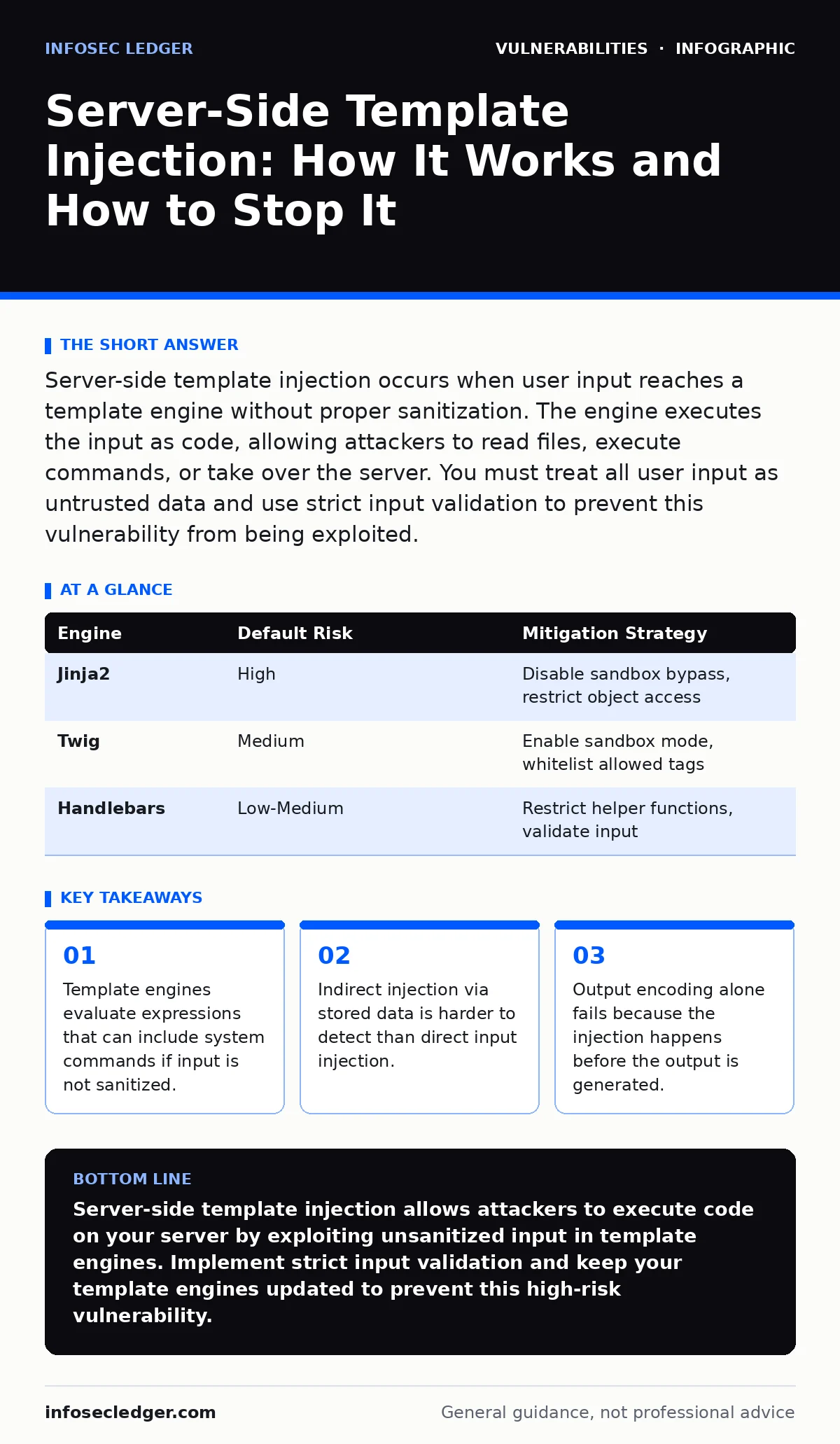
Server-side template injection occurs when user input reaches a template engine without proper sanitization. The engine executes the input as code, allowing attackers to read files, execute commands, or take over the server. You must treat all user input as untrusted data and use strict input validation to prevent this vulnerability from being exploited.
What is server-side template injection?
Server-side template injection is a vulnerability where an attacker injects malicious code into a template engine that runs on the server. Template engines combine static HTML with dynamic data to create web pages. When the application passes unsanitized user input to the engine, the engine treats the input as executable code rather than plain text. This allows the attacker to run arbitrary commands on the server, access sensitive files, or modify application behavior. The attack succeeds because the boundary between data and code is blurred during the rendering process.
How does a template injection attack work?
A template injection attack works by sending specially crafted input that mimics the syntax of the template language. The application accepts this input and passes it to the template engine for processing. The engine parses the input and executes any embedded expressions or functions. For example, an attacker might inject a command that reads a configuration file or lists directory contents. The result is sent back to the attacker, often in the HTTP response body. This mechanism turns a simple data field into a remote code execution vector.
What are the most common template engines affected?
Popular template engines like Jinja2, Twig, and Handlebars are frequently targeted because they support complex expressions. Jinja2, used in Python frameworks, allows access to Python objects and functions, making it highly dangerous if input is not filtered. Twig, used in PHP applications, has a sandbox mode, but misconfigurations can bypass these protections. Handlebars, common in JavaScript environments, can also be exploited if helper functions are not restricted. The risk depends on how the developer configures the engine and handles user input. Older versions of these engines often lack strict sandboxing by default.
Can server-side template injection lead to remote code execution?
Server-side template injection can lead to remote code execution if the template engine allows access to system functions. Attackers chain multiple injection steps to escalate their privileges. First, they identify the template engine and its syntax. Next, they inject code to read sensitive files, such as environment variables or database credentials. Finally, they use these credentials to execute system commands or install malware. This progression transforms a simple injection flaw into a full server compromise. The ability to execute code depends on the engine’s capabilities and the application’s security settings.
| Engine | Default Risk | Mitigation Strategy |
|---|---|---|
| Jinja2 | High | Disable sandbox bypass, restrict object access |
| Twig | Medium | Enable sandbox mode, whitelist allowed tags |
| Handlebars | Low-Medium | Restrict helper functions, validate input |
Why does output encoding fail to prevent this?
Output encoding fails because server-side template injection occurs before the output is generated. Encoding protects against cross-site scripting by converting special characters into safe HTML entities. However, template injection happens during the template rendering phase, where the engine evaluates expressions. If the input is executed as code, encoding the result does not stop the initial execution. The damage is already done by the time the encoded output reaches the browser. You must sanitize input before it reaches the template engine, not after. This distinction is critical for understanding why standard web security measures are insufficient.
How do you detect server-side template injection?
Detecting server-side template injection requires testing how the application handles dynamic input. Start by entering simple template syntax, such as {{7*7}}, into input fields. If the response contains 49, the input was evaluated by the template engine. Next, try accessing system variables, such as {{config}} or {{self}}, to see if sensitive data is exposed. Automated scanners may miss these issues because they look for known patterns rather than evaluating logic. Manual testing is necessary to identify indirect injection vectors. You should also review code for places where user input is passed directly to template rendering functions.
What is indirect server-side template injection?
Indirect server-side template injection occurs when malicious input is stored in a database or file and later rendered by the template engine. The attacker does not see the immediate result of their injection. Instead, the payload executes when another user or system process views the stored data. This makes detection difficult because the attack is asynchronous. For example, an attacker might inject code into a comment field. When an administrator reviews comments, the template engine executes the code. This variant is particularly dangerous because it can bypass input filters that only check initial requests.
How do you fix server-side template injection?
Fixing server-side template injection requires strict input validation and secure configuration. Never pass user input directly to the template engine without sanitization. Use a whitelist approach to define allowed characters and patterns. If the template engine supports sandboxing, enable it and restrict access to system functions. Regularly update your template engine to patch known vulnerabilities. Consider using a framework that separates data from logic, reducing the risk of injection. Implementing a software bill of materials (SBOM) helps you track dependencies and identify vulnerable components quickly.
What role does patch management play in prevention?
Patch management ensures that your template engines and frameworks are up to date with security fixes. Developers often release patches for newly discovered injection vulnerabilities. Ignoring these updates leaves your application exposed to known exploits. Automated patch management systems can help apply updates consistently across your infrastructure. You must also test patches in a staging environment to ensure they do not break existing functionality. This process is similar to managing unpatched software risks in other parts of your system. Consistent updates reduce the attack surface and limit the tools available to attackers.
How does this differ from cross-site scripting?
Server-side template injection differs from cross-site scripting in where the code executes. Cross-site scripting runs in the user’s browser, affecting only the individual user. Server-side template injection runs on the server, affecting the entire application and all users. The impact of server-side template injection is far more severe because it can lead to full server compromise. Cross-site scripting is often prevented by output encoding and Content Security Policy. Server-side template injection requires input validation and secure template configuration. Understanding this difference helps you prioritize your security efforts and choose the right defenses.
What are the business risks of ignoring this?
Ignoring server-side template injection risks severe data breaches and service disruption. Attackers can steal customer data, financial records, and intellectual property. They can also deface your website or use your server to launch further attacks. The cost of remediation after a breach far exceeds the cost of prevention. Regulatory fines and reputational damage can harm your business long-term. Implementing secure coding practices and regular security audits reduces these risks. You should treat template injection as a critical vulnerability that requires immediate attention. Proactive security measures protect your assets and maintain customer trust.
Key takeaways
- Template engines evaluate expressions that can include system commands if input is not sanitized.
- Indirect injection via stored data is harder to detect than direct input injection.
- Output encoding alone fails because the injection happens before the output is generated.
Server-side template injection allows attackers to execute code on your server by exploiting unsanitized input in template engines. Implement strict input validation and keep your template engines updated to prevent this high-risk vulnerability.
Frequently asked questions
Is server-side template injection common in modern web applications?
It remains common because many developers rely on default configurations that do not restrict template engine capabilities. Modern frameworks often provide safer defaults, but misconfigurations still occur frequently.
Can a web application firewall stop template injection?
A web application firewall can block known attack patterns, but it may miss novel injection techniques. You still need secure coding practices and input validation to provide comprehensive protection.
How do I know if my template engine is vulnerable?
Check the version of your template engine against known vulnerability databases. Review your configuration to ensure sandboxing is enabled and user input is not passed directly to rendering functions.
Does using a microservices architecture prevent this?
Microservices do not prevent template injection. Each service must still handle input securely. The architecture changes how services communicate, but the underlying vulnerability remains the same if input is not validated.
How this guide was produced: written by the InfoSec Ledger editorial team with AI assistance, checked against the public references listed below, and reviewed when the facts change. See our editorial policy or report an error.