
How VPN and ADC Vulnerabilities Exploit Network Gateways Step by Step
Misconfigured routing tables and legacy protocols in application delivery controllers allow attackers to bypass authentication entirely without brute-forcing credentials.
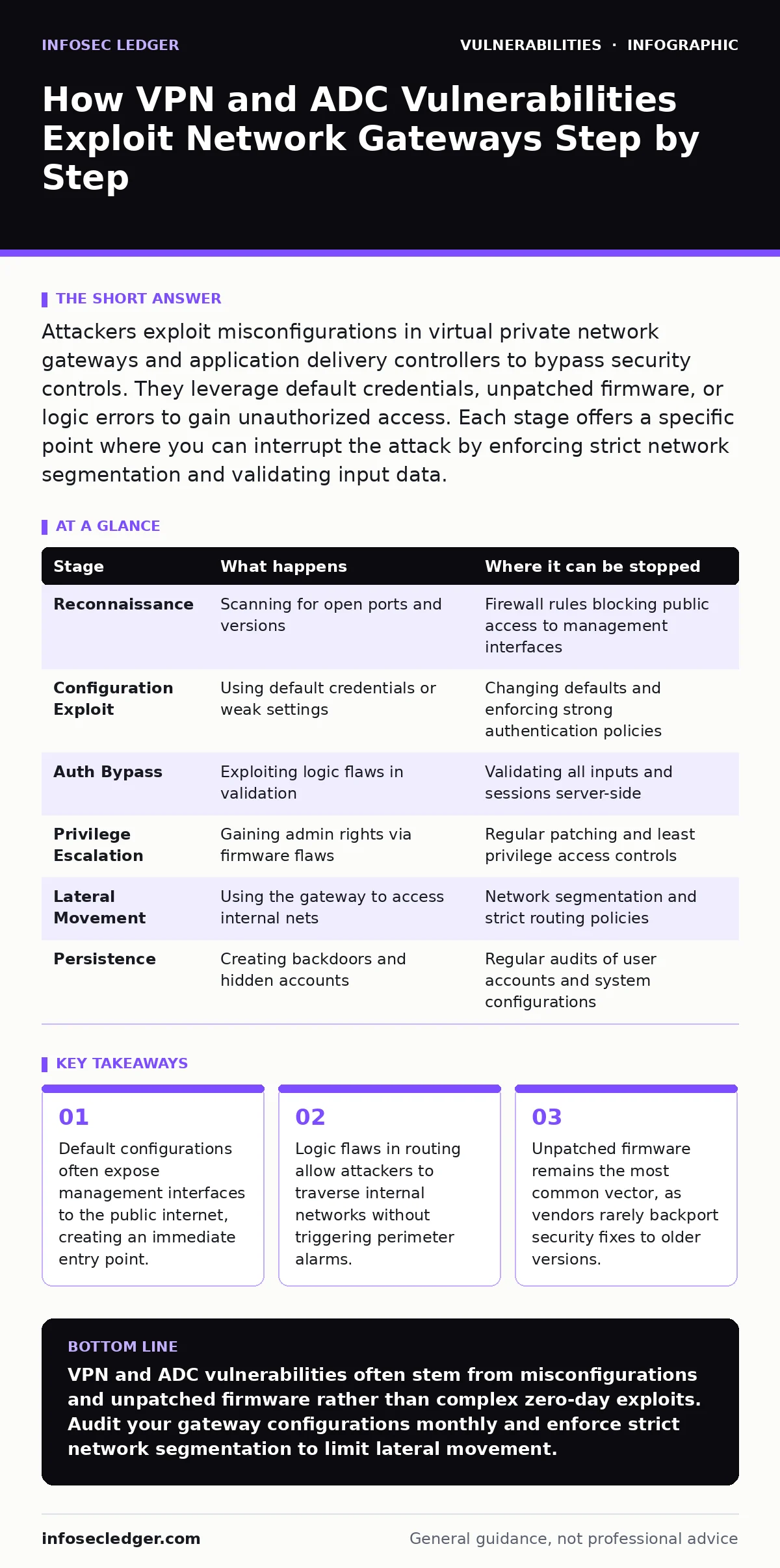
Attackers exploit misconfigurations in virtual private network gateways and application delivery controllers to bypass security controls. They leverage default credentials, unpatched firmware, or logic errors to gain unauthorized access. Each stage offers a specific point where you can interrupt the attack by enforcing strict network segmentation and validating input data.
Initial Reconnaissance and Discovery
Attackers begin by scanning your network perimeter for exposed services. They look for default ports associated with virtual private network gateways and application delivery controllers. These devices often advertise themselves through open ports that reveal software versions. An attacker uses this information to identify known weaknesses in your specific infrastructure.
This phase relies on the fact that many organizations leave default settings intact. Management interfaces are frequently accessible from the public internet. You can interrupt this stage by ensuring no administrative ports are reachable from untrusted networks. Implementing strict firewall rules blocks these initial probes. This prevents the attacker from even seeing what software you are running.
Exploiting Configuration Errors
Once a target is identified, the attacker attempts to exploit configuration errors. This is not always a code flaw. It is often a mistake in how the device was set up. For example, weak default credentials on an application delivery controller allow immediate login. This bypasses all subsequent security checks.
Another common error is allowing unencrypted management protocols. If you allow simple network management protocol or telnet, traffic is sent in plain text. The attacker captures this traffic and extracts credentials. You stop this by disabling legacy protocols. Use secure shell and encrypted management interfaces exclusively. This ensures that even if traffic is intercepted, the data remains unreadable.
Bypassing Authentication Mechanisms
Authentication bypass is a critical step in compromising these gateways. Attackers look for flaws in how the device validates user credentials. This might involve a logic error that allows access without a valid token. It can also involve exploiting a flaw in how multi-factor authentication is processed.
Imagine a scenario where the application delivery controller fails to verify the session token correctly. The attacker crafts a request that mimics a valid session. The device accepts it and grants access. This is similar to how insecure direct object references (IDOR) work in web applications. You mitigate this by validating every request server-side. Do not trust client-side state. Ensure that every action requires a fresh, verified authentication check.
Gaining Initial Access and Privilege Escalation
With authentication bypassed, the attacker gains initial access to the management interface. This access is often limited. They then look for ways to escalate their privileges. This is where privilege escalation vulnerabilities become relevant. The attacker exploits a flaw that allows them to run commands as a superuser.
This step often relies on unpatched software. If the device firmware has a known vulnerability, the attacker uses a public exploit. They gain root or administrator access. This allows them to modify system settings, install malware, or create backdoors. You interrupt this by maintaining a rigorous patching schedule. Keep your firmware up to date. Regularly audit user permissions to ensure the principle of least privilege is enforced.
Pivoting and Lateral Movement
Once inside the gateway, the attacker uses it as a pivot point. Virtual private network gateways are designed to bridge networks. The attacker uses this feature to move laterally. They access internal resources that were previously isolated. This is where the damage expands significantly.
The attacker may use the application delivery controller to route traffic to sensitive internal servers. They bypass internal firewalls because the traffic appears to come from a trusted source. This is a hidden cost of misconfigured routing. You stop this by segmenting your network. Treat the gateway as untrusted, even after authentication. Use micro-segmentation to limit what resources the gateway can reach.
Establishing Persistence and Data Exfiltration
The final stage involves establishing persistence. The attacker ensures they can return even if you detect and remove their current access. They may create hidden user accounts or modify startup scripts. They also begin exfiltrating data. This data can include sensitive customer information or intellectual property.
Data exfiltration often happens slowly to avoid detection. The attacker uses the encrypted tunnel of the virtual private network to hide their traffic. This makes it difficult for intrusion detection systems to spot the anomaly. You mitigate this by monitoring for unusual data flows. Look for large outbound transfers during off-hours. Implement data loss prevention tools to block unauthorized data transfers.
Mapping the Attack Lifecycle
Understanding the full lifecycle helps you defend against these attacks. The table below summarizes each stage, what happens, and where you can intervene.
| Stage | What happens | Where it can be stopped |
|---|---|---|
| Reconnaissance | Scanning for open ports and versions | Firewall rules blocking public access to management interfaces |
| Configuration Exploit | Using default credentials or weak settings | Changing defaults and enforcing strong authentication policies |
| Auth Bypass | Exploiting logic flaws in validation | Validating all inputs and sessions server-side |
| Privilege Escalation | Gaining admin rights via firmware flaws | Regular patching and least privilege access controls |
| Lateral Movement | Using the gateway to access internal nets | Network segmentation and strict routing policies |
| Persistence | Creating backdoors and hidden accounts | Regular audits of user accounts and system configurations |
Integrating Defense Strategies
Defending against these vulnerabilities requires a layered approach. You must address configuration, patching, and monitoring. Ignoring any one of these areas leaves a gap. Attackers are patient and will exploit the weakest link.
Consider how HTTP security headers can protect the web applications behind your application delivery controller. These headers help prevent cross-site scripting and clickjacking. They add an extra layer of security even if the gateway is compromised. Similarly, understanding Content Security Policy can help you restrict how resources are loaded. This limits the impact of a successful injection attack.
Maintaining Long-Term Security
Security is not a one-time task. It is an ongoing process. You must continuously monitor your systems for changes. Regular audits help you identify misconfigurations before attackers do. Training your staff on security best practices is also vital.
Remember that IoT device vulnerabilities can also serve as entry points. If an IoT device is compromised, it might be used to pivot to your network. Ensure all devices, not just gateways, are secure. Keep your knowledge updated on emerging threats. The techniques attackers use evolve, and your defenses must evolve with them.
Key takeaways
- Default configurations often expose management interfaces to the public internet, creating an immediate entry point.
- Logic flaws in routing allow attackers to traverse internal networks without triggering perimeter alarms.
- Unpatched firmware remains the most common vector, as vendors rarely backport security fixes to older versions.
VPN and ADC vulnerabilities often stem from misconfigurations and unpatched firmware rather than complex zero-day exploits. Audit your gateway configurations monthly and enforce strict network segmentation to limit lateral movement.
Frequently asked questions
How do I know if my VPN gateway is vulnerable?
Check for open management ports on the public internet and verify that your firmware is up to date. Look for any default credentials that have not been changed.
Can an application delivery controller be used to launch attacks?
Yes, if compromised, an ADC can be used to pivot to internal networks or to serve malicious content to users, amplifying the impact of the breach.
What is the difference between a VPN gateway and an ADC vulnerability?
VPN gateway vulnerabilities often focus on tunneling and remote access, while ADC vulnerabilities frequently involve web application logic and load balancing configurations.
How often should I patch my network devices?
You should patch as soon as critical updates are released. Regular monthly reviews of available patches help ensure you do not miss important security fixes.
How this guide was produced: written by the InfoSec Ledger editorial team with AI assistance, checked against the public references listed below, and reviewed when the facts change. See our editorial policy or report an error.