
Vulnerability Chaining: How Attackers Link Weaknesses to Breach Systems
Attackers rarely exploit a single flaw; they connect minor, low-risk issues into a single path that bypasses your strongest defenses.
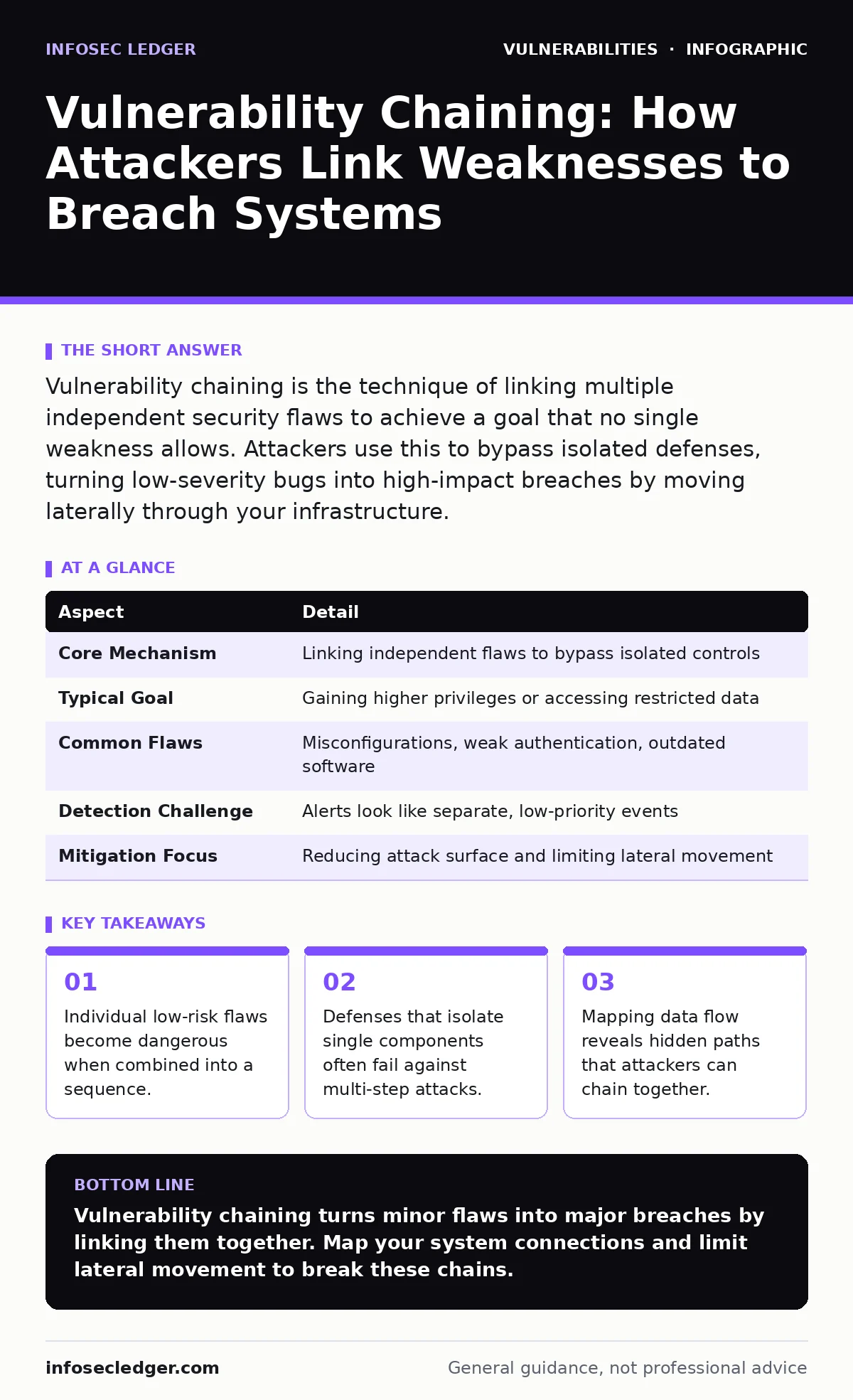
Vulnerability chaining is the technique of linking multiple independent security flaws to achieve a goal that no single weakness allows. Attackers use this to bypass isolated defenses, turning low-severity bugs into high-impact breaches by moving laterally through your infrastructure.
The Domino Effect in Cybersecurity
Imagine a bank with three separate security measures. The front door has a weak lock. The alarm system has a blind spot. The vault requires a key that is left under the mat. No single failure allows a thief to steal millions. A weak lock only lets you inside the lobby. A blind spot only lets you walk past a sensor. A key under the mat only opens the vault if you are already inside.
When an attacker combines these three issues, the result changes completely. They use the weak lock to enter, walk through the blind spot to avoid detection, and use the key to open the vault. This sequence is vulnerability chaining. It relies on the interaction between separate systems rather than a single catastrophic failure.
Most security teams measure risk by looking at individual components. They fix the weak lock. They patch the alarm. They move the key. They assume each fix reduces risk linearly. This view misses the structural risk of how components connect. The chain only breaks if you remove one critical link or disconnect the components entirely.
Defining the Mechanism of Chaining
Vulnerability chaining is the methodical linking of two or more distinct security weaknesses to achieve an unauthorized action. The term comes from the practice of connecting exploits like links in a chain. Each link must hold weight for the chain to pull the target. If one link is missing or too weak, the chain snaps, and the attack fails.
This technique differs from a single complex exploit. A complex exploit usually targets one specific bug in a complex way. Chaining targets simple bugs in multiple places. The attacker does not need a zero-day vulnerability. They need common, known issues that exist in different parts of your environment.
The goal is usually privilege escalation or data exfiltration. An attacker might start with a public-facing web server. They exploit a minor configuration error to read a file. That file contains credentials for an internal database. They use those credentials to access the database and extract customer records. Each step is simple. The combination is devastating.
At a Glance: How Chaining Works
| Aspect | Detail |
|---|---|
| Core Mechanism | Linking independent flaws to bypass isolated controls |
| Typical Goal | Gaining higher privileges or accessing restricted data |
| Common Flaws | Misconfigurations, weak authentication, outdated software |
| Detection Challenge | Alerts look like separate, low-priority events |
| Mitigation Focus | Reducing attack surface and limiting lateral movement |
Where the Term Comes From in Practice
The concept originates from penetration testing methodologies. Testers map an application or network to find paths from outside to inside. They document each potential entry point. Then they look for connections between those points. This mapping process reveals chains that automated scanners miss.
Scanners check for known vulnerabilities. They report a missing patch on Server A. They report a default password on Server B. They do not report that Server A can talk to Server B. The human tester connects these dots. They realize that compromising Server A allows access to Server B. This connection is the chain.
In daily operations, this means your security tools are likely blind to the real risk. You see a list of tickets to fix. You do not see the narrative of how an attacker moves. The term "chaining" reminds us that security is not a list of items. It is a graph of relationships. Understanding these relationships is the first step to breaking the chains.
How Attackers Use Chaining Day to Day
Attackers start with reconnaissance. They scan for open ports and public services. They look for low-hanging fruit. A misconfigured API endpoint is a good start. It might leak internal IP addresses. An attacker uses this information to target internal services directly.
Next, they exploit a secondary weakness. Perhaps an internal service trusts requests from the API without re-verifying identity. This is a trust boundary violation. The attacker sends a crafted request from the compromised API to the internal service. The service accepts it as legitimate.
Finally, they achieve their objective. They might read sensitive files or escalate privileges. The entire chain relies on the first link. If the API did not leak internal IPs, the attacker could not target the internal service. If the internal service verified identity, the forged request would fail. Breaking any link stops the attack.
What People Usually Get Wrong
Many teams believe that fixing high-severity vulnerabilities is enough. They prioritize patches based on public scores. They ignore low-severity issues because they seem harmless. This approach fails because attackers do not care about public scores. They care about what works in your specific environment.
Another mistake is assuming that network segmentation stops chaining. Segmentation limits direct access. It does not stop an attacker from using one system to attack another within the same segment. If an attacker compromises a web server, they can scan other servers in that segment. They can find new targets.
Teams also misunderstand the role of business logic. Technical flaws are easy to scan for. Logic flaws require understanding how the application works. An attacker might exploit a logic flaw to bypass a payment check. This is not a code bug. It is a design flaw. It is hard to detect but easy to chain with other issues.
The Hidden Cost of Isolated Defenses
Isolated defenses create a false sense of security. You patch the web server. You harden the database. You think you are safe. But you ignore the connection between them. The attacker uses the web server to reach the database. Your isolated fixes do not address the path.
This hidden cost is the complexity of monitoring. You need to see across boundaries. You need to correlate events from different systems. A failed login on the web server might be noise. A successful login on the database seconds later might be normal. Together, they signal a chain. Most monitoring tools do not connect these dots automatically.
You must design your architecture to break chains. Limit what each system can do. Do not give the web server direct access to the database. Use an intermediary service that validates requests. This adds latency. It adds complexity. But it breaks the direct link that attackers need.
Practical Steps to Break Chains
You must reduce the attack surface. Remove unnecessary services. Close unused ports. Minimize the number of entry points. Fewer entry points mean fewer starting links for attackers.
You must implement strict access controls. Every system should have the minimum permissions needed. A web server should not have administrative rights. A database user should not be able to install software. Limiting privileges stops the chain from escalating.
You must monitor for lateral movement. Look for unusual connections between systems. Alert when a public-facing service communicates with an internal resource. Investigate these events immediately. They often indicate the start of a chain.
Related Concepts to Consider
Understanding vulnerability chaining helps you see the bigger picture. You may want to read about privilege escalation vulnerabilities to understand how attackers gain power. You might explore CVSS environmental scores to better assess risk in your specific context.
If you manage Linux systems, look into sudo vulnerabilities. These can be critical links in a chain. For remote access, consider vulnerabilities in VPN gateways and application delivery controllers. These are common entry points.
For developers, null pointer dereference bugs and business logic vulnerabilities are frequent starting points. Threat modeling for applications helps you map these chains before they are exploited. Finally, server-side template injection is a specific technique that often leads to full system compromise.
Key takeaways
- Individual low-risk flaws become dangerous when combined into a sequence.
- Defenses that isolate single components often fail against multi-step attacks.
- Mapping data flow reveals hidden paths that attackers can chain together.
Vulnerability chaining turns minor flaws into major breaches by linking them together. Map your system connections and limit lateral movement to break these chains.
Frequently asked questions
How do I detect vulnerability chaining in real time?
You need security information and event management tools that correlate logs across different systems. Look for sequences of events that span multiple components.
Can automated scanners find vulnerability chains?
Most scanners find individual vulnerabilities. They do not typically analyze how those vulnerabilities interact. You need manual analysis or advanced threat modeling to find chains.
Is vulnerability chaining common in cloud environments?
Yes. Cloud environments have many interconnected services. Misconfigurations in one service can expose others. The dynamic nature of cloud makes chaining easier for attackers.
How does this differ from a multi-stage attack?
A multi-stage attack is a general term. Vulnerability chaining specifically refers to linking technical flaws. The chain relies on the existence of multiple distinct weaknesses.
How this guide was produced: written by the InfoSec Ledger editorial team with AI assistance, checked against the public references listed below, and reviewed when the facts change. See our editorial policy or report an error.