
Privacy by Design: The 7 Foundational Principles Explained
Privacy by Design embeds data protection into system architecture rather than adding it later, preventing structural flaws that compliance checklists miss.
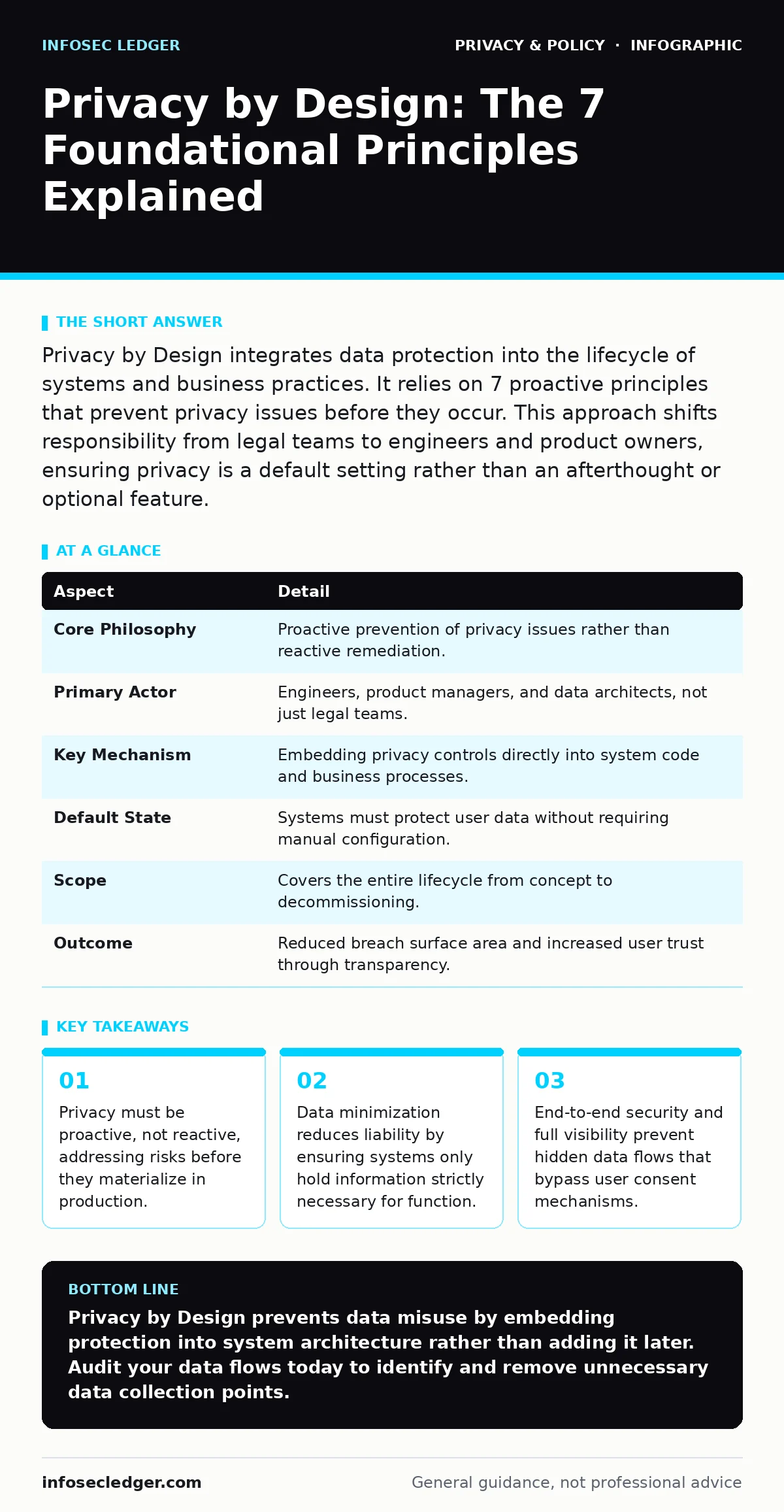
Privacy by Design integrates data protection into the lifecycle of systems and business practices. It relies on 7 proactive principles that prevent privacy issues before they occur. This approach shifts responsibility from legal teams to engineers and product owners, ensuring privacy is a default setting rather than an afterthought or optional feature.
The Architectural Shift
Imagine building a house where the locks are installed after the walls are up. You can bolt deadbolts to the doors, but the windows remain open, and the foundation lacks reinforcement. Privacy by Design rejects this retrofitting model. It treats privacy as a foundational element of system architecture, similar to structural integrity in construction. You do not add privacy settings to a completed application. You design the application so that privacy is the default state. This approach changes how software is written, how data is stored, and how users interact with services. It moves privacy from a legal checklist to an engineering constraint.
| Aspect | Detail |
|---|---|
| Core Philosophy | Proactive prevention of privacy issues rather than reactive remediation. |
| Primary Actor | Engineers, product managers, and data architects, not just legal teams. |
| Key Mechanism | Embedding privacy controls directly into system code and business processes. |
| Default State | Systems must protect user data without requiring manual configuration. |
| Scope | Covers the entire lifecycle from concept to decommissioning. |
| Outcome | Reduced breach surface area and increased user trust through transparency. |
Privacy by Design: The 7 Foundational Principles
The framework rests on 7 specific pillars that guide implementation. These principles ensure that privacy is not an abstract concept but a measurable engineering standard.
- Proactive not Reactive; Preventative not Remedial. Anticipate privacy issues before they happen. You design controls to stop data misuse before it can occur. This requires threat modeling during the design phase, not after a leak.
- Privacy as the Default. Users should not have to take action to protect their privacy. The system must automatically enforce the highest privacy settings. No opt-in forms for basic protection.
- Privacy Embedded into Design. Privacy is integral to the core functionality. It is not an add-on module. You cannot separate the privacy controls from the main application logic.
- Full Functionality. Privacy and security are not trade-offs against usability. You must achieve positive-sum outcomes where both privacy and utility are maximized.
- End-to-End Security. Protect data throughout its entire lifecycle. This includes encryption at rest, in transit, and in use. Secure deletion is as important as secure storage.
- Visibility and Transparency. Operations must be open to scrutiny. Users and auditors can verify that privacy promises are kept. Hidden data flows violate this principle.
- Respect for User Privacy. Keep users at the center. Provide relevant notices, consent mechanisms, and user controls. Design for reasonable expectations of privacy.
How the Mechanism Works in Practice
Implementing these principles requires changing workflow. Development teams must include privacy impact assessments before writing code. Data architects must map data flows to identify unnecessary collection points. Suppose you are building a login system. A reactive approach stores passwords and adds two-factor authentication for personal accounts later.
A proactive approach designs the system to never store plain-text credentials and integrates multi-factor verification into the initial authentication handshake. This reduces the attack surface immediately. You also ensure that session tokens expire quickly, limiting the damage if a token is stolen. This is not about adding features. It is about removing opportunities for abuse.
Who It Affects and Why
This framework affects every organization that processes personal data. Small businesses often believe they are too small to matter. This is incorrect. Data breaches do not discriminate by company size. A small retailer storing customer credit card details has the same liability as a large corporation if those details are exposed. Privacy by Design affects product managers who define features.
It affects developers who write the code. It affects legal teams who draft terms of service. It forces a collaboration that often does not exist. Engineers must understand legal requirements. Legal teams must understand technical constraints. This collaboration reduces the risk of building features that are legally non-compliant or technically insecure.
What People Usually Get Wrong
Many organizations confuse compliance with Privacy by Design. Checking boxes for regulations like GDPR or CCPA is reactive. Privacy by Design is proactive. Another common error is treating privacy as a cost center. Organizations assume that embedding privacy slows down development. In reality, fixing privacy flaws after launch is exponentially more expensive.
Refactoring code to remove unnecessary data collection takes weeks. Designing it out from the start takes hours. There is also a misconception that privacy hinders innovation. Constraints often drive better design. When you cannot track users via online tracking pixels, you must find better ways to understand user needs through direct feedback and aggregated, anonymized data. This leads to more sustainable business models.
See also: Cyber Insurance for Small Teams: Coverage Gaps and Cost Control · Third-Party Cookies: Hidden Risks and Protection for Small Businesses
The Hidden Costs of Ignoring the Framework
Ignoring these principles creates hidden technical debt. Systems become complex because data flows are not mapped. You do not know where customer data lives. When a user requests deletion, you cannot guarantee it is removed from all backups and third-party integrations. This leads to manual, error-prone processes. It also erodes user trust. Users are increasingly aware of how their data is used.
If they discover that you collect more data than necessary, they will leave. The cost of acquiring a new customer is higher than retaining an existing one. Privacy by Design protects your revenue by protecting your reputation. It also simplifies audits. When privacy is embedded, you can demonstrate compliance through architecture diagrams rather than manual logs.
Integrating with Existing Security Measures
Privacy by Design complements other security practices. It works alongside two-factor authentication for personal accounts to ensure that access controls are robust. It informs how you handle biometric data, which requires higher protection standards due to its immutable nature. It dictates how you manage browser cookies, ensuring that only necessary tracking is allowed.
It guides the use of private browsing mode recommendations for your users, acknowledging that client-side protections are limited. It helps you understand the risks of public Wi-Fi, prompting you to design systems that do not rely on network-level security. It clarifies how people-search sites aggregate data, encouraging you to opt-out mechanisms or data minimization. It addresses the challenges of online tracking, pushing for first-party data collection over third-party surveillance.
Implementing the Principles Today
Start by auditing your current data flows. Identify where data is collected, stored, and shared. Map this against the 7 principles. Look for areas where data is collected without a clear purpose. Remove those collection points. Next, review your default settings. Ensure that privacy is the highest setting by default. Engage your engineering team to embed these checks into the development pipeline. Use automated tools to scan for privacy violations in code. Train your staff on the difference between compliance and design. Make privacy a key performance indicator for product teams. This shift requires leadership commitment. It is not a one-time project. It is a continuous practice.
Key takeaways
- Privacy must be proactive, not reactive, addressing risks before they materialize in production.
- Data minimization reduces liability by ensuring systems only hold information strictly necessary for function.
- End-to-end security and full visibility prevent hidden data flows that bypass user consent mechanisms.
Privacy by Design prevents data misuse by embedding protection into system architecture rather than adding it later. Audit your data flows today to identify and remove unnecessary data collection points.
Frequently asked questions
Does Privacy by Design replace legal compliance?
No, it complements it. Compliance sets the minimum legal requirements. Privacy by Design ensures those requirements are met through technical architecture, reducing the risk of accidental non-compliance.
Can small businesses afford to implement these principles?
Yes, and they should. The cost of implementing privacy early is lower than the cost of a breach. Small teams can start by mapping data flows and removing unnecessary data collection.
Is Privacy by Design only for software companies?
No, it applies to any organization that processes personal data. This includes retailers, healthcare providers, and service businesses. It covers physical processes as well as digital ones.
How do I know if I am doing it right?
If you can demonstrate that privacy was considered at the design stage, that defaults are private, and that data is minimized, you are on the right track. Regular audits help verify this.
How this guide was produced: written by the InfoSec Ledger editorial team with AI assistance, checked against the public references listed below, and reviewed when the facts change. See our editorial policy or report an error.