
Medical Identity Theft Description: How It Works and What To Do
Medical identity theft often goes undetected for years because financial alerts do not trigger when someone uses your name for non-monetary healthcare services.
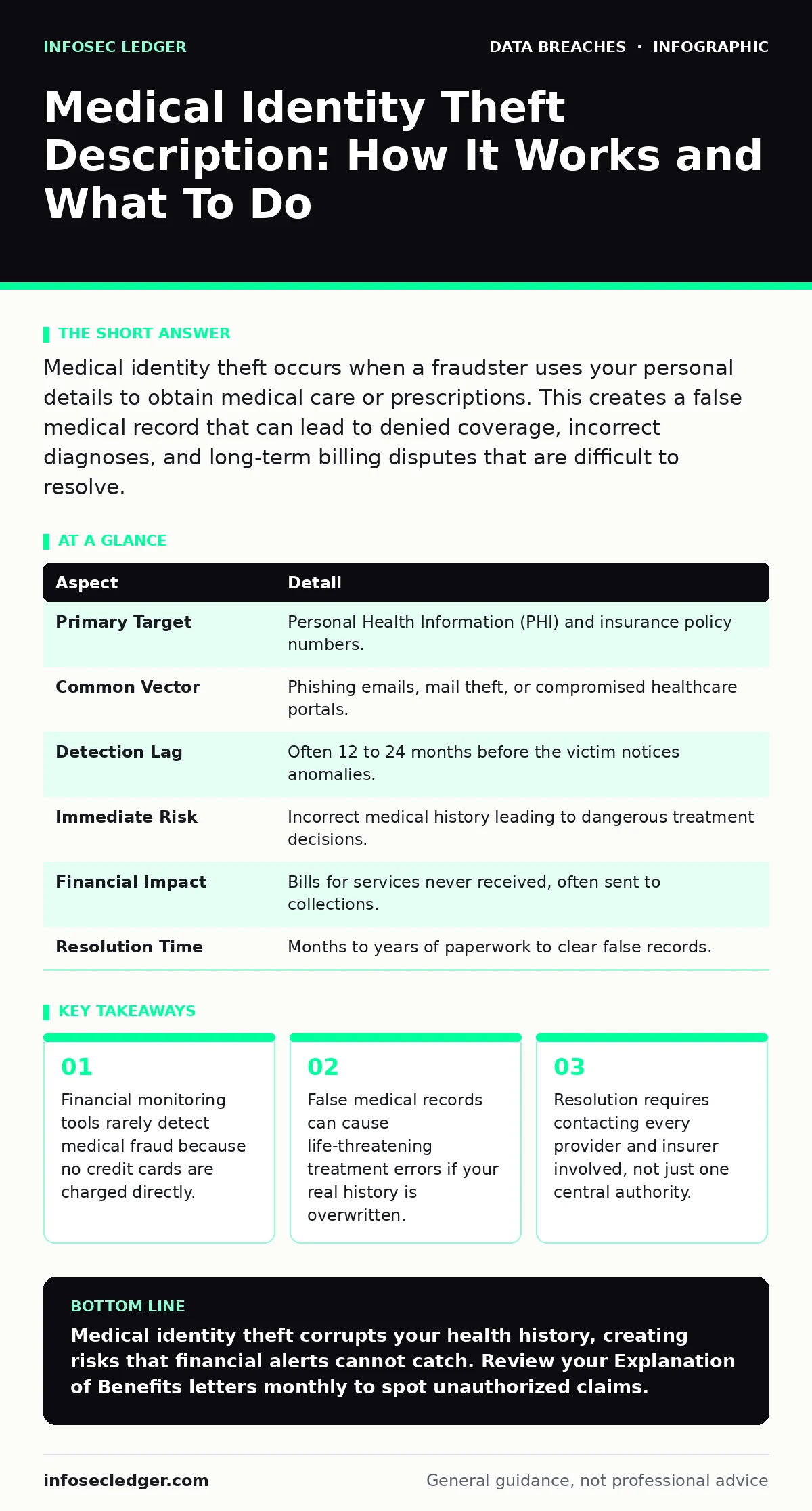
Medical identity theft occurs when a fraudster uses your personal details to obtain medical care or prescriptions. This creates a false medical record that can lead to denied coverage, incorrect diagnoses, and long-term billing disputes that are difficult to resolve.
The Library Card Analogy
Imagine a library where borrowing books requires only your name and birthdate. A stranger uses your details to check out medical textbooks. You never know this happened. When you finally visit the library, the system shows you have borrowed dangerous materials. The librarian refuses to lend you safe books because your record is flagged. Medical identity theft operates on this same principle of silent record contamination.
The thief does not need your bank account. They need your identity to access services covered by insurance. This creates a hidden liability that grows over time. You do not see the damage until you need care yourself. The system then rejects you based on a history you never lived.
| Aspect | Detail |
|---|---|
| Primary Target | Personal Health Information (PHI) and insurance policy numbers. |
| Common Vector | Phishing emails, mail theft, or compromised healthcare portals. |
| Detection Lag | Often 12 to 24 months before the victim notices anomalies. |
| Immediate Risk | Incorrect medical history leading to dangerous treatment decisions. |
| Financial Impact | Bills for services never received, often sent to collections. |
| Resolution Time | Months to years of paperwork to clear false records. |
Medical Identity Theft Description
Medical identity theft is the unauthorized use of your personal information to obtain medical services, prescriptions, or medical equipment. The perpetrator assumes your identity to bill an insurance provider for care they receive. This is distinct from financial fraud because the victim rarely sees a direct charge on a credit card statement.
The core mechanism relies on the assumption that healthcare systems prioritize speed over verification. Providers often accept insurance cards without rigorous identity checks. The fraudster walks into a clinic, presents your card, and receives treatment. The bill goes to the insurer. The insurer pays it. You receive an Explanation of Benefits (EOB) for a service you never requested.
This description highlights a critical gap in traditional security. Most people monitor their bank accounts. They rarely monitor their health records. The theft happens in the background, altering your medical history. A simple flu shot for the thief becomes a documented allergy in your file. This alteration has real-world consequences for your future health.
How The Fraud Operates
The process begins with data acquisition. Attackers steal personal information through phishing emails, malware, or physical theft of mail. They need your name, date of birth, and insurance policy number. With these details, they can impersonate you at most clinics.
The fraudster visits a healthcare provider. They present your insurance card. The provider checks the card for validity, not necessarily for the person holding it. The service is rendered. The provider submits a claim to the insurance company. The claim is processed automatically. No red flags appear because the policy number is valid.
The victim remains unaware. The thief may repeat this process multiple times. They might also use the stolen identity to obtain prescription drugs. These drugs are then sold on the black market. The volume of fake claims can trigger an audit by the insurer. The insurer contacts you. Only then do you realize your identity has been compromised.
Who Is Most At Risk
Anyone with health insurance is a target. However, certain groups face higher exposure. Individuals with chronic conditions are attractive because their care is frequent and expensive. Fraudsters can blend in with legitimate claims. A fake claim for a routine injection looks similar to real claims.
People who receive care in multiple facilities are also vulnerable. Disconnected electronic health records make it harder to spot inconsistencies. A fraudster might use your identity at a lab in one city and a clinic in another. The two systems do not talk to each other. The fraud goes unnoticed.
Small businesses often face indirect risks. If an employee’s identity is stolen, the company may face administrative burdens. The employee spends work hours resolving the fraud. Productivity drops. The employer may also face pressure if the fraud involves company-sponsored health plans. Understanding this risk helps you prioritize data loss prevention measures for sensitive employee records.
What People Usually Get Wrong
Many victims believe that monitoring their credit report is enough. This is a mistake. Credit bureaus track financial debt. They do not track medical services. A thief can drain your insurance benefits without touching your credit score. You need separate monitoring for your health information.
Another common error is ignoring Explanation of Benefits letters. These documents list every service billed to your policy. People discard them as junk mail. They are actually your primary detection tool. Reading them allows you to spot services you did not receive. Ignoring them delays detection.
Victims also assume the insurance company will fix the problem. Insurers can stop paying fraudulent claims. They cannot correct the medical record at the provider’s office. The provider holds the clinical data. You must contact the provider to remove false entries. This separation of financial and clinical data complicates resolution.
See also: Securing AI Agents With Information-Flow Control: The Silent Boundary · Why is anonymization a challenge of cybersecurity for your data
Steps To Resolve The Fraud
Resolution requires a systematic approach. You must address both the financial and medical sides of the theft. Start by contacting your insurance provider. Report the fraud. Ask them to flag your account. This prevents further claims from being processed under your name.
Next, contact every healthcare provider involved. Request that they mark the fraudulent claims as errors. Ask them to delete or correct the false medical information in your chart. This step is critical. Incorrect medical history can lead to wrong diagnoses. It can also cause doctors to prescribe medications that interact dangerously with your actual conditions.
Place a fraud alert on your credit reports. This adds an extra step for anyone trying to open new accounts in your name. It does not stop medical theft, but it helps prevent the fraudster from expanding their activities. Keep records of all communications. Follow up in writing. Persistence is required to clear your name.
Preventing Future Exposure
Prevention starts with securing your personal data. Shred documents containing health information. Do not leave mail in unsecured boxes. Use encryption at rest for any digital files containing personal health details. This ensures that even if your device is stolen, the data remains unreadable.
Be cautious with email communications. Phishing attacks often mimic healthcare providers. They ask for verification of your policy number. Never click links in unsolicited emails. Go directly to the provider’s official website. Verify the legitimacy of any request for personal information.
Review your data retention policies if you manage employee health records. Keep only what is necessary. Delete old records securely. The less data you hold, the less value you present to attackers. Implementing strong vendor risk management practices also helps. Ensure that third-party service providers meet strict security standards. This reduces the chance of a breach in the supply chain.
The Hidden Cost Of Inaction
The financial cost is obvious. You may be billed for services you never received. These bills can go to collections. This damages your credit score. The hidden cost is medical. False records can alter your treatment. A documented allergy to penicillin might be fake. If a doctor sees this record, they will avoid using penicillin. This limits your treatment options during an emergency.
Correcting these records takes time. You may need to visit multiple facilities. You may need legal assistance. The stress is significant. The fraud does not stop until you actively dismantle the false narrative. Passive monitoring is not enough. You must be proactive in verifying your health data.
Key takeaways
- Financial monitoring tools rarely detect medical fraud because no credit cards are charged directly.
- False medical records can cause life-threatening treatment errors if your real history is overwritten.
- Resolution requires contacting every provider and insurer involved, not just one central authority.
Medical identity theft corrupts your health history, creating risks that financial alerts cannot catch. Review your Explanation of Benefits letters monthly to spot unauthorized claims.
Frequently asked questions
Does a credit freeze stop medical identity theft?
No, a credit freeze prevents new credit accounts from being opened. It does not stop someone from using your insurance card for medical services.
How long does it take to clear false medical records?
It can take months or years. You must contact each provider and insurer individually to correct their specific records.
Should I change my insurance policy number?
You cannot simply change it. You must report the fraud to your insurer. They will issue a new card and number after closing the compromised account.
Can my employer help me resolve this?
Employers can provide HR contacts for plan details. They cannot access your medical records or resolve clinical data errors with providers.
How this guide was produced: written by the InfoSec Ledger editorial team with AI assistance, checked against the public references listed below, and reviewed when the facts change. See our editorial policy or report an error.