Cybercrime-as-a-Service Misconceptions and Real Risks for Your Network
Understanding that cybercrime-as-a-service lowers the technical barrier for attackers reveals why traditional perimeter defenses often fail against low-skill adversaries.
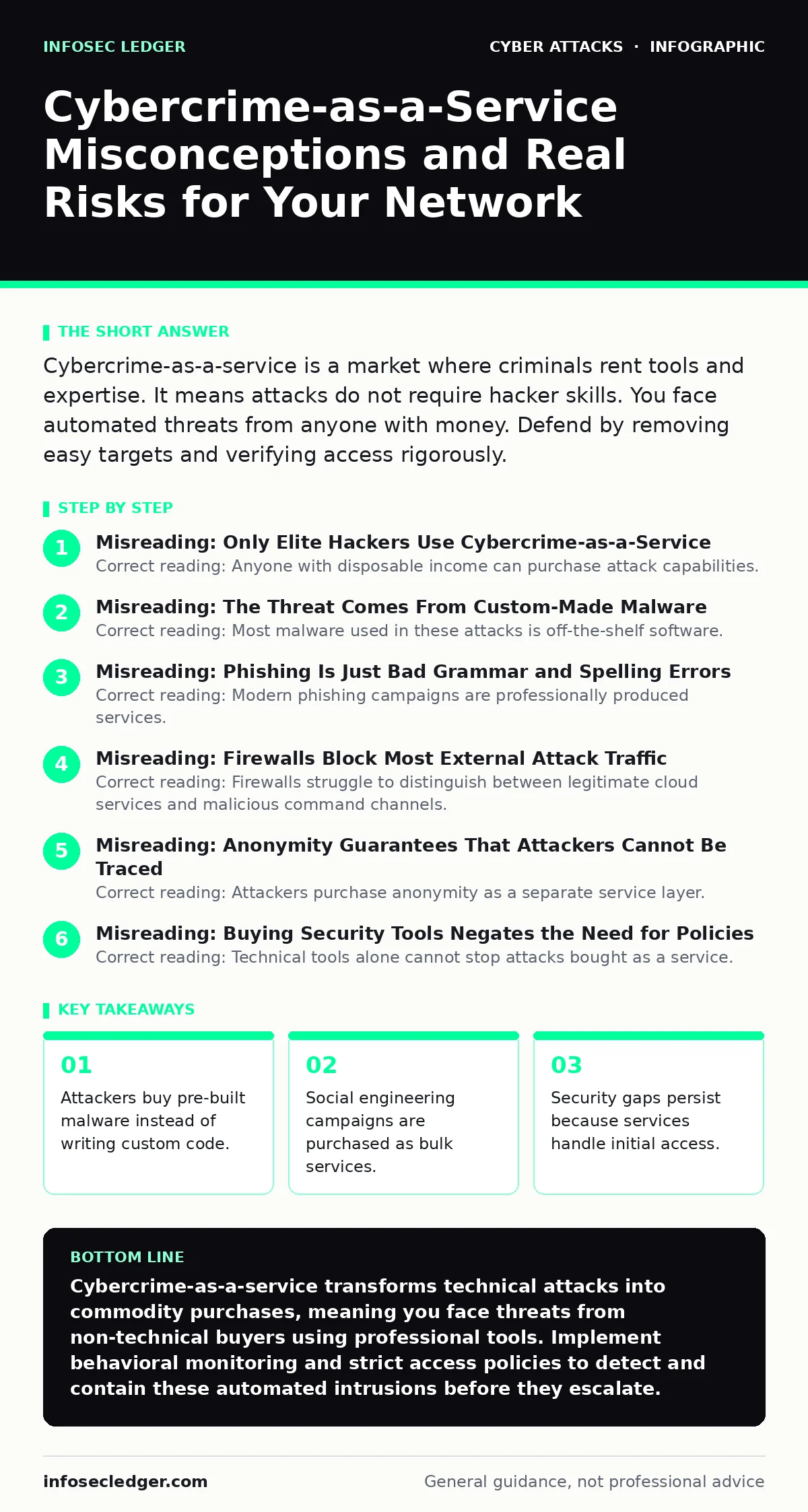
Cybercrime-as-a-service is a market where criminals rent tools and expertise. It means attacks do not require hacker skills. You face automated threats from anyone with money. Defend by removing easy targets and verifying access rigorously.
Misreading: Only Elite Hackers Use Cybercrime-as-a-Service
Correct reading: Anyone with disposable income can purchase attack capabilities. The market operates like a standard software subscription model. Vendors provide malware, phishing templates, and access to compromised accounts. The buyer does not need coding skills or deep technical knowledge. This democratization of crime increases the volume of attacks significantly. Small organizations face the same automated tools that target enterprises. You cannot assume an attacker is a state-sponsored group. Most threats come from low-skill users buying high-impact tools. This shifts the risk from sophisticated targeting to broad, automated spraying.
Misreading: The Threat Comes From Custom-Made Malware
Correct reading: Most malware used in these attacks is off-the-shelf software. Criminals sell standardized ransomware kits and remote access trojans. These tools are updated centrally by the developer. Your security tools may recognize the signature, but new variants appear daily. The real risk is the configuration of these tools. Attackers customize behavior to avoid detection without changing the core code. This makes static signature detection less effective. You need behavioral analysis to spot anomalies. The malware itself is common, but its deployment strategy is tailored to your specific environment.
Misreading: Phishing Is Just Bad Grammar and Spelling Errors
Correct reading: Modern phishing campaigns are professionally produced services. Vendors provide templates that mimic legitimate corporate communications. They include correct branding, tone, and legal disclaimers. Some services offer A/B testing to optimize open rates. This quality makes detection difficult for human reviewers. The content is often grammatically perfect. The deception relies on urgency and authority, not language errors. You must verify the sender identity through technical controls. Relying on visual inspection is ineffective against purchased social engineering assets. Treat every unexpected email as potentially crafted by a professional.
Misreading: Firewalls Block Most External Attack Traffic
Correct reading: Firewalls struggle to distinguish between legitimate cloud services and malicious command channels. Cybercrime-as-a-service platforms often use legitimate infrastructure for control traffic. This traffic looks like normal web browsing or API calls. Blocking all unknown IPs is impossible without breaking business operations. The attacker leverages this ambiguity to maintain access. Your perimeter defense sees allowed HTTPS traffic. The compromise happens inside the allowed connection. You must monitor internal behavior rather than just external entry points. Look for unusual data flows or command sequences.
Misreading: Anonymity Guarantees That Attackers Cannot Be Traced
Correct reading: Attackers purchase anonymity as a separate service layer. They use bulletproof hosting, encrypted messaging, and cryptocurrency mixing. This adds cost and complexity for the criminal. Mistakes in this layer are common and exploitable. Operational security errors often reveal the attacker’s identity. However, you cannot rely on law enforcement to stop the attack in real time. You must assume the attacker believes they are anonymous. This emboldens them to act aggressively. Your defense must not depend on attribution or deterrence. Focus on detection and containment instead.
See also: Intrusion Prevention System vs Firewall: How To Layer Your Network Defense · Malicious Bot Traffic: Detection, Mitigation, and Hidden Costs
Misreading: Buying Security Tools Negates the Need for Policies
Correct reading: Technical tools alone cannot stop attacks bought as a service. Criminals sell access to human weaknesses. They provide scripts to manipulate employees into granting access. No firewall can stop an employee from handing over credentials. You need strict conditional access policies to limit what compromised credentials can do. You need email authentication to verify sender identity. You need attack surface reduction to remove unnecessary entry points. Tools enforce policy, but policy defines the rules. Without clear rules, tools are misconfigured or bypassed.
Misreading: Botnets Are Only for Distributed Denial-of-Service Attacks
Correct reading: Botnets are now rented for credential stuffing and data scraping. Attackers buy access to millions of compromised devices. They use these devices to distribute attacks geographically. This makes blocking by IP address ineffective. The traffic appears to come from residential users worldwide. Your intrusion prevention systems may see this as legitimate user traffic. You must monitor for unusual login patterns from diverse locations. Rate limiting helps, but sophisticated services rotate IPs constantly. Behavioral detection is more reliable than geographic blocking.
Misreading: Session Cookies Are Safe If Passwords Are Strong
Correct reading: Attackers sell stolen session cookies directly. These cookies allow immediate access without needing the password. The victim’s password remains unchanged, so no reset is triggered. This bypasses multi-factor authentication entirely. The attacker hijacks the active session. Your systems see a valid, authenticated user. You must monitor for session anomalies, such as impossible travel or unusual activity times. Expire sessions frequently to limit the window of opportunity. Treat session tokens as sensitive credentials. Rotate them upon any suspicious activity.
Misreading: Malicious Bot Traffic Is Always Detectable by Volume
Correct reading: Modern bot services mimic human browsing patterns precisely. They randomize mouse movements, scroll speeds, and typing delays. This evasion technique defeats basic rate-limiting and volume thresholds. The bot traffic blends in with legitimate user activity. It can perform account takeovers or data scraping slowly. You need advanced heuristics to detect subtle deviations. Look for inconsistencies in browser fingerprints or device attributes. Behavioral biometrics can reveal non-human actors. Do not rely solely on request counts for protection.
Misreading: Tailgating Is a Physical Security Issue Only
Correct reading: Cybercrime-as-a-service vendors often facilitate physical breaches. They sell guides on how to bypass reception protocols. They provide fake badges or escort requests. This physical access allows attackers to install hardware keyloggers. It also enables direct network access via open ports. Physical security is part of the digital attack chain. You must integrate physical access logs with digital monitoring. An insider threat or tailgating event should trigger network alerts. Secure your physical perimeter as rigorously as your digital one.
Misreading: Email Authentication Fully Prevents Compromise
Correct reading: Email authentication protocols like SPF, DKIM, and DMARC verify sender domains. They do not verify the intent or content of the message. Attackers buy access to legitimate email accounts. They send emails from verified, trusted domains. These emails pass all authentication checks. The recipient sees a known sender, such as a vendor or colleague. The content is malicious, but the envelope is clean. You cannot trust authentication alone. You must analyze content and context. Monitor for unexpected attachments or links from known senders.
Key takeaways
- Attackers buy pre-built malware instead of writing custom code.
- Social engineering campaigns are purchased as bulk services.
- Security gaps persist because services handle initial access.
- Detection fails when traffic looks like normal cloud usage.
Cybercrime-as-a-service transforms technical attacks into commodity purchases, meaning you face threats from non-technical buyers using professional tools. Implement behavioral monitoring and strict access policies to detect and contain these automated intrusions before they escalate.
Frequently asked questions
How do I know if my network is targeted by cybercrime-as-a-service?
Look for automated, low-skill attack patterns such as broad credential stuffing or generic phishing templates. These indicate the use of purchased tools rather than custom attacks.
Can multi-factor authentication stop cybercrime-as-a-service attacks?
MFA stops password-based attacks but fails against session cookie theft or social engineering. Attackers buy services that bypass MFA by stealing active sessions or tricking users.
What is the cost of defending against cybercrime-as-a-service?
Defense costs come from implementing behavioral monitoring and strict access policies. These measures add complexity but reduce the success rate of automated, purchased attacks.
Do I need a security operations center to detect these threats?
You need continuous monitoring, which can be achieved through managed services or automated tools. The key is detecting behavioral anomalies, not just known signatures.
How this guide was produced: written by the InfoSec Ledger editorial team with AI assistance, checked against the public references listed below, and reviewed when the facts change. See our editorial policy or report an error.