
Document retention policies for nonprofits: reduce risk and save space
Keeping files longer than necessary increases your attack surface and storage costs without providing legal or operational benefit.
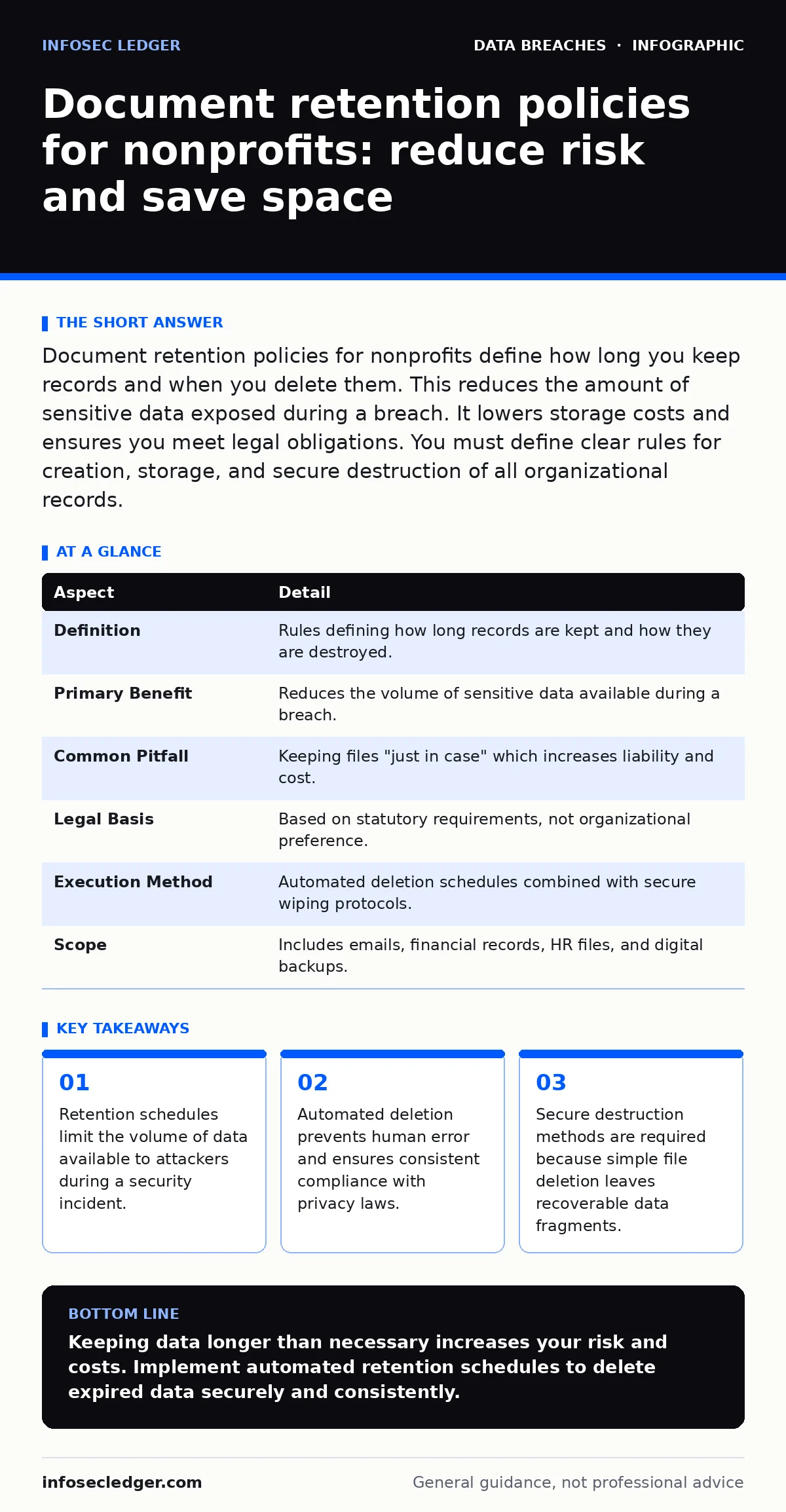
Document retention policies for nonprofits define how long you keep records and when you delete them. This reduces the amount of sensitive data exposed during a breach. It lowers storage costs and ensures you meet legal obligations. You must define clear rules for creation, storage, and secure destruction of all organizational records.
Why data retention matters for security
Imagine a library that never discards old books. The shelves overflow, making it hard to find current titles. Worse, sensitive ledgers from decades ago remain accessible to anyone with a key. Data retention policies function as the library’s archiving and disposal system. They dictate how long specific types of records must be kept and when they must be destroyed.
For organizations handling donor information, employee records, or grant data, this policy is a primary defense against unauthorized access. The less data you hold, the less an attacker can steal. Retention policies also address the hidden cost of storage. Cloud storage fees accumulate over time as you keep inactive files. Deleting obsolete data reduces these ongoing expenses while shrinking your digital footprint.
| Aspect | Detail |
|---|---|
| Definition | Rules defining how long records are kept and how they are destroyed. |
| Primary Benefit | Reduces the volume of sensitive data available during a breach. |
| Common Pitfall | Keeping files "just in case" which increases liability and cost. |
| Legal Basis | Based on statutory requirements, not organizational preference. |
| Execution Method | Automated deletion schedules combined with secure wiping protocols. |
| Scope | Includes emails, financial records, HR files, and digital backups. |
How retention schedules work
A retention schedule is a detailed list of record categories and their required holding periods. You start by identifying every type of document your organization creates. This includes financial statements, board minutes, donor lists, and employee contracts. Next, you determine the legal or operational minimum time each type must be retained.
Once the periods are set, you implement a process to move data from active storage to archival storage. Active data is accessed frequently and requires high security. Archival data is rarely accessed and can be moved to cheaper, colder storage. Finally, you establish a destruction phase. When the retention period expires, the data must be permanently removed. Simple deletion is insufficient. You must use methods that overwrite the data, making it unrecoverable. This ensures that even if someone gains physical access to your hard drives, they cannot reconstruct the deleted files.
Who needs strict retention rules
Every organization that collects personal or financial information needs a retention policy. Nonprofits are particularly vulnerable because they often handle sensitive donor data and volunteer information. They may also manage grants with specific reporting requirements that dictate record-keeping periods.
Small teams often lack dedicated compliance officers. This makes automated retention critical. Without clear rules, staff members keep files on their desktops or in personal cloud accounts. This creates shadow IT environments where data sits unprotected. A formal policy applies to everyone, from the executive director to the intern. It ensures that data handling is consistent regardless of who created the file. This consistency is vital for maintaining trust with donors and partners.
Document retention policies for nonprofits
Nonprofits face unique pressures regarding data handling. They often operate with limited budgets, making expensive storage solutions difficult to justify. They also rely heavily on volunteers who may not understand data privacy concepts. Document retention policies for nonprofits must be simple enough for volunteers to follow but strict enough to protect sensitive information.
You must align your policy with the specific laws in your jurisdiction. Some regions require financial records to be kept for seven years. Others may have shorter periods for personnel files. You cannot guess these periods. You must consult legal counsel to determine the exact requirements. Once defined, these periods become the hard limit for your data. Keeping files beyond this limit provides no legal protection and only adds risk.
What people usually get wrong
Many organizations believe that keeping data forever is the safest option. This is incorrect. Keeping data increases the window of opportunity for attackers. It also increases the cost of defending that data. Another common mistake is assuming that deleting a file removes it permanently. Most operating systems only remove the reference to the file. The actual data remains on the disk until it is overwritten by new information.
People also forget about backups. If you delete a file from your main system, it may still exist in your backup tapes or cloud snapshots. Your retention policy must apply to backups as well. You need a process to purge old backups that contain expired data. Ignoring backups creates a hidden reservoir of sensitive information that attackers can exploit. This oversight often undermines the entire security strategy.
See also: Unauthorized Access Meaning: How Intruders Bypass Controls · Fraud Alerts: How Early Warning Systems Stop Identity Theft
Integrating with other security measures
Retention policies do not work in isolation. They must integrate with your broader security framework. For instance, encryption at rest protects data while it is stored, but it does not solve the problem of excess data. You still need to delete what you no longer need. Similarly, data loss prevention tools can monitor data movement, but they cannot enforce deletion schedules.
Vendor risk management is also relevant. If you use third-party services to store records, you must ensure their retention policies align with yours. You cannot control data you do not own, but you can require vendors to follow your destruction timelines. Secure file sharing protocols help prevent data leakage during the active life of a document, but the end-of-life process is what defines retention. Understanding these connections helps you build a cohesive defense strategy.
Implementing your policy
Start by auditing your current data. Identify where records are stored and how long they have been there. Create a matrix of record types and their required retention periods. Assign ownership of each record type to a specific department. The finance team owns financial records. Human resources owns employee files.
Next, configure your systems to enforce these rules. Use automated tagging to classify new files as they are created. Set up alerts for files approaching their expiration date. Finally, establish a secure destruction process. This may involve using certified software to overwrite digital files or shredding physical documents. Document every destruction event. This audit trail proves that you followed your policy, which is critical during legal disputes or security investigations.
Key takeaways
- Retention schedules limit the volume of data available to attackers during a security incident.
- Automated deletion prevents human error and ensures consistent compliance with privacy laws.
- Secure destruction methods are required because simple file deletion leaves recoverable data fragments.
Keeping data longer than necessary increases your risk and costs. Implement automated retention schedules to delete expired data securely and consistently.
Frequently asked questions
How long should I keep donor information?
You should keep donor information only as long as required by law or for active fundraising purposes. Once the relationship ends and legal periods expire, delete the data securely to minimize breach risk.
Does deleting a file from my computer remove it from backups?
No, deleting a file from your active system does not automatically remove it from backups. You must configure your backup system to purge expired data or use immutable storage with defined retention windows.
What is the difference between archiving and retention?
Archiving moves inactive data to cheaper storage for long-term preservation. Retention defines the specific time limit for keeping that data before it must be permanently destroyed. Archiving is a step within the retention lifecycle.
Can I use cloud storage for sensitive records?
Yes, but you must ensure the cloud provider supports your retention requirements. Verify that they offer secure deletion options and that their data centers comply with relevant privacy laws and security standards.
How this guide was produced: written by the InfoSec Ledger editorial team with AI assistance, checked against the public references listed below, and reviewed when the facts change. See our editorial policy or report an error.