
Application Threat Modeling: 8 Best Practices for Secure Design
Threat modeling exposes architectural flaws before code is written, preventing costly retrofits and reducing the attack surface through deliberate design choices.
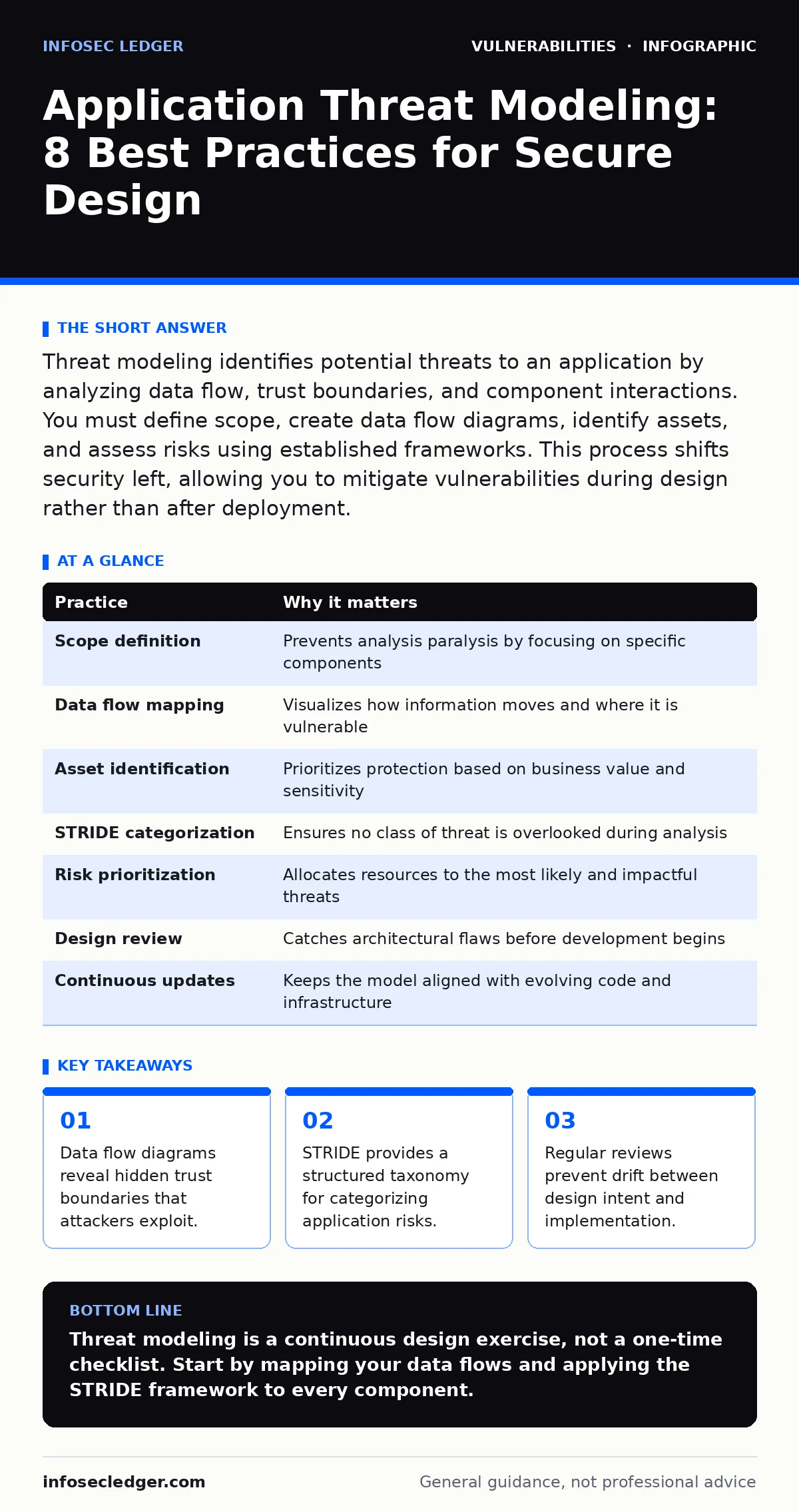
Threat modeling identifies potential threats to an application by analyzing data flow, trust boundaries, and component interactions. You must define scope, create data flow diagrams, identify assets, and assess risks using established frameworks. This process shifts security left, allowing you to mitigate vulnerabilities during design rather than after deployment.
Define the scope and boundaries
Threat modeling begins with precise definition of what you are protecting. You must draw a clear line around the application components, external services, and user interactions. Without this boundary, the analysis becomes unmanageable and misses critical external dependencies. You are not securing the entire internet, only the specific system under review. This focus ensures that every identified threat has a clear owner and a measurable mitigation strategy.
Imagine a web application that relies on a third-party payment processor. If you exclude the processor from your scope, you miss the risk of compromised callbacks. Defining scope includes identifying all inputs and outputs. You must list every API endpoint, database connection, and user interface element. This inventory becomes the foundation for your risk assessment.
| Practice | Why it matters |
|---|---|
| Scope definition | Prevents analysis paralysis by focusing on specific components |
| Data flow mapping | Visualizes how information moves and where it is vulnerable |
| Asset identification | Prioritizes protection based on business value and sensitivity |
| STRIDE categorization | Ensures no class of threat is overlooked during analysis |
| Risk prioritization | Allocates resources to the most likely and impactful threats |
| Design review | Catches architectural flaws before development begins |
| Continuous updates | Keeps the model aligned with evolving code and infrastructure |
| Stakeholder inclusion | Brings diverse perspectives to identify blind spots |
Map the data flow in detail
You must create data flow diagrams that show every component and interaction. These diagrams are not just technical drawings; they are security maps. Each box represents a component, and each arrow represents data movement. You label each arrow with the data type, such as user credentials or financial records. This visualization reveals where data crosses trust boundaries. Trust boundaries are points where data moves from a less trusted environment to a more trusted one.
Many developers assume that internal networks are safe. This assumption is incorrect. Data moving between microservices crosses a trust boundary just as it does when entering from the internet. You must mark these boundaries explicitly. When data crosses a boundary, you must verify its integrity and authenticity. Failure to do so leads to injection attacks and unauthorized access. The diagram makes these hidden transitions visible.
Identify and value assets
Not all data is equally important. You must identify which assets require protection. These assets include user data, intellectual property, and system credentials. You assign a value to each asset based on confidentiality, integrity, and availability requirements. Confidentiality prevents unauthorized access. Integrity ensures data is not altered. Availability guarantees access when needed.
Prioritizing assets helps you focus your efforts. Protecting public marketing pages requires less effort than protecting customer financial records. You should ask what happens if an asset is compromised. The answer determines the required control strength. This step prevents over-engineering security for low-value items while under-protecting critical data. It aligns security spending with business risk.
Apply the STRIDE model
STRIDE is a mnemonic for six categories of threats. It stands for Spoofing, Tampering, Repudiation, Information Disclosure, Denial of Service, and Elevation of Privilege. You apply this model to each component and data flow in your diagram. For each category, you ask specific questions. Can an attacker spoof a user identity? Can they tamper with data in transit? Can they deny service to legitimate users?
This structured approach prevents oversight. Developers often focus on data theft but ignore availability or repudiation. By forcing consideration of all six categories, you uncover a broader range of risks. For example, you might identify that lack of audit logs enables repudiation. You then add logging controls to the design. This method turns vague concerns into specific, actionable items.
Assess likelihood and impact
Identifying threats is not enough. You must assess how likely each threat is and what impact it would have. Likelihood depends on the attacker's skill, resources, and motivation. Impact depends on the value of the asset and the business consequences. You combine these factors to calculate risk. High likelihood and high impact require immediate mitigation. Low likelihood and low impact can be accepted or monitored.
This assessment prevents resource waste. You cannot mitigate every threat. You must choose where to invest. Consider the cost of mitigation versus the cost of a breach. If a threat is unlikely and the impact is minor, you may choose to accept the risk. If the threat is likely and the impact is severe, you must design controls to prevent or detect it. This balance is key to effective security.
See also: CVSS Environmental Scores: How to Rank Vulnerabilities That Actually Matter · Detect Host Header Injection: Warning Signs and Immediate Response
Design mitigations into architecture
Mitigations should be part of the design, not an afterthought. You integrate security controls directly into the architecture. This includes input validation, authentication, authorization, and encryption. You choose controls that address the specific risks identified. For example, if information disclosure is a risk, you implement encryption in transit and at rest.
Designing mitigations early is cheaper than fixing them later. Changing code is expensive. Changing architecture is even more expensive. You should consider defense in depth. This means having multiple layers of protection. If one control fails, another catches the threat. For instance, input validation prevents injection, but parameterized queries also block it. This redundancy increases resilience.
Review and update regularly
Threat models are not static documents. They must evolve with the application. Every time you add a feature, change a dependency, or modify an interface, you review the model. You update the data flow diagrams and reassess risks. New features introduce new attack surfaces. Old features may be deprecated, removing some risks.
Regular reviews prevent drift. The model may become outdated if you do not maintain it. An outdated model gives a false sense of security. You should schedule reviews alongside development sprints. This ensures that security keeps pace with functionality. You also review when new threats emerge in the industry. This continuous process keeps your application secure over time.
Include diverse perspectives
Security is a team sport. You should include developers, designers, and operations staff in the threat modeling process. Each role brings a different perspective. Developers understand the code. Designers understand the user experience. Operations staff understand the infrastructure. Together, they identify risks that a single person might miss.
Diverse teams find more flaws. They challenge assumptions and ask different questions. A developer might miss a usability flaw that leads to security errors. A designer might miss a technical vulnerability. By combining insights, you create a more robust model. You also build a culture of security. When everyone participates, security becomes a shared responsibility rather than a bottleneck.
Consider related topics like Content Security Policy to protect against cross-site scripting. Understanding OAuth misconfigurations helps secure authentication flows. Reviewing privilege escalation vulnerabilities ensures proper access controls. These specific areas often appear in threat models and require dedicated attention.
Key takeaways
- Data flow diagrams reveal hidden trust boundaries that attackers exploit.
- STRIDE provides a structured taxonomy for categorizing application risks.
- Regular reviews prevent drift between design intent and implementation.
Threat modeling is a continuous design exercise, not a one-time checklist. Start by mapping your data flows and applying the STRIDE framework to every component.
Frequently asked questions
How often should I update my threat model?
Update your threat model whenever you make significant changes to the application architecture, add new features, or introduce new third-party dependencies. Regular reviews during development sprints are recommended.
Can threat modeling replace penetration testing?
No. Threat modeling identifies architectural risks during design. Penetration testing validates the effectiveness of controls in the deployed system. Both are necessary for comprehensive security.
Who should lead the threat modeling process?
A security engineer or architect should facilitate the process. However, it requires active participation from developers, designers, and operations staff to be effective and thorough.
What if I don't have a security team?
You can still perform threat modeling using public frameworks and checklists. Focus on data flow diagrams and the STRIDE model. External consultants can provide guidance if internal expertise is lacking.
How this guide was produced: written by the InfoSec Ledger editorial team with AI assistance, checked against the public references listed below, and reviewed when the facts change. See our editorial policy or report an error.