
Detecting Medical Identity Theft: Log Signals and Blind Spots
Medical identity theft often hides in routine billing adjustments and minor demographic updates that standard security tools ignore entirely.
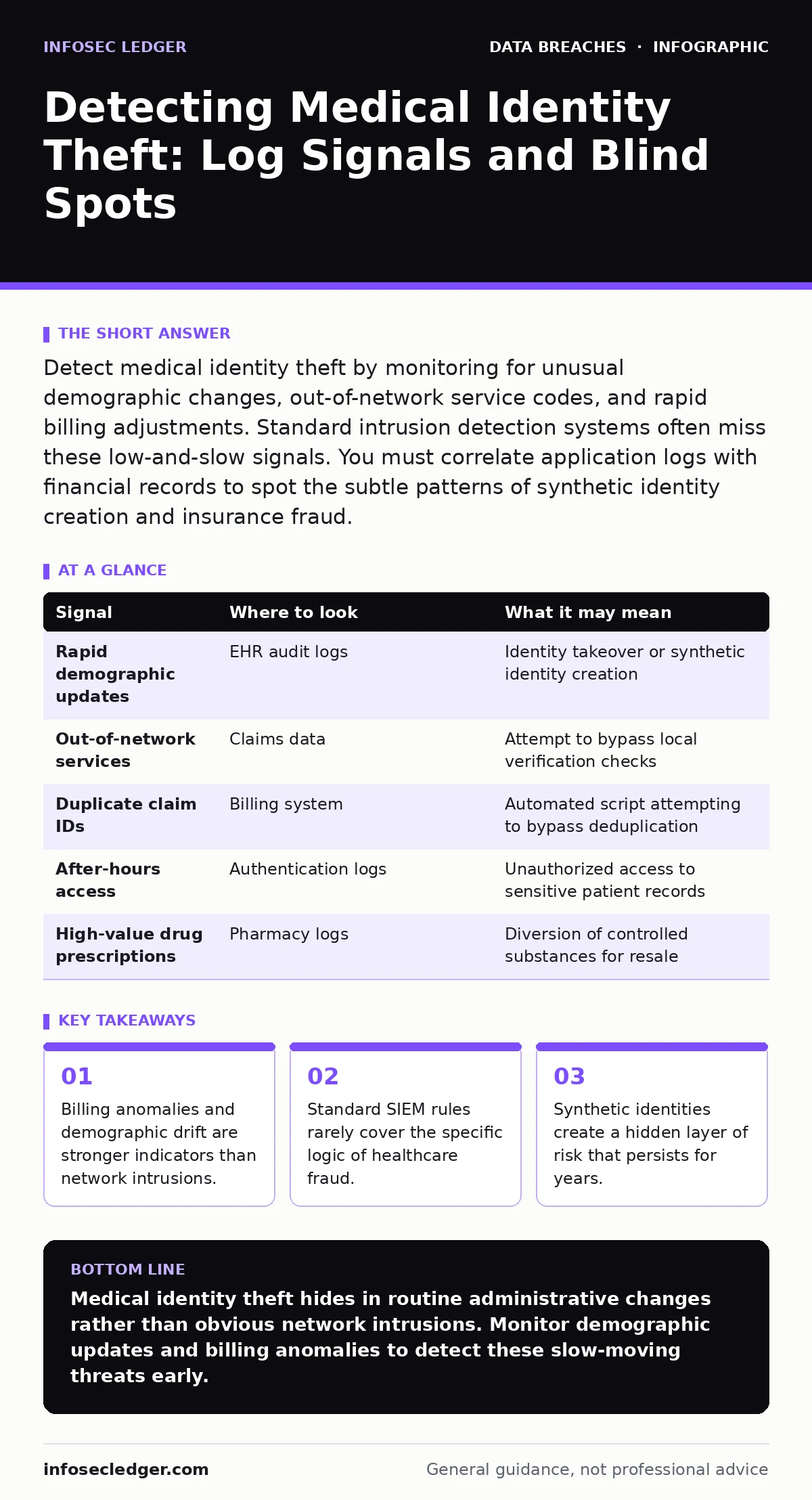
Detect medical identity theft by monitoring for unusual demographic changes, out-of-network service codes, and rapid billing adjustments. Standard intrusion detection systems often miss these low-and-slow signals. You must correlate application logs with financial records to spot the subtle patterns of synthetic identity creation and insurance fraud.
Demographic Drift in Patient Records
Patient demographic data is the foundation of medical identity theft. Attackers often update a victim’s date of birth, address, or insurance ID to blend stolen data with their own. This creates a synthetic identity that looks legitimate to automated systems. You must monitor for changes to these fields. A single change might be an honest mistake. Multiple changes within a short window indicate manipulation.
Check the audit logs of your electronic health record system. Look for updates to sensitive fields that occur outside of normal business hours. Verify that the user making the change has a clinical reason to do so. Administrative staff rarely update medical history fields. If an admin account changes a patient’s birth date, flag it for review. This behavior often precedes a larger fraud scheme.
Billing Code Anomalies
Medical billing codes are complex. Attackers exploit this complexity by submitting claims for services that never happened. They often use codes that are expensive but easy to justify. For example, they might bill for routine lab work that matches the patient’s age and gender. This makes the claim pass initial automated checks. You need to look for patterns in the billing data, not just the presence of a claim.
Monitor for clusters of similar claims from the same provider or facility. Check for services that are medically inconsistent. A patient cannot receive certain treatments simultaneously. Look for rapid sequences of billing adjustments. Attackers often submit a claim, wait for a denial, then resubmit with minor tweaks. This pattern of persistence is a strong signal of fraud.
| Signal | Where to look | What it may mean |
|---|---|---|
| Rapid demographic updates | EHR audit logs | Identity takeover or synthetic identity creation |
| Out-of-network services | Claims data | Attempt to bypass local verification checks |
| Duplicate claim IDs | Billing system | Automated script attempting to bypass deduplication |
| After-hours access | Authentication logs | Unauthorized access to sensitive patient records |
| High-value drug prescriptions | Pharmacy logs | Diversion of controlled substances for resale |
Authentication Log Patterns
Standard login alerts are insufficient for detecting medical identity theft. Attackers often use stolen credentials that belong to legitimate staff members. They log in from known locations and devices. This bypasses geographic anomaly checks. You must look at the behavior after the login. Do not just count failed attempts. Look at the data accessed during successful sessions.
Check for access to records that fall outside the user’s normal scope. A billing clerk should not be viewing detailed clinical notes. A receptionist should not be exporting large batches of patient data. Use role-based access control logs to detect these deviations. If a user accesses records for patients they have never seen before, investigate immediately. This lateral movement is a key step in identity theft.
Financial Transaction Irregularities
The financial layer is where the theft becomes visible. Attackers aim to redirect payments or create false debts. They may add unauthorized insurance providers to a patient’s record. This diverts billing to a fraudster-controlled account. You must monitor for changes to payment methods and insurance information. These changes are often subtle and buried in administrative updates.
Look for sudden spikes in self-pay charges. This may indicate that an attacker is draining a victim’s insurance benefits. Monitor for refunds issued to new bank accounts. Verify that the account details match the patient’s established records. Use data loss prevention tools to catch sensitive financial data leaving the network. These tools can alert you when someone tries to export billing spreadsheets.
System Behavior and Data Exfiltration
Attackers need to move data out of your environment. They often use legitimate tools to do this. Email, cloud storage, and file transfer protocols are common vectors. You must monitor for large data transfers. Look for uploads to personal cloud accounts. Check for emails sent to external addresses with large attachments. These actions are often masked as routine work.
Implement secure file sharing policies that restrict outbound transfers. Monitor for the use of encryption tools by non-IT staff. Attackers often encrypt stolen data before exfiltrating it to avoid detection. Check for unusual DNS queries. These may indicate communication with command-and-control servers. Combine these network signals with application logs to build a complete picture.
See also: Detect People Search Sites in Logs and Network Traffic · Stop Misusing Encryption at Rest: 6 Hidden Risks and Fixes
Common Blind Spots in Detection
Most security teams focus on network perimeter breaches. They miss the insider threats and credential theft that drive medical identity theft. Your biggest blind spot is likely your own data retention policies. Old records that are not actively monitored are prime targets. Attackers know that older data is less likely to trigger alerts.
Another blind spot is vendor risk management. Third-party vendors often have access to your patient data. If a vendor suffers a breach, your data is compromised. You must ensure that your vendors follow the same security standards. Review their access logs regularly. Do not assume that a contract guarantees security. Verify their controls independently.
Integrating Detection with Response
Detection is only the first step. You must have a clear plan for responding to these signals. Your data breach response plans should include specific procedures for identity theft. Define who investigates demographic changes. Define who freezes accounts. Define who contacts law enforcement. Practice these procedures regularly.
Coordinate with your cyber insurance provider. Ensure that your policy covers identity theft remediation. This includes credit monitoring and legal fees. Do not wait until a breach occurs to understand your coverage. Review your policy annually. Make sure it reflects the current threats. This preparation reduces the financial impact of an incident.
Building a Resilient Monitoring Program
You cannot detect medical identity theft with a single tool. You need a layered approach. Combine application logs, financial data, and network traffic. Use automation to correlate these signals. Reduce the noise by tuning your alerts. Focus on high-fidelity signals that indicate actual fraud.
Train your staff to recognize the signs. They are the first line of defense. Encourage them to report suspicious activity. Make reporting easy and anonymous. This cultural shift is as important as your technical controls. Security is a shared responsibility. Everyone must play a part in protecting patient data.
Key takeaways
- Billing anomalies and demographic drift are stronger indicators than network intrusions.
- Standard SIEM rules rarely cover the specific logic of healthcare fraud.
- Synthetic identities create a hidden layer of risk that persists for years.
Medical identity theft hides in routine administrative changes rather than obvious network intrusions. Monitor demographic updates and billing anomalies to detect these slow-moving threats early.
Frequently asked questions
How do I distinguish between honest errors and identity theft?
Honest errors are usually isolated incidents. Identity theft involves patterns of changes across multiple fields and systems over time. Look for consistency and persistence in the anomalies.
How often should I review access logs?
Review access logs daily for critical systems. For less critical systems, weekly reviews may suffice. Automate the initial screening to reduce manual workload and ensure consistent monitoring.
How this guide was produced: written by the InfoSec Ledger editorial team with AI assistance, checked against the public references listed below, and reviewed when the facts change. See our editorial policy or report an error.