
Stop Misusing Encryption at Rest: 6 Hidden Risks and Fixes
Encryption at rest hides data from casual viewers, but it fails if your key management is poor or if you ignore the processing phase where data is exposed.
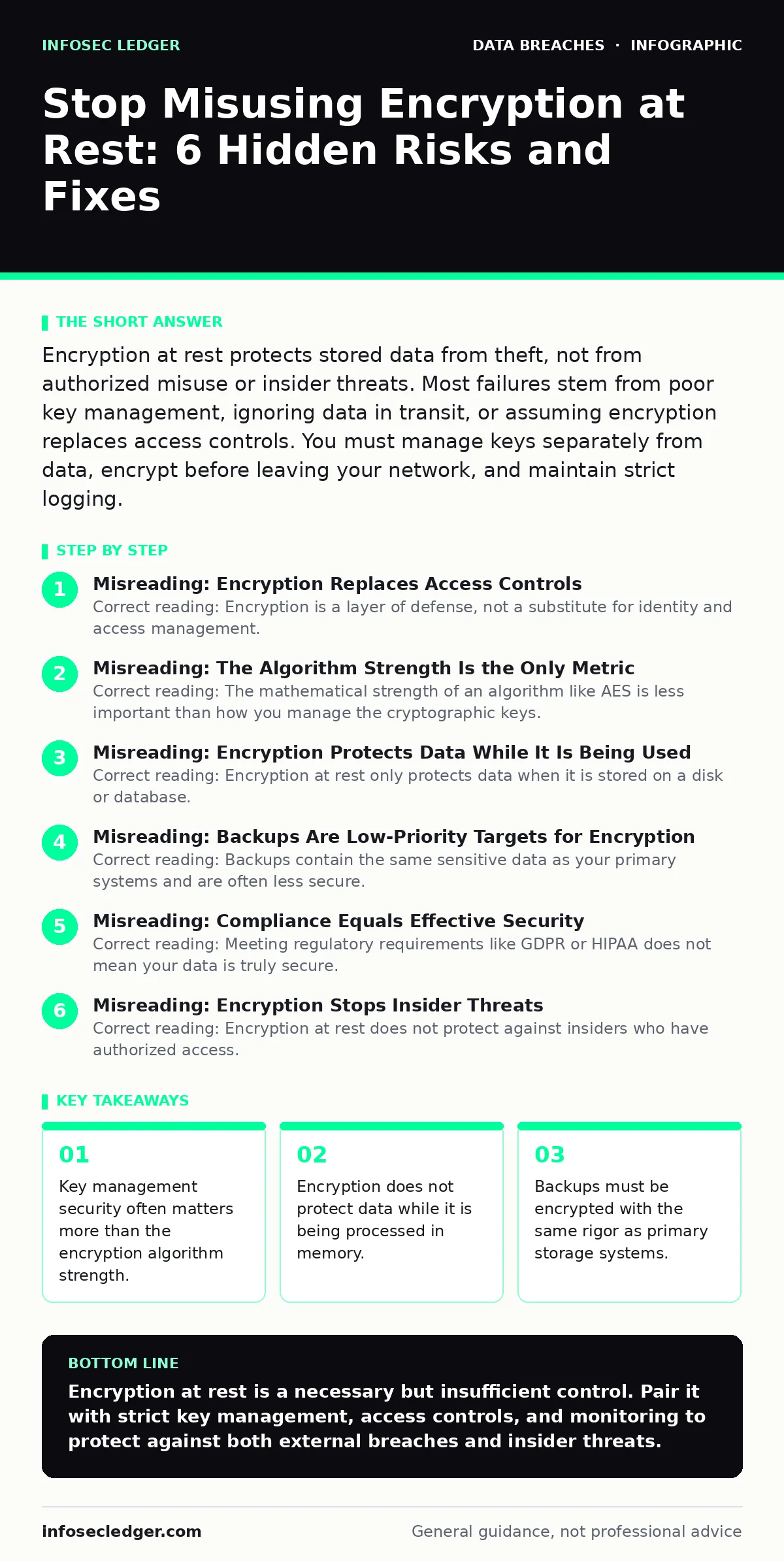
Encryption at rest protects stored data from theft, not from authorized misuse or insider threats. Most failures stem from poor key management, ignoring data in transit, or assuming encryption replaces access controls. You must manage keys separately from data, encrypt before leaving your network, and maintain strict logging.
Misreading: Encryption Replaces Access Controls
Correct reading: Encryption is a layer of defense, not a substitute for identity and access management. If an attacker gains administrative privileges, they can often access data before it is encrypted or after it is decrypted for processing. You must implement least-privilege access principles alongside encryption. Encryption hides data from someone who steals the drive. It does not stop an administrator who has legitimate access to the system.
Without strict access controls, encryption provides a false sense of security. Imagine a locked safe with the combination written on the door. The lock works, but the security fails. You need both the lock and a secret combination known only to authorized users. Review your access policies to ensure only necessary personnel can decrypt sensitive files. This prevents internal misuse and limits the blast radius of a compromised account. See our guide on unauthorized access for deeper strategies on limiting privileges.
Misreading: The Algorithm Strength Is the Only Metric
Correct reading: The mathematical strength of an algorithm like AES is less important than how you manage the cryptographic keys. A strong algorithm with a weak key storage method is vulnerable. If you store keys in the same database as the encrypted data, a single breach compromises everything. You must use a separate key management system. This separation ensures that stealing the data does not grant immediate access to the keys. Key rotation is also critical.
If a key is compromised, you must be able to re-encrypt data with a new key quickly. Many organizations use default keys or hardcode them in application settings. This is a critical failure point. Attackers scan for hardcoded credentials in public repositories. Use a dedicated hardware security module or a cloud-based key management service. These tools automate rotation and limit exposure. Never store the decryption key where the encrypted data resides.
Misreading: Encryption Protects Data While It Is Being Used
Correct reading: Encryption at rest only protects data when it is stored on a disk or database. It does not protect data while it is in use in memory or in transit across networks. When an application reads encrypted data, it must decrypt it to process it. During this window, the data is plaintext and vulnerable to memory scraping attacks. You must also encrypt data in transit using protocols like TLS. If you encrypt files on a server but send them over an unencrypted channel, the protection is lost.
Imagine locking your house but leaving the windows open. The door is secure, but the interior is exposed. You need a defense-in-depth strategy. This includes encrypting data at rest, in transit, and in use. Emerging technologies like confidential computing help protect data in memory. Until those are standard, assume that any data being processed is potentially visible to the system administrator or malware with high privileges.
Misreading: Backups Are Low-Priority Targets for Encryption
Correct reading: Backups contain the same sensitive data as your primary systems and are often less secure. Attackers know that backups are frequently neglected. They may reside on external drives, tape libraries, or cloud storage with weaker access controls. If your primary system is encrypted, your backups must be encrypted with equal rigor. Many organizations encrypt live data but store backups in plaintext for ease of recovery.
This creates a single point of failure. If an attacker steals an unencrypted backup, they have a complete copy of your data. Ensure your backup solution supports encryption at rest. Verify that the encryption keys are managed securely and separately from the backup storage. Test your recovery process to ensure you can decrypt and restore data quickly. A backup that cannot be decrypted is useless, but one that is unencrypted is dangerous. Balance accessibility with security.
Misreading: Compliance Equals Effective Security
Correct reading: Meeting regulatory requirements like GDPR or HIPAA does not mean your data is truly secure. Compliance checklists often specify minimum encryption standards, but they do not account for implementation flaws. You might use approved algorithms but fail to rotate keys or log access attempts. This creates a gap between compliance and actual security. Auditors check for the presence of encryption, not its effectiveness against modern threats.
Do not treat compliance as the final step. Use it as a baseline. Go beyond the minimum requirements. Implement continuous monitoring and regular security assessments. Check for vulnerabilities in your encryption implementation. Ensure that your logging captures who accessed data and when. This helps you detect misuse even if the encryption holds. See our guide on data breach response plans to understand how to react when controls fail.
See also: How AI Usage Policies Work: From Data Capture to Risk Control · Secure File Sharing Mistakes That Expose Your Business Data
Misreading: Encryption Stops Insider Threats
Correct reading: Encryption at rest does not protect against insiders who have authorized access. An employee with decryption privileges can read, copy, or exfiltrate data without triggering alerts if no other controls are in place. Encryption hides data from outsiders, not from authorized users. You need additional controls to monitor and limit insider behavior. Implement data loss prevention tools to detect unusual data transfers.
Use user behavior analytics to flag anomalous access patterns. Restrict bulk download capabilities. Encrypting data is necessary, but it is not sufficient against motivated insiders. Combine encryption with strict access reviews and monitoring. This layered approach reduces the risk of data theft from within. See our guide on data loss prevention for strategies to monitor data movement.
Key takeaways
- Key management security often matters more than the encryption algorithm strength.
- Encryption does not protect data while it is being processed in memory.
- Backups must be encrypted with the same rigor as primary storage systems.
- Compliance checkmarks do not guarantee actual data confidentiality or integrity.
Encryption at rest is a necessary but insufficient control. Pair it with strict key management, access controls, and monitoring to protect against both external breaches and insider threats.
Frequently asked questions
Does full disk encryption protect my laptops?
Yes, it protects data if the laptop is lost or stolen. It does not protect against malware on the running system or unauthorized user access.
How often should I rotate encryption keys?
Rotate keys regularly, such as annually or after a personnel change. More frequent rotation reduces the impact of a compromised key.
Can I use the same key for all data?
No, use separate keys for different data sets or environments. This limits the scope of exposure if one key is compromised.
Does encryption affect system performance?
Modern hardware minimizes the performance impact. The overhead is usually negligible compared to the security benefit.
How this guide was produced: written by the InfoSec Ledger editorial team with AI assistance, checked against the public references listed below, and reviewed when the facts change. See our editorial policy or report an error.