
Vendor Risk Management: 6 Common Misreadings That Leave Gaps
Vendor risk management often fails because organizations treat it as a compliance checkbox rather than a continuous mapping of data flows and access privileges.
Vendor risk management is not a one-time audit or a legal waiver. It is a continuous process of mapping data flows, verifying technical controls, and defining exit strategies. Misunderstanding it as static compliance leaves your organization exposed to third-party failures that bypass your own security perimeter.
Misreading: Vendor risk management is a one-time onboarding step
Correct reading: Vendor risk management requires continuous monitoring because vendor environments change daily. A security posture that is acceptable today may degrade tomorrow due to new hires, updated software, or relaxed internal controls. Imagine a cloud provider that passes your initial audit with flying colors. Six months later, they update their logging configuration to save storage costs, inadvertently disabling alerts for brute-force attempts.
Your one-time assessment missed this shift. Continuous monitoring tools or periodic re-assessments catch these drifts. You must treat vendor risk as a living process, not a finished project. This aligns with the principles in our guide on data loss prevention, which emphasizes that data protection does not stop at your network edge.
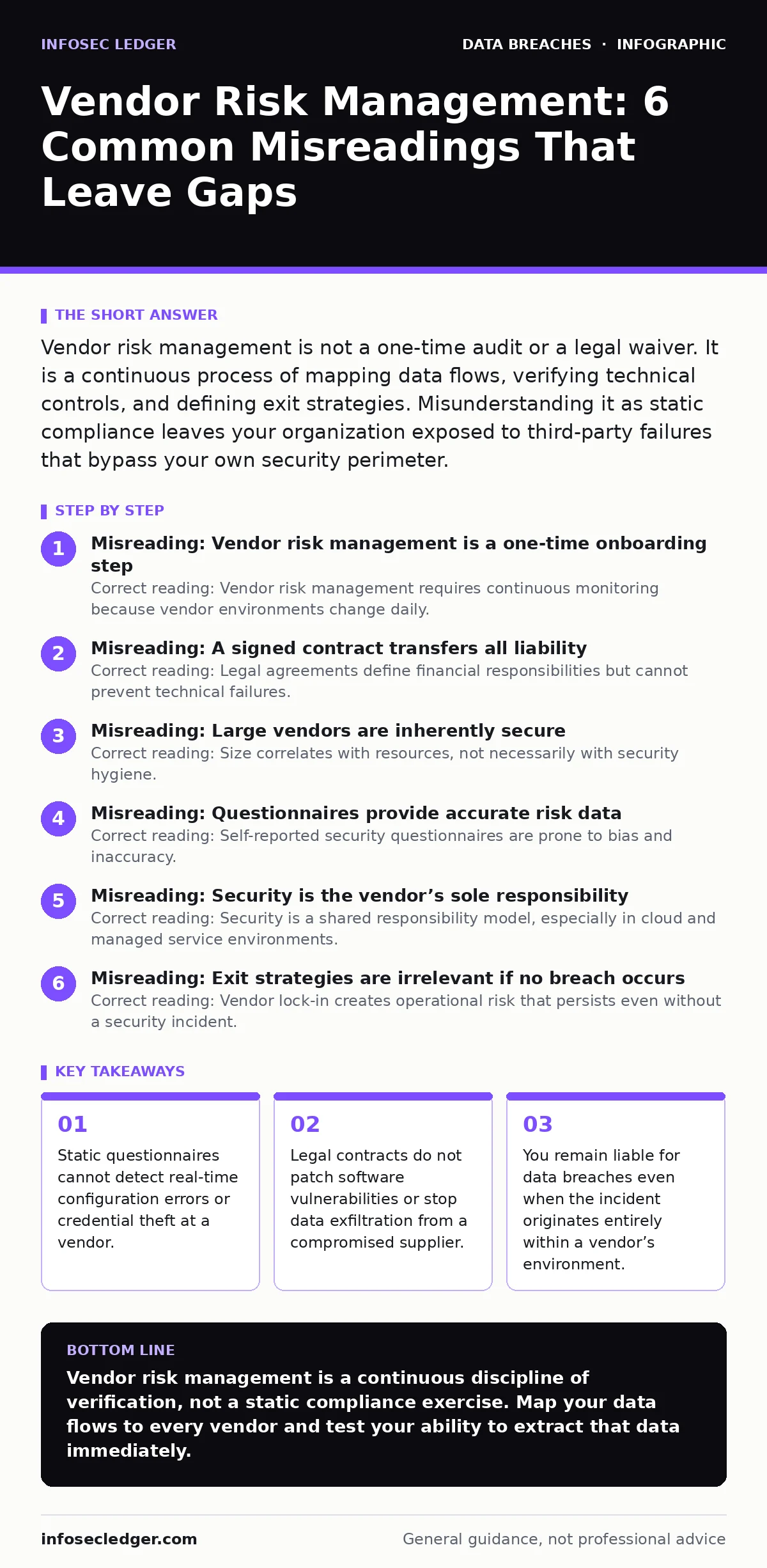
Misreading: A signed contract transfers all liability
Correct reading: Legal agreements define financial responsibilities but cannot prevent technical failures. A contract may state that the vendor bears the cost of a breach, but it does not stop the breach from happening. More importantly, regulatory fines and reputational damage often fall on you as the data owner. Suppose your payment processor suffers a ransomware attack.
The contract might cover the immediate loss, but customers blame your brand. You face regulatory scrutiny because you chose to entrust them with sensitive information. Liability sharing does not equal risk elimination. You must implement technical controls that limit exposure regardless of contract terms. This reality underscores why cyber insurance policies often require proof of active vendor management, not just signed indemnification clauses.
Misreading: Large vendors are inherently secure
Correct reading: Size correlates with resources, not necessarily with security hygiene. Large organizations often have complex, legacy infrastructure that is difficult to patch consistently. They may also have more internal employees with access to your data, increasing the risk of insider threats. Imagine a multinational logistics company that uses outdated authentication methods for a specific legacy system.
A small, agile competitor might use modern zero-trust architecture everywhere. Do not assume scale equals safety. You must verify the specific controls relevant to your data, regardless of the vendor’s market capitalization. Check their incident history and security certifications, but verify the details yourself. Reliance on reputation alone is a common failure mode in data breach response plans, where assumptions about partner reliability delay containment efforts.
Misreading: Questionnaires provide accurate risk data
Correct reading: Self-reported security questionnaires are prone to bias and inaccuracy. Vendors often answer with what they hope to achieve rather than what they currently practice. A "yes" to "Do you encrypt data at rest?" may be technically true for some systems but not for the specific service you use. Imagine a SaaS provider that encrypts database backups but leaves application logs in plaintext.
The questionnaire covers the former but ignores the latter. You must request independent evidence, such as SOC 2 Type 2 reports or penetration test summaries. These documents provide audited proof of controls rather than marketing promises. Cross-reference these reports with your specific data flows. This verification step is critical for maintaining accurate data retention policies, as you need to know exactly where and how long your data persists.
Misreading: Security is the vendor’s sole responsibility
Correct reading: Security is a shared responsibility model, especially in cloud and managed service environments. The vendor secures the infrastructure, but you often secure the data, identities, and access configurations. Imagine a cloud storage bucket that the provider secures against physical theft. If you configure it with public access permissions, the data is exposed. The vendor did not fail; your configuration did.
You must understand the boundary of responsibility for every service. Define who manages encryption keys, who resets passwords, and who monitors logs. Clear division of labor prevents gaps where both parties assume the other is handling a specific control. This shared duty is often overlooked when setting up secure file sharing channels, leading to accidental exposure of sensitive documents.
See also: Medical Identity Theft Description: How It Works and What To Do
Misreading: Exit strategies are irrelevant if no breach occurs
Correct reading: Vendor lock-in creates operational risk that persists even without a security incident. If a vendor raises prices, degrades service, or goes out of business, you must migrate your data quickly. Without a predefined exit strategy, this migration becomes chaotic and risky. Imagine a critical application vendor that ceases support for your version of their software. You cannot access your data in a usable format because the export feature was never tested.
You must define data portability requirements in your contracts. Test the extraction process annually to ensure you can retrieve your data in a standard format. This preparation reduces dependency and maintains operational continuity. It also supports effective fraud alerts systems, as you need immediate access to transaction logs if a vendor’s platform becomes compromised or unavailable.
Misreading: Technical controls replace human oversight
Correct reading: Automated tools detect anomalies but cannot interpret context. A spike in data downloads might be a legitimate quarterly report or a massive exfiltration event. Algorithms flag the anomaly; humans determine the cause. Imagine a monitoring system that alerts on unusual login times. The vendor’s employee was working late on a deadline, not stealing data.
False positives create alert fatigue, causing your team to ignore real threats. You must combine automated monitoring with human review processes. Define clear escalation paths for vendor-related alerts. Ensure your incident response team knows which vendors handle which data. This human-in-the-loop approach is vital for interpreting signals from unauthorized access attempts that originate from legitimate vendor accounts.
Misreading: All vendors require the same level of scrutiny
Correct reading: Risk-based segmentation allows you to focus resources on high-impact vendors. A newsletter service that only collects emails requires less scrutiny than a payroll provider that handles social security numbers. Applying maximum due diligence to every vendor drains your security team’s capacity. Imagine spending weeks auditing a vendor that provides generic stock images.
This time could have been spent verifying the encryption keys of your primary database host. Categorize vendors by data sensitivity and access level. Apply rigorous controls to high-risk vendors and streamlined checks for low-risk ones. This prioritization ensures you catch the most dangerous threats without burning out your staff.
Key takeaways
- Static questionnaires cannot detect real-time configuration errors or credential theft at a vendor.
- Legal contracts do not patch software vulnerabilities or stop data exfiltration from a compromised supplier.
- You remain liable for data breaches even when the incident originates entirely within a vendor’s environment.
Vendor risk management is a continuous discipline of verification, not a static compliance exercise. Map your data flows to every vendor and test your ability to extract that data immediately.
Frequently asked questions
How often should I re-assess my critical vendors?
Re-assess critical vendors at least annually or whenever they announce significant changes to their infrastructure, services, or ownership structure. Continuous monitoring tools should alert you to changes in between these formal reviews.
What if a vendor refuses to share their security reports?
Treat refusal to share audited security reports as a high-risk indicator. Consider the vendor non-compliant with your security requirements. Either negotiate access to these documents or select an alternative vendor that provides transparency.
Do I need to audit every sub-processor my vendor uses?
You should contractually require your vendor to manage their sub-processors to your standards. Request a list of sub-processors and verify that your vendor actively monitors them. Direct auditing of every sub-processor is often impractical but contractual accountability is mandatory.
How does vendor risk affect my data retention policies?
Vendors may retain data longer than necessary for operational reasons. Ensure your contracts specify deletion timelines and methods. Verify that vendors actually delete your data upon contract termination to comply with your **data retention policies** and legal obligations.
How this guide was produced: written by the InfoSec Ledger editorial team with AI assistance, checked against the public references listed below, and reviewed when the facts change. See our editorial policy or report an error.